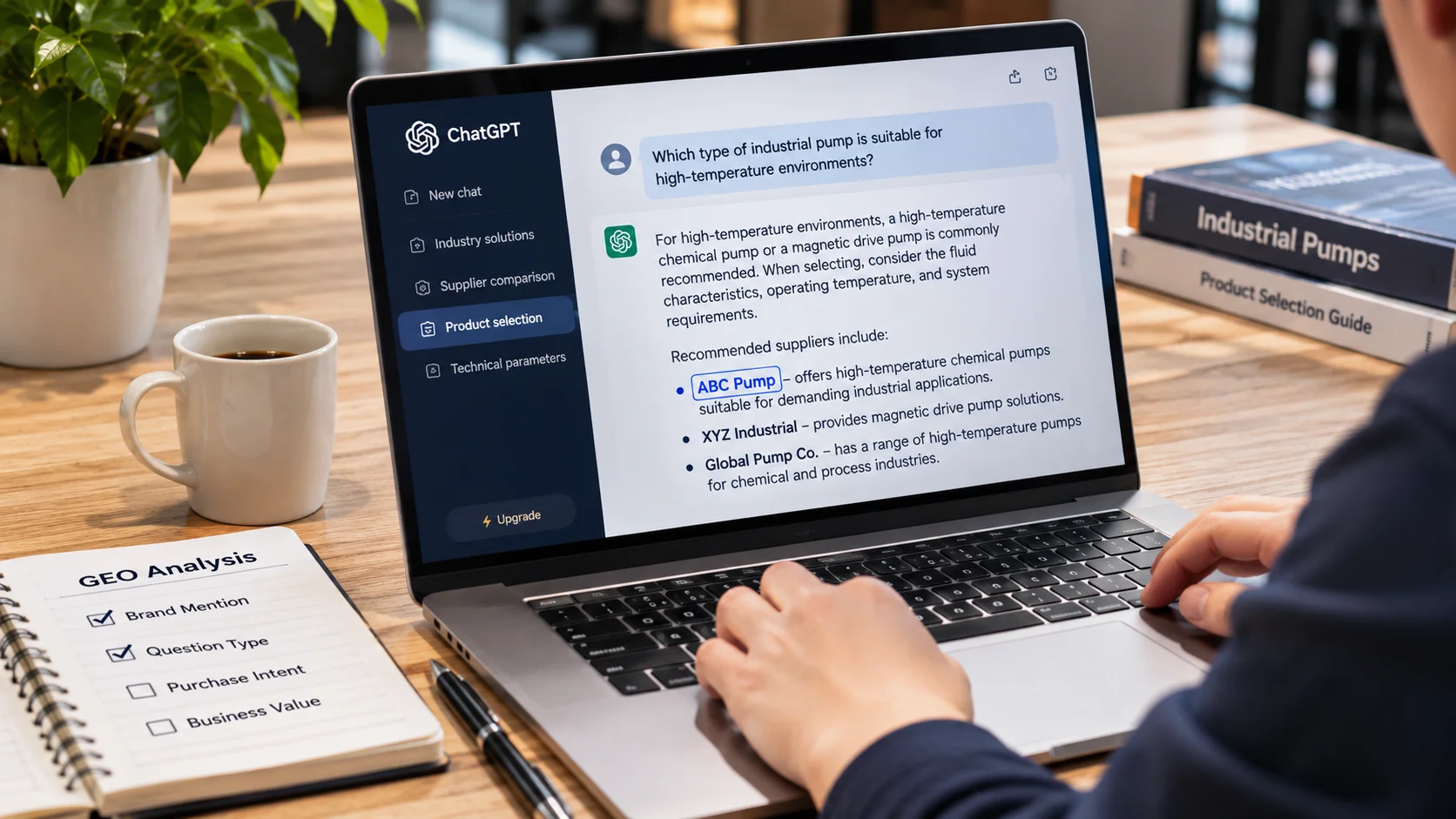
Business owners often ask me: “AI only mentions us in questions that nobody searches for. What's the point?” This is especially true for companies just starting with GEO. When they see their brand already appearing in answers from AI platforms like ChatGPT and Gemini, but find that the related questions aren't popular, they begin to doubt whether this exposure has any commercial value. In fact, when evaluating GEO performance, you can't just look at how popular a question is—you also need to understand who is asking it and whether there's real business demand behind it.
Core Answer
Yes, it has value—but not every low-volume question is worth investing in.
If a low-frequency question corresponds to a target customer's professional needs, product selection, or purchasing decisions, it may bring meaningful brand exposure even if few people search for it. Conversely, if a question has some search volume but little relevance to the company's actual business, the brand appearing in the answer may not help customers better understand the product or service.
Therefore, to determine the GEO value of a low-volume question, you need to consider customer relevance, purchase intent, and business value together—not just count brand mentions or question popularity.
More importantly, through continuous auditing, observe whether the brand can gradually move from a few niche questions into more AI answers related to core business.
Low question search volume doesn't mean low customer value
Many companies are used to judging content value by keyword search volume in traditional SEO—assuming that the more people search, the greater the exposure opportunity. But in the GEO context, this judgment can't be applied directly.
For example, a potential customer of an industrial equipment manufacturer might ask AI whether a certain type of equipment is suitable for a specific production environment, or which suppliers can meet specific technical requirements. These questions have a relatively limited audience, but they may come from procurement staff who are actively selecting products.
In contrast, some general industry knowledge questions have a broader audience, but the askers may just be learning basic concepts and have no clear purchasing plans.
So I usually suggest companies first answer three questions: Who would ask this question? Why are they asking? After getting the answer, how far are they from an actual decision?
In GEO, it's not that the more popular a question is, the more valuable it is—the closer it is to a real decision, the more attention it deserves.
To judge whether a low-volume question has value, see if it's close to real purchase intent
To determine whether a low-volume question is worth continuing to optimize, you can first classify AI search questions by scenario: awareness, comparison, recommendation, selection, and purchasing.
For example, “What is a certain industrial material” is a basic awareness question, while “Which material is suitable for high-temperature production environments” is closer to actual application and selection. If the question further asks “Which manufacturers can provide products that meet the relevant technical requirements,” it may involve vendor screening.
If the brand mainly appears in basic knowledge questions, the commercial value may be limited; if it appears in professional selection, solution comparison, or vendor recommendation questions, it's worth continuous attention even if search frequency is low.
For overseas markets, you can observe brand appearances in ChatGPT, Gemini, Google AI Mode, Perplexity, and Google AI Overview. For the Chinese market, you can observe Doubao, Kimi, Wenxin Yiyan, Tongyi Qianwen, Quark AI, and Yuanbao separately.
The key is not to compare which platform mentions the brand more, but to see whether the questions where the brand appears match the real needs of target customers.
Don't judge GEO success or failure by a single low-volume question—look at the trend across a set of questions
Some companies find that AI mentions their brand in a certain specialized question and conclude that GEO has already succeeded. But a single brand mention isn't enough to show that overall visibility has changed sustainably.
I recommend building a set of questions related to core business through GEO audit reports, and continuously recording which questions the brand appears in, how the answers describe the brand, and whether competing brands appear at the same time.
Performance monitoring can further compare brand mentions and answer context across different questions, observing whether the brand gradually expands from a few low-frequency questions into more product comparison, professional selection, and purchasing decision scenarios.
Then combine with data analysis to determine which questions are worth continued investment, and which questions may bring brand exposure but aren't strongly related to actual business.
If the brand only appears in marginal knowledge questions over the long term while core product and purchasing questions remain uncovered, you need to re-examine question selection and optimization direction rather than continuing to pursue more low-relevance exposure.
Next Steps
If you find that AI only mentions your brand in low-volume questions, first compile the AI questions where the brand currently appears—there's no need to immediately conclude that this exposure has no value.
I suggest tagging each question with three dimensions: customer relevance, purchase intent, and business value. Prioritize keeping questions that, although low in search frequency, clearly correspond to target customer needs, product selection, or purchasing decisions.
Then include these questions in a fixed GEO audit scope and continuously observe whether brand appearances, competitor performance, and answer context change.
If the brand gradually enters more relevant decision scenarios, you can continue evaluating investment direction; if it remains stuck in questions weakly related to the business, you should adjust question selection. This is how you distinguish commercially meaningful niche exposure from incidental brand mentions.
If you want to know which AI questions your brand currently appears in, run a free GEO Audit first and see your real visibility across 6 major AI engines in 1 minute. Then combine question-level customer relevance and purchase intent to determine which niche scenarios are worth continued attention.
Related Questions
AI only mentions us in low-frequency questions—does that count as GEO working?
It can be seen as the brand gaining visibility in relevant questions, but you still need to judge whether the questions are related to target customers and actual business. You can't conclude there's commercial impact just because the brand appears.
Are low-search-volume questions worth doing GEO for?
If a question corresponds to clear professional needs, product selection, or purchasing decisions, it may be worth investing in even with low search volume. The key is evaluating actual business value.
Are more popular questions where AI recommends brands always better?
Not necessarily. Popular questions may bring broader exposure, but they don't necessarily have clear purchase intent. You need to consider both question relevance and the user's decision stage.
How do you judge whether a low-volume AI question has commercial value?
You can judge from three aspects: customer relevance, purchase intent, and business value, combined with analysis of the context in which the brand appears in AI answers.
Which questions should B2B companies prioritize for GEO?
We recommend prioritizing the technical solutions, product comparisons, professional selection, and vendor purchasing questions that target customers actually ask, rather than ranking solely by search popularity.
The brand only appears in specialized questions—why doesn't it appear in popular questions?
It may be that the brand's association with specialized application scenarios is clearer, while popular questions cover a broader range of needs. You can further examine question coverage, brand descriptions, and competitor performance, then decide whether to expand the optimization scope.