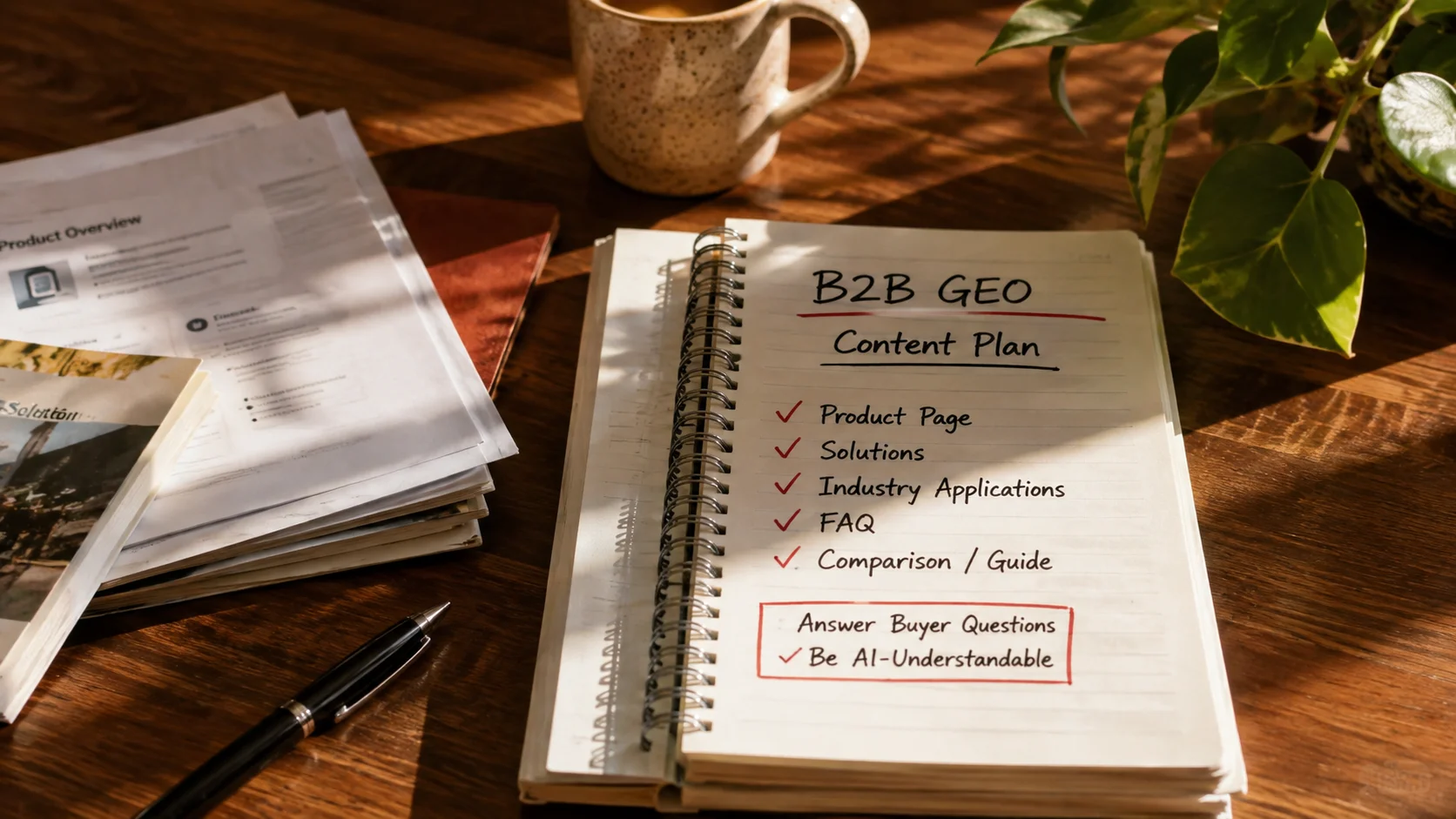
I'm often asked this question by foreign trade clients: When preparing for GEO, should we start by writing industry trend articles, market analyses, or a large volume of educational content? These types of content aren't off-limits, but for cross-border B2B companies just starting out, it's more important to first check whether the website clearly explains your products, application scenarios, and procurement value.
The Core Answer
For cross-border B2B GEO, it's not recommended to mass-produce broad industry articles at the outset. Instead, you should first fill in several types of foundational content: what the product is, which customers it suits, what scenarios it applies to, how to choose between different solutions, and common concerns during the procurement process.
When AI organizes answers, it needs to determine what product category your company belongs to, what problems you can solve, and whether you're relevant to the current query. If your website only has a simple company introduction and product names, even if the pages are indexed, the AI may not accurately understand the relationship between your brand and procurement-related questions.
Start with Content That Lets AI Understand "What You Do"
For B2B companies, the first step is usually not discussing industry trends, but rather helping AI understand your product categories, target customers, application industries, and service capabilities. You should prioritize reviewing your core product pages, solution pages, and industry application pages to ensure these pages clearly state product use cases, applicable conditions, and actual procurement scenarios.
If foundational pages are vague, listing only specifications or marketing slogans, AI will struggle to determine when your brand should be mentioned in answers. Cross-border B2B GEO content isn't about writing more first—it's about helping AI understand which procurement problems you can solve.
The Second Batch of Content Should Answer "How to Choose" and "Why Choose You"
Cross-border B2B search demand often isn't about asking what a product is, but rather comparing which specification, model, or solution best fits a specific project. Therefore, the second batch of content can revolve around procurement decisions, such as model differences, specification selection, scenario matching, certification requirements, delivery conditions, and common procurement considerations.
Selection guides, solution comparison pages, and FAQs are well-suited to address these types of questions. Compared to just introducing company history, this content provides structured, directly extractable answers and helps AI better understand why your product suits certain types of customers.
Overseas GEO Should Prioritize Public Web Pages and Procurement Questions
Platforms like ChatGPT, Gemini, Google AI Mode, Perplexity, and Google AI Overview reference public web pages, searchable content, and whether messaging remains consistent across different pages. Foreign trade companies should especially emphasize product terminology, application industries, certification capabilities, delivery capabilities, and procurement Q&A on their English-language pages.
Your website shouldn't just be a corporate showcase; it should gradually become a knowledge base organized around procurement questions. After completing the foundational content, combine GEO audits, performance monitoring, and data analysis to observe which questions already feature your brand and which questions still lack supporting content.
Next Steps
You can start by conducting a simple content inventory of your website to check whether you already have five types of pages: core product pages, industry application pages, selection guides, FAQ pages, and solution or product comparison pages. If there are significant gaps, the first batch of GEO content should answer the questions customers ask before purchasing and that AI references when generating answers—rather than starting with broad industry articles.
If you're unsure which content types your website is currently missing, you can run a free GEO Audit first. See your real visibility across 6 major AI engines in just 1 minute, then determine where your first batch of content should start.
Related Questions
What should a foreign trade B2B company write for its first GEO article?
Prioritize questions directly related to your core products and procurement decisions, such as how to choose specifications, which scenarios the product suits, and what to pay attention to when purchasing.
Will a B2B website with limited content affect AI's recommendation of the brand?
It might. Page count isn't the only criterion, but if product descriptions, application scenarios, and procurement Q&A are missing, the information AI can use to understand your brand will also be quite limited.
Which is more important for GEO: product pages or blog articles?
They serve different purposes. Product pages explain what you offer, while blogs and guides answer how customers should choose. In the foundational stage, it's usually more important to flesh out product pages and solution pages first.
Are selection guides suitable for GEO optimization?
Yes. Selection guides can centrally answer questions about specifications, models, scenarios, and procurement conditions, making it easier for AI to extract and organize them into comparison or recommendation answers.
Should foreign trade companies write competitor comparison content for GEO?
You can, but comparisons should be objective and based on publicly available, verifiable product differences. There's no need to disparage other brands, and you shouldn't make unverifiable promises about results.
How can a B2B website determine which content to prioritize?
Start with the procurement questions customers frequently ask, then check whether your website already has corresponding pages. The areas where high-frequency questions lack clear answers are usually where you should prioritize filling gaps.