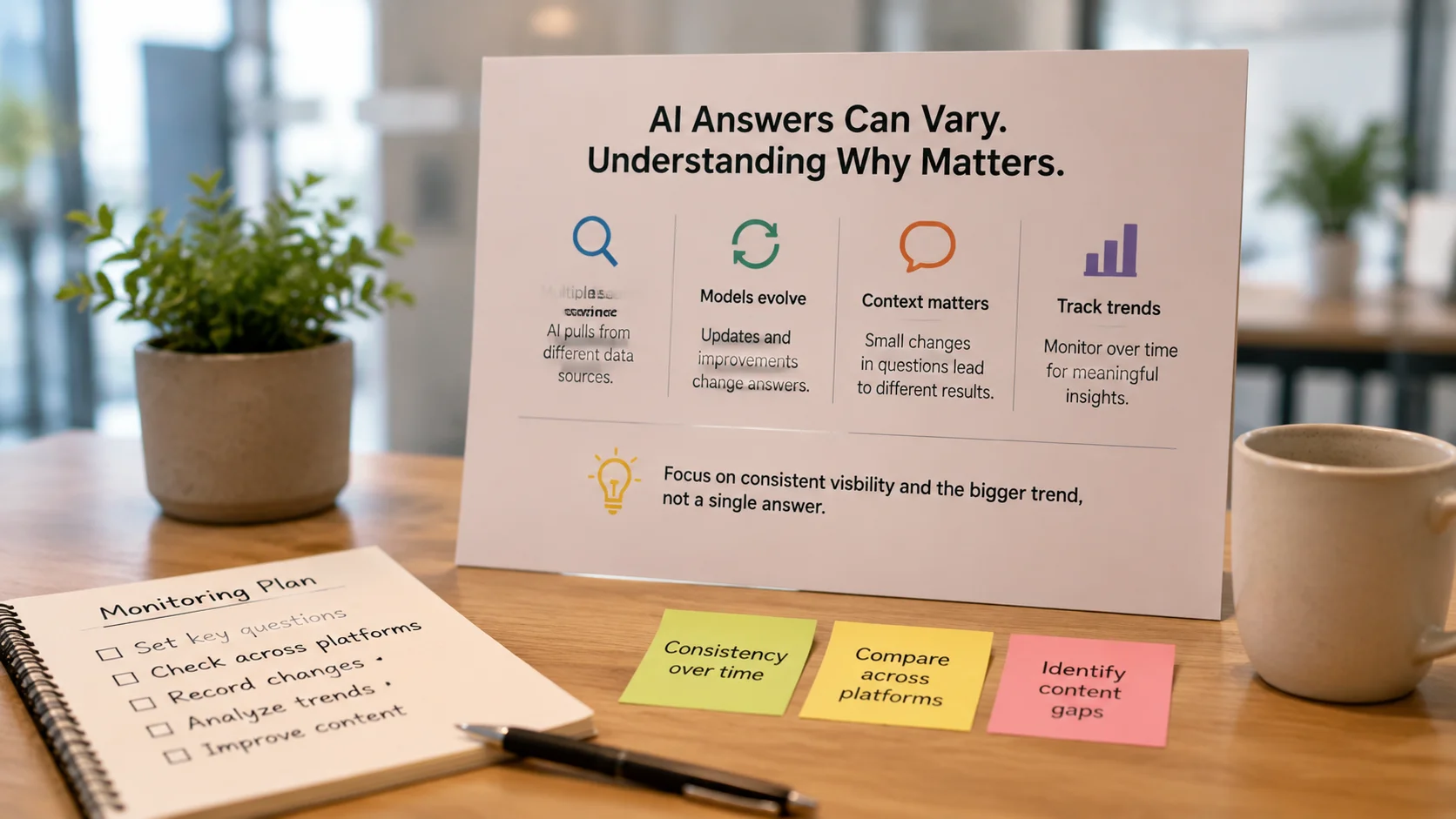
I'm often asked: "Why did AI answer this way yesterday, but differently today?" This is a common concern for many businesses exploring AI search. In the past, SEO relied on fixed rankings and pages to measure performance, but AI search answers are not a static result. They shift based on data, models, sources, and how questions are phrased.
For marketing and SEO professionals, the focus shouldn't be on whether a single AI answer has changed, but rather on the reasons behind that change and whether the brand remains consistently visible for key questions.
The Core Answer
AI answers vary each time, typically not due to system errors, but due to influences from data sources, update times, user query phrasing, and generation logic. GEO isn't about making all AI platforms give identical answers; it's about enhancing a brand's stable visibility for critical questions.
So, when businesses notice inconsistencies in AI results across different times or platforms, they shouldn't immediately try to determine which answer is 'correct'. Instead, they should analyze why the answer changed, what factors influenced it, and whether the brand's information is being consistently and accurately understood.
Why AI Answers Change: Key Influencing Factors
First, AI answers change based on their information sources. Generative AI doesn't just read a static database; it generates responses based on multiple information sources. When web content is updated, cited sources change, or the model itself is adjusted, the answers can change.
Second, user query phrasing also affects results. Even if expressing the same need, different keyword combinations, angles, or context can lead the AI to integrate different information. For example, "recommend a provider" versus "how to choose a provider" might yield different answer logic despite being closely related topics.
Therefore, a single test result only represents a snapshot in time and cannot directly indicate long-term performance. A more robust approach is to observe trends through multiple tests over time, rather than judging brand acceptance by AI based on one response.
Different AI Platforms Give Different Answers: Understand Their Source Differences First
Besides changes over time, different AI platforms themselves produce varying answers. Each platform has different data sources, content retrieval methods, and answer generation mechanisms, so a brand's performance can differ across various AIs.
In overseas markets, ChatGPT, Gemini, Google AI Mode, Perplexity, and Google AI Overview differ in content sources and answer organization. Some platforms rely more on public web content, others emphasize source citations, and some generate answers by integrating search capabilities.
In the Chinese market, Doubao, Kimi, ERNIE Bot, Tongyi Qianwen, Quark AI, and Yuanbao are also influenced by different content ecosystems. A brand might be mentioned on one platform but not another, which doesn't necessarily mean one result is wrong.
Therefore, GEO audits need to distinguish between platforms and markets. If a business primarily targets overseas customers, focus on the overseas AI environment. If the target market is China, analyze brand performance on Chinese AI platforms separately, avoiding conclusions drawn from single results.
Evaluating AI Answer Changes: Focus on Long-Term Trends Over Single Results
Businesses often fall into the trap of checking for a single appearance: "Was I mentioned today?" However, AI answers fluctuate. A single screenshot only reflects the current state, not long-term effectiveness.
A more effective method is to establish a fixed set of questions and consistently track changes across different AI platforms. Observe if the brand is mentioned, if competitors appear, how AI describes the brand, which sources are cited, and whether these factors evolve over time.
Fluctuations in AI answers aren't the real concern; what matters is whether the brand consistently appears in the right contexts.
When analyzing data, focus on three aspects: which questions now include the brand, which are still dominated by competitors, and which descriptions require correction due to inaccuracies. Through periodic performance monitoring, businesses can determine whether issues stem from content gaps, unclear brand messaging, or mere platform differences.
Next Steps
Start by creating a fixed set of test questions covering scenarios like brand awareness, product demand, competitor comparison, and purchase decisions. Regularly test on the AI platforms relevant to your target market, recording changes rather than just saving a single screenshot.
For example, track how answers to the same question evolve: Does the brand start appearing? Does the frequency increase? Are AI descriptions of the brand becoming more accurate? Are competitors still holding the primary answer positions?
To understand your brand's current standing in AI, begin with a basic GEO audit to see where your brand appears, identify gaps, and use those findings to guide your optimization strategy.
If you want to assess your brand's current visibility across different AI environments, start with a basic audit. See your real visibility across 6 major AI engines in just 1 minute, and identify where your brand appears and where gaps remain.
Related Questions
Why does ChatGPT give different answers each time for the same question?
Because AI answers are influenced by data sources, context, query phrasing, and generation logic. The same question can trigger different combinations of information at different times.
Which AI platform's search results are more trustworthy?
It's not accurate to simply declare one platform as more trustworthy. A comprehensive analysis considering source types, consistency across platforms, and long-term trends is necessary.
Do changes in AI answers affect a business's GEO efforts?
They affect how you observe results, but they don't change the goal of GEO. The focus isn't on fixing a single answer, but on improving the brand's stable visibility for key questions.
How can you tell if AI result changes are normal fluctuation or a decline in brand performance?
Compare results through periodic testing. Only if mentions consistently decrease across multiple platforms over time, or brand descriptions continually worsen, is further analysis needed.
How often should a business audit AI search results?
It's recommended to establish a regular audit schedule, such as bi-weekly or monthly observations, adjusting frequency based on business changes and target market.
Why do AI answers still change after GEO optimization?
Because AI platforms' data sources, model updates, and user query phrasing all change. GEO focuses on improving long-term understanding and visibility, not on making results completely static.