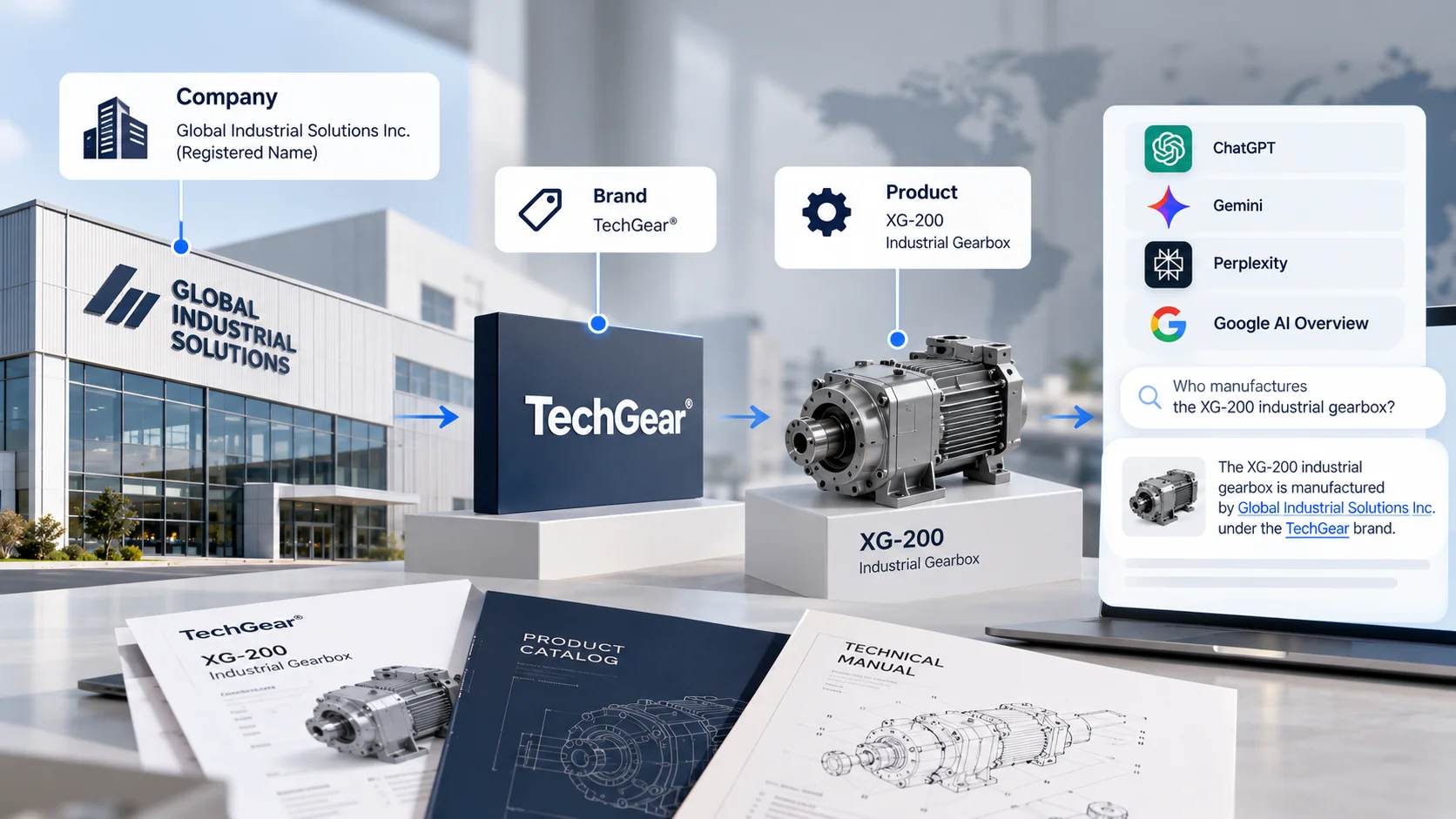
If you are a B2B manufacturer targeting markets in North America, Europe, or Australia, your company may simultaneously use a registered English legal name, an English abbreviation, a commercial brand name, product series names, and specific model numbers in overseas operations. These names appear on your website, in PDF product brochures, on your LinkedIn company page, in industry directories, and in trade show materials. None of them may look problematic on their own, but when an overseas buyer asks ChatGPT, Gemini, or Perplexity who manufactures a certain product or which company owns a certain brand, AI may not be able to accurately connect this information.
For example, the website homepage uses the commercial brand name, the About Us page uses the registered company name, product brochures highlight specific model numbers, and industry directories retain an old company abbreviation. When a buyer searches for a product, AI may recognize the product name but fail to accurately associate it with the manufacturer; it may also confuse the brand operator with the actual manufacturing company, or even use different identity descriptions for the same company across different questions.
For B2B overseas-facing companies dealing in industrial equipment, mechanical parts, electronic components, testing instruments, and industrial materials, this type of issue is not just a naming convention problem — it also involves how search systems understand company identity, brand ownership, and product origin.
GEO entity optimization is not about making all names use the same spelling — it is about helping AI understand what each name represents and what real relationships exist among the company, brand, products, and manufacturing entities.
Where exactly does name inconsistency affect AI understanding?
Problem 1: The same company has multiple name versions without a clear mapping
A company may simultaneously use a registered legal name, an English commercial name, a commonly used abbreviation, and a historical name. These names are not necessarily problematic in themselves — what really matters is whether the website and other public materials clearly explain how they relate to one another.
Suppose an industrial equipment company uses an English abbreviation on its website, a registered legal name in its technical manuals, and an old name in trade show directories. If these materials do not share a common website address, company description, or other verifiable information, search systems must determine based on names, context, and other public information whether they refer to the same entity.
Diagnostic conclusion: Companies need to establish mapping rules between official names and confirmed aliases, rather than requiring all public-facing contexts to mechanically use the same spelling.
Problem 2: Company, brand, and product are mixed together, and entity relationships are unclear
The company entity, commercial brand, product series, and specific models serve different business functions, but when companies create web pages and technical materials, they often present these names together without clearly explaining what each one represents.
For example, a product page may only show the brand and model number without identifying the actual manufacturer; a company description may emphasize its production capabilities but not clarify which products it manufactures itself and which are made by partner factories. If the brand operator, manufacturing entity, and sales entity are not the same, simply placing them on the same page is not enough to prove they belong to the same entity.
Diagnostic conclusion: Companies must not only standardize names but also clarify the entity type each name corresponds to, as well as the actual relationships among brand ownership, manufacturing, and sales.
Problem 3: Information conflicts between the website and third-party public sources
The company information overseas buyers encounter may come from LinkedIn, industry associations, trade show exhibitor directories, professional B2B platforms, and certification bodies' public materials. These sources sometimes retain old company names, different website domains, or business descriptions that are inconsistent with the official website.
For example, the website describes the company as a Manufacturer, but some directories only classify it as a Supplier or Exporter; or the website has updated its brand name, but old product brochures and trade show materials still use the previous name. These discrepancies can make it harder for AI to determine company identity and product origin.
Diagnostic conclusion: Entity optimization cannot be limited to modifying the website — it also requires identifying discrepancies in important external materials and establishing an ongoing maintenance mechanism.
First distinguish entities, then establish relationships — don't cram all names into the same entity
When I analyze GEO entity issues for B2B companies, I do not start by requiring all pages to use a single name. Instead, I first confirm what each name represents. The registered company, commercial brand, product series, and specific models may be related, but they are not the same entity.
Layer 1: What exactly does each name represent?
You can first categorize the names a company uses externally into the following types:
- Company entity: registered company name, official English name, commonly used abbreviation, and historical names.
- Commercial brand: the company's own brand, independently operated brands, or other genuinely existing brand entities.
- Product series: names used to distinguish product categories or product lines.
- Specific products: specific product names, model numbers, and specification variants.
- Names in external materials: names used in industry directories, trade show materials, and other public sources.
Record the entity type, official URL, usage context, and verification source for each name. For example, a product series name should not be treated as a company alias simply because it often appears next to the company name; a product model number should not be considered the brand itself simply because it belongs to a brand.
Layer 2: What real relationships exist among these entities?
After categorizing the names, you need to further confirm the business relationships among the entities.
- Company and brand: Is the company the brand owner, the operator, or a party licensed to use the brand?
- Brand and product: Does the product genuinely belong to that brand?
- Company and product: Is the company the actual manufacturer, supplier, exporter, or does it serve another function?
- Product series and models: Do specific models belong to the corresponding product series?
These relationships need to be supported by company materials, product information, or other trustworthy sources. If a product is manufactured by a third-party factory and the brand owner is responsible for sales, the brand owner should not be described as the actual manufacturer simply because the brand belongs to that company.
Layer 3: Can the website, structured data, and external materials consistently express these relationships?
I typically cross-check three information layers.
- Website body content: Does it clearly describe the company name, brand ownership, product models, and manufacturing entity?
- Structured data: Does it use appropriate entity types and relationship properties to express actual business relationships?
- Third-party materials: Are there obvious conflicts in names, domains, brand ownership, or manufacturer identity?
If discrepancies exist across the three layers, verify the actual situation first, then determine the order of modifications. The workflow for entity optimization is to first identify entities, then confirm relationships, and finally have the website and trustworthy external sources jointly express these relationships.
How do you build consistent entity signals among company, brand, and products?
Method 1: Build an enterprise entity master data table that clarifies official names and aliases
What to do: Based on the registered company name and verified company materials, build a unified entity master data table as the naming basis for the website, product brochures, overseas market materials, and third-party profiles.
How to do it: Create separate records for the company, brands, product series, and specific models, including at least the following information:
- Official English name, commonly used abbreviation, and historical names.
- Entity type: company, brand, product series, or specific product.
- Corresponding official URL and primary usage context.
- Brand ownership, actual manufacturer, and product series relationships.
- Official materials or trustworthy sources that can verify names and relationships.
- The team responsible for maintenance, and the update process for new models or brand renames.
Why do this: Without a unified data source, marketing, sales, technical, and website operations teams may create materials according to their own habits, resulting in inconsistent names and relationship descriptions.
What problem it solves: It provides a unified verification basis for subsequent website modifications, structured data deployment, and third-party material maintenance. Note that the purpose of the master data table is to record confirmed entity relationships, not to list all associated names as aliases of the same company.
Method 2: Use authentic Schema to establish entity relationships among company, brand, and products
What to do: Based on actual business relationships, use appropriate Schema types to describe the company, brand, and products, and establish connections through stable entity identifiers.
How to do it:
- Use Organization to describe the company entity, filling in properties such as name, legalName, alternateName, url, and logo according to the actual situation.
- For brands with independent entity significance, use Brand to describe brand information.
- Use Product to describe specific products, providing product names, descriptions, and applicable product information based on the actual page content.
- Set stable @id values for different entities and reference them consistently across related pages.
- In the product's manufacturer property, associate the actual manufacturer; in the brand property, associate the actual brand.
- Only use sameAs to establish equivalence relationships when the relevant pages or materials genuinely represent the same entity.
For example, if a manufacturing company owns an independent brand and sells a certain model of industrial equipment under that brand, the company entity should express the manufacturer's identity, the brand entity should express the brand name, and the product entity should describe the specific model. The product associates the actual manufacturer through manufacturer and the corresponding brand through brand.
Why do this: Structured data can help search systems understand the entities described on web pages and their relationships, but only if the entity types, identifiers, and relationship properties are accurate and consistent with the body content.
What problem it solves: It reduces confusion among the company entity, brand, and products. Do not fabricate nonexistent Manufacturer Schema types, and do not merge information from different entities into the same Organization.
Method 3: Unify name and relationship expressions across different pages of the website
What to do: Check the website's main pages and public technical materials to ensure that company, brand, and product relationships can be clearly understood — not just unify spelling across pages.
How to do it: Check page by page according to page type.
Homepage and About Us page: Use the official English company name and explain the commonly used abbreviation in an appropriate place. If the company uses an independent brand, clearly state the real relationship between the brand and the company; if the manufacturer and brand operator are different, accurately describe each one's identity.
Product detail pages: Clearly display the product brand, product series, specific model, and actual manufacturer. The product title, body content, and structured data should correspond to the same product entity; if there are different specifications or model variants, also explain the product relationships among them.
Factory / Manufacturing page: Describe the manufacturing functions the company actually performs, the production entity, and the applicable product scope. For companies with in-house production, OEM, or ODM capabilities, you can describe production processes, equipment categories, quality control, customization scope, and testing methods based on the actual situation, and link to the corresponding product pages.
Contact page and PDF technical materials: Verify the company name, website domain, brand spelling, and model naming conventions. For historical materials that are still publicly accessible, check whether they need to be updated, version-labeled, or have their access entry adjusted. Also check whether names in page titles, body content, breadcrumbs, Open Graph information, and structured data are consistent.
Why do this: Different pages serve different user tasks, but they should jointly express the same set of real entity relationships.
What problem it solves: It reduces identity description conflicts among the homepage, product pages, technical manuals, and company descriptions, so that buyers and search systems can obtain mutually supporting information from different pages.
Method 4: Verify third-party public sources and use sameAs correctly
What to do: Check important public sources about the company outside the website, and identify company names, brand spellings, website domains, and manufacturer descriptions that are inconsistent with official information.
How to do it:
- Check LinkedIn company pages, industry associations, trade show directories, and professional B2B platforms.
- Compare against the official English name, company website, brand spelling, and actual business identity.
- Prioritize correcting incorrect names, expired URLs, and inaccurate product information in materials the company has the right to maintain.
- For historical materials that cannot be directly modified, record the source, discrepancies, and follow-up handling approach.
- In the Organization's sameAs, only associate official or trustworthy material pages that genuinely represent the same company entity.
- If a brand page and the company page represent different entities, do not treat the brand page as the company's sameAs simply because a business relationship exists between them.
Why do this: AI may obtain company information from multiple public sources, but similar names do not mean two pages describe the same entity. Companies need to verify sources and relationships before deciding whether to make corrections.
What problem it solves: It reduces identity conflicts between the website and external public sources, and avoids incorrectly merging company, brand, and products. For historical materials that can no longer be maintained, keep records and continuously assess their impact, rather than assuming all external information can be updated immediately.
Method 5: Establish an entity consistency and AI answer monitoring mechanism
What to do: Build a fixed set of AI queries around the company name, brand name, product series, and specific models, and regularly check whether entity recognition and relationship descriptions are accurate.
How to do it: You can start testing with four types of questions.
Company identity type:
- What is the official name of [company]?
- Is [company abbreviation] the same company as [registered company name]?
Brand ownership type:
- Is [brand] owned or operated by [company]?
- Which company manufactures products under [brand]?
Product manufacturer type:
- Who manufactures [product model]?
- Which company is responsible for manufacturing [product]?
Product line relationship type:
- What products does [company] manufacture?
- Which product series belong to [brand]?
In ChatGPT, Gemini, Google AI Mode, Perplexity, and Google AI Overview, conduct tests according to the retrieval methods each platform actually provides, and record the query date, company names and aliases used by AI, brand ownership descriptions, manufacturer identification, and the URLs actually cited.
If AI describes the brand operator as the manufacturer, go back to the website body content, Schema, and third-party materials to verify the relationship. If AI cannot map the company abbreviation to the official name, check the master data table, website descriptions, and external sources for gaps.
Why do this: Completing website modifications does not mean AI has accurately understood the relevant entities. Fixed queries help teams continuously check changes in name recognition, entity relationships, and citation sources.
What problem it solves: It establishes a reviewable monitoring mechanism so that the next round of technical and content adjustments has a clear basis, rather than judging optimization results solely by whether the brand appears.
Names are already unified — how do you determine whether AI truly understands the entity relationships?
Entity optimization is not just about checking whether spelling is consistent — it also requires observing whether AI can distinguish among the company, brand, products, and manufacturing entity. It is recommended to continuously review from the following dimensions.
Whether name variants are correctly mapped: Check whether AI can map confirmed company abbreviations, official English names, and historical names to the correct company. If confusion persists, check whether the website explains name relationships and whether external materials still retain old information.
Whether company, brand, and products are correctly distinguished: Check whether AI can identify the registered company entity, actual manufacturer, commercial brand, product series, and specific models. If the brand operator is described as the manufacturer, verify whether the website and third-party materials accurately express the actual relationship.
Whether structured data is consistent with body content: Check whether entity identifiers, manufacturer, brand, sameAs, and other properties on different pages match the real situation. If conflicts exist between body content and Schema, correct the data first, then check the updated pages.
Whether important discrepancies still exist in external materials: Regularly check LinkedIn, industry directories, trade show materials, and professional B2B platform pages that can be maintained. For materials that cannot be directly modified, record their content and handling progress.
Whether answers are accurate across different queries and platforms: Through different questions such as company identity, brand ownership, and product manufacturer, observe whether AI can consistently express correct entity relationships. It is not necessary to require all platforms to use exactly the same wording — the evaluation should focus on whether entity identity, actual relationships, and citation sources are accurate.
From scattered names to clearer entity relationships — what is a reasonable optimization timeline?
The following is a methodological projection of typical industry scenarios and does not represent a fixed outcome commitment. Actual progress depends on the number of company names, the scale of historical materials, third-party page maintenance permissions, and the retrieval and generation mechanisms of different platforms.
| Optimization Dimension | Typical State Before Optimization | Reasonable Target State After Optimization | Reference Timeline |
|---|---|---|---|
| Name consistency | The website, product materials, and third-party directories use multiple name versions without a clear mapping | Core public pages form unified official names, aliases, and naming conventions | Approximately 4–8 weeks |
| Entity relationship clarity | Ownership relationships among the company, brands, product series, and models are unclear | Website body content, internal links, and structured data clearly express real entity relationships | Approximately 4–8 weeks |
| AI entity recognition | Different queries may show name confusion, incorrect brand ownership, or unclear manufacturer identification | Some highly relevant queries can more accurately distinguish company, brand, and product entities | Typically approximately 8–12 weeks or longer |
| Brand- and product-related queries | Information in queries related to brand ownership, manufacturer, and product lines is missing or inconsistently described | Some relevant queries begin to show company descriptions or page citations consistent with the website's entity relationships | Typically approximately 8–12 weeks or longer |
Approximately 4–8 weeks can be used for company entity inventory, naming standardization, website information adjustments, and structured data deployment. Changes in AI's understanding of the relationships among the company, brands, and products should be continuously observed for 8–12 weeks or longer. Corrections to third-party materials usually require longer-term accumulation.
Schema deployment and name unification do not mean AI will necessarily recognize or cite the specified entities. Evaluation should be based on fixed queries, actual citation records, and information accuracy on an ongoing basis, rather than using a single answer as the completion standard.
B2B manufacturer entity consistency checklist
If this methodology is to be handed off to overseas marketing, brand, SEO/GEO, and website operations teams for execution, check in the following order:
- Compile the registered company name, official English name, commonly used abbreviation, and historical names.
- Distinguish among the company entity, brands, product series, and specific product models.
- Record the official URL, name source, and mapping for each entity.
- Verify brand ownership, actual manufacturer, and product series relationships.
- Check names and relationship descriptions on the homepage, About Us, product pages, Factory / Manufacturing pages, and PDF technical materials.
- Use Organization, Brand, and Product to express different entities, and establish stable @id values.
- Verify whether properties such as manufacturer, brand, and sameAs match real relationships.
- Check important entity information on LinkedIn, industry associations, trade show directories, and professional B2B platforms.
- Build an AI Query Set related to company identity, brand ownership, and product manufacturer.
- Regularly record AI answers, cited URLs, missing names, and incorrect associations, and continuously make corrections based on the results.
This process covers AIPO's five rings: GEO detection report, website optimization, content planning and platform publishing, performance monitoring, and data analysis. Different companies do not necessarily have the same problems, so information gaps should be identified first, then the priority order for technical adjustments, content supplementation, and external material maintenance should be determined.
Related questions
1. Must company names, brand names, and product names be unified into the same spelling?
No. The company, brand, and products may inherently be different entities. The key is to establish mapping rules between official names and aliases, and to clearly explain the real relationships among brand ownership, manufacturer, and specific products.
2. What is the difference between Organization, Brand, and Product?
Organization is used to describe a company or organizational entity, Brand is used to describe a brand entity, and Product is used to describe a specific product. They can be connected through applicable relationship properties, but information from different entities should not all be merged into the same entity.
3. If a product is manufactured by one factory but sold under another brand, how should Schema be written?
The manufacturer and brand should be described separately based on the actual business relationship. The product's manufacturer should point to the actual manufacturer, and brand should point to the corresponding brand entity; if the brand operator and manufacturer are different, each one's identity should also remain clear.
4. Can sameAs be used to associate a company website, brand page, and product page?
sameAs should be used for pages or materials that genuinely represent the same entity. If a brand page and the company page represent different entities, sameAs should not be used simply because a business relationship exists between them. The relationships among company, brand, and products should be expressed through the corresponding entities and properties.
5. Schema has already been deployed on the website — why does AI still confuse the company and the brand?
Schema is one signal that helps search systems understand entity relationships, but it cannot determine AI's answers on its own. If name conflicts still exist in the website body content, product brochures, and third-party materials, or if the actual business relationships are not clearly described, AI may still show recognition bias.
6. After establishing unified entity signals, how long does it take to observe changes in GEO performance?
According to methodological projections for this type of scenario, core entity inventory, naming standardization, website information adjustments, and structured data deployment typically take approximately 4–8 weeks; changes in AI's understanding of entity relationships should be continuously observed for 8–12 weeks or longer. Actual results depend on the consistency of public information, the maintenance status of third-party materials, and the retrieval and generation mechanisms of different platforms.
If your company simultaneously uses a registered company name, an English abbreviation, a commercial brand, and multiple product series, but you cannot confirm whether AI correctly understands the relationships among these names, you can start by requesting a free GEO Audit. By checking website entity information, structured data, product manufacturer descriptions, and important third-party materials, we identify name conflicts, missing relationships, and incorrect associations, then determine which pages and information sources should be corrected first.