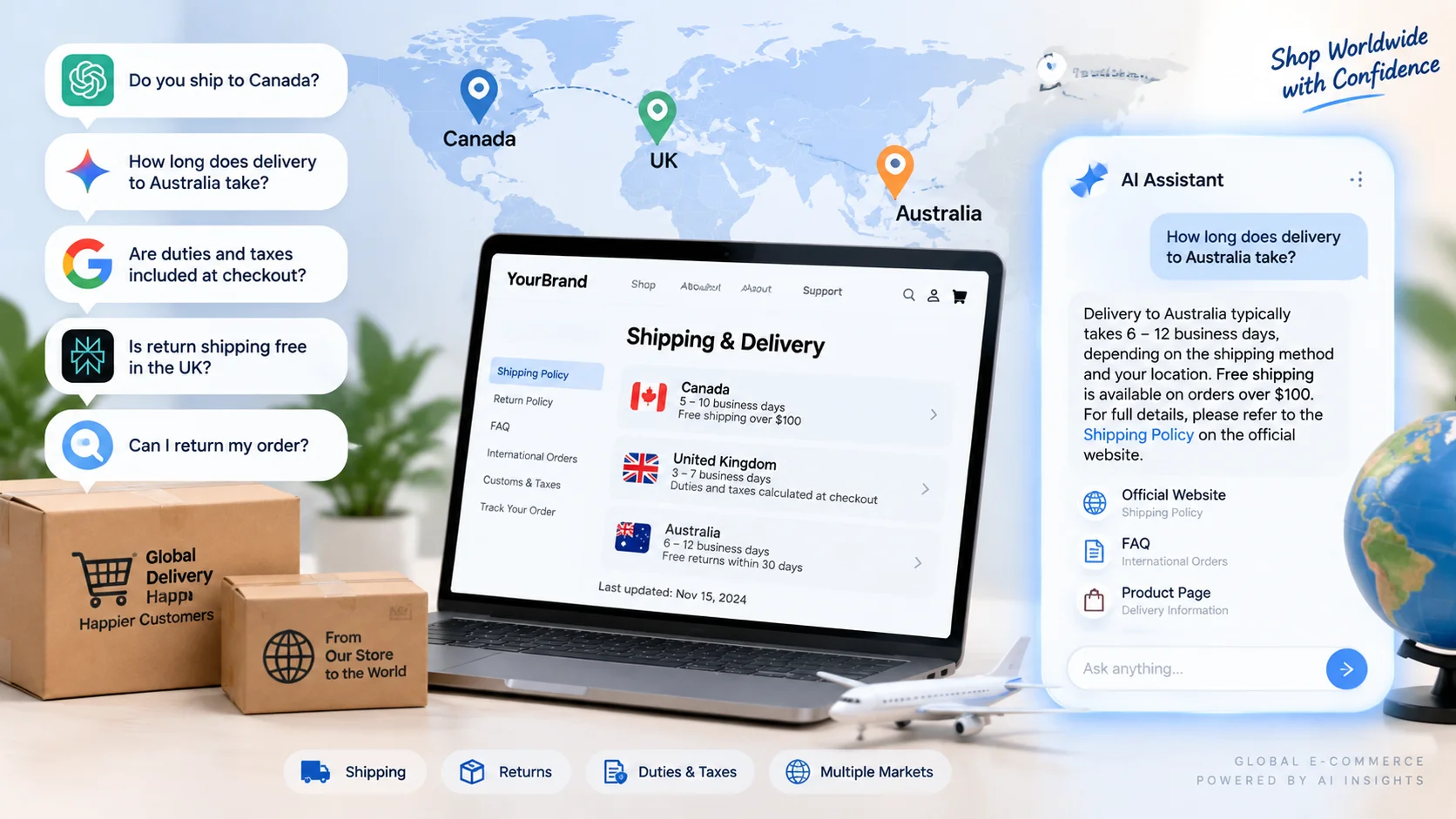
When users ask AI first, can your website's policy pages still explain things clearly?
I've seen many cross-border B2C DTC sites that have already built fairly complete policy systems: Shipping Policy, Return Policy, FAQ, Help Center, and even shipping notices displayed on the checkout page. But as the way consumers get information changes, more and more people no longer start by opening a website menu and searching page by page—they go straight to ChatGPT, Gemini, Perplexity, or Google AI Mode.
If you're a brand selling to English-speaking markets like North America, Europe, and Australia through Shopify, WooCommerce, Magento / Adobe Commerce, or a custom-built DTC site, consumers might directly ask: “Do you ship to Canada?” “How long does delivery to Australia take?” “Is return shipping free in the UK?”
These questions seem simple, but they usually involve multiple business conditions: shipping country, shipping method, product type, order value, tax handling, remote area restrictions, return window, and who bears the return cost.
The problem is that your website may already have this information, but it's scattered across different locations.
The Shipping Policy may state international shipping rules, the Product page may mention restrictions on certain items, the FAQ may answer some common questions, and the Checkout page dynamically shows different results based on the address. If different pages are updated at different times, AI may face multiple versions of information when compiling answers.
So the challenge facing cross-border e-commerce GEO is not “whether the website has policy content,” but whether these business rules are organized into a structure that machines can understand.
Based on our methodology observations, this type of scenario requires first using a GEO audit report to identify the sources of errors in AI answers, then determining whether to adjust policy pages, FAQ, structured data, or on-site information synchronization mechanisms. The scenario setting table also summarizes the core issues into three directions: difficulty identifying cross-country policies, unclear rule expression on pages, and conflicting information across pages.
Why can AI still get it wrong even when the website has a policy?
Many businesses assume that as long as the Shipping Policy is written completely, AI should be able to answer accurately. But from a GEO perspective, there are several intermediate steps between “the page exists” and “the machine correctly understands it.”
Scope of application is not clearly stated
Suppose a website says:
“International delivery usually takes 7–14 business days.”
For a human user, this sentence might be sufficient as a reference. But for AI, several key conditions are still missing:
- Which countries does it apply to?
- Does it include different markets like Canada, France, and Australia?
- Do different shipping methods have different timeframes?
- Are there additional times for remote areas?
- Do oversized items follow the same rules?
AI can read this sentence, but it can't necessarily determine which region and order type it applies to.
If the same brand serves multiple overseas markets simultaneously, a single generic rule can easily be misapplied.
Content is suitable for human reading but not necessarily easy for machines to interpret
The problem with many policy pages is not missing information, but that the information is organized in a way that's more suited to human reading.
For example, shipping rules are buried in long paragraphs, important conditions are placed in collapsed menus, and the FAQ only says “we support international shipping” without specifying which countries, timeframes, costs, and restrictions.
For consumers, they need to keep searching for answers themselves; for AI, it also needs to further infer the relationships between these rules.
A clearer approach is usually to break questions down into explicit information units:
- Where do you ship to;
- How long does it take;
- How are costs calculated;
- Which products have restrictions;
- What are the return conditions.
Information conflicts exist across multiple pages
Cross-border DTC sites often maintain multiple pages simultaneously:
- Shipping Policy;
- Return Policy;
- Product pages;
- FAQ;
- Checkout notices;
- Automated email templates.
If different teams maintain these separately, version differences are likely to occur.
For example:
A Product page says “Free shipping,” while the Shipping Policy says “Free shipping applies only above a certain order amount”; the Return Policy has already updated the return window, but the FAQ still retains the old rule.
AI may read one version when answering, while the user sees another version.
AI answers are not verified after page updates
Completing changes to policy pages does not mean all AI platforms will immediately adopt the latest information.
Therefore, cross-border policy GEO cannot just involve page modifications—it also requires establishing a monitoring mechanism.
You need to record:
- Test platform;
- Query question;
- Target country;
- AI-returned answer;
- Cited source pages;
- Error type.
Only then can you determine whether the problem comes from policy content, page structure, or the information update cycle.
First determine the rule source, then decide how to modify pages
When handling this type of cross-border policy scenario, I don't start with Schema or FAQ modifications. Instead, I first determine: where does this rule apply, to which orders, under what conditions does it hold, and which page should serve as the final reference source.
Because for AI, the biggest challenge is usually not finding the text, but understanding the business conditions behind the text.
Step 1: Define policy dimensions
Cross-border shipping rules need to be broken down into different dimensions first, rather than putting all markets into one generic description.
Common dimensions include:
- Country or region: Canada, UK, Australia, different EU markets;
- Shipping method: standard shipping, express shipping, special logistics solutions;
- Product category: regular items, oversized items, specially restricted items;
- Order conditions: value thresholds, membership status, promotional rules;
- Tax model: whether tax is included, whether consumers pay import fees;
- Return conditions: return window, return costs, product condition requirements.
For example, the phrase “free shipping,” without specifying country, amount, and product scope, is hard to turn into a complete rule.
For AI, clear information boundaries are more important than a longer description.
Step 2: Designate a single source of truth
One of the most common problems with cross-border websites is that the same rule exists in multiple versions.
So in our methodology, we first designate the primary policy sources:
- Shipping Policy handles shipping rules;
- Return Policy handles return rules;
- FAQ answers high-frequency questions and links back to the primary pages;
- Product pages only display special notes related to the current product.
Other pages can summarize, but it's not recommended that each maintains the complete rules independently.
The purpose of this is to reduce the probability of conflicts between different pages.
Step 3: Distinguish stable information from dynamic information
Not all policy information is suitable for long-term fixed display.
For example:
- Shipping coverage;
- Return window;
- Return conditions.
These are typically relatively stable and can be maintained long-term.
But real-time shipping rates, inventory status, and remote area surcharges may change based on address, carrier, or order situation.
This type of information needs to clearly state: the final result is subject to the checkout page calculation, rather than fixing a potentially outdated number on the policy page.
Step 4: Serve both users and machines
A good policy page doesn't sacrifice user experience for machines.
Consumers need to find answers quickly; machines need to understand rule relationships.
So the page structure can consider both:
- Clear headings;
- Country or region categorization;
- Q&A format expression;
- Internal linking relationships;
- Applicable structured data.
For example, headings like “Shipping to Canada” and “Delivery times for Australia” are more effective at expressing specific scope than “International Shipping Information.”
Step 5: Prioritize verifying high-risk queries
Not all policy questions need to be optimized simultaneously.
Typically, prioritize issues that affect purchase decisions:
- Whether you ship to a certain country;
- How long it takes to receive the product;
- Whether taxes and duties are included;
- Whether returns require a fee.
These questions directly affect whether consumers continue with their purchase.
So the goal of GEO optimization is not to make all AI platforms output exactly the same sentence, but to make the applicable region, business conditions, and effective sources behind answers as consistent as possible.
Five actions to organize scattered policies into a recognizable information system
Method 1: Build shipping information structure by country and region
The first step is to reorganize the Shipping Policy.
Don't just write one international shipping description covering all markets—instead, build country or region dimensions based on your business situation.
For example, you can organize by:
- Shipping to Canada;
- Shipping to United Kingdom;
- Shipping to Australia.
Separately explaining:
- Shipping coverage;
- Shipping methods;
- Estimated timeframes;
- Shipping cost conditions;
- Tax handling;
- Restricted products;
- Remote area exceptions.
If there are many markets, you can first create a regional overview page, then link to key country pages.
The reason for this is to make it easier for AI to distinguish between “rules common to all markets” and “special rules for a specific country.”
In terms of execution, it's recommended to add an update date to pages, such as “Last updated,” to help users and machines understand how fresh the information is.
Method 2: Turn FAQ into real pre-purchase queries
The biggest problem with many website FAQs is that the answers are too generic.
For example:
“We offer worldwide shipping.”
This sentence doesn't address what consumers really care about.
FAQs that are closer to actual queries can revolve around:
- Do you ship to Canada?
- How long does delivery to Australia take?
- Is return shipping free in the UK?
- Can oversized products be shipped internationally?
- Are duties and taxes included at checkout?
Each answer should clearly specify:
- Applicable region;
- Specific conditions;
- Exceptions;
- Policy pages for further details.
If the page actually displays these Q&A contents, you can use schema.org/FAQPage to mark up the question-answer relationships.
But note that structured data must be consistent with what users actually see on the page—you cannot add information that doesn't exist on the page.
Method 3: Add structured data related to shipping and returns
The role of structured data is to help search systems understand entity and attribute relationships on a page.
Where applicable, you can enhance:
- Organization;
- Product;
- Offer;
- OfferShippingDetails;
- MerchantReturnPolicy.
For example, a Product page can express:
- Brand;
- Product name;
- Sale status;
- Price currency.
Shipping-related pages can express, based on actual business situations:
- Shipping destination;
- Shipping method;
- Cost conditions.
But Schema can only describe information that actually exists.
It cannot replace policy body text, nor can it include rules that the website hasn't publicly stated.
Method 4: Establish a single source of truth and synchronization process for on-site policies
The difficulty of maintaining cross-border website policies is often not due to missing content, but because update processes are scattered.
For example, the logistics team modifies shipping rules, operations updates the FAQ, and the product team modifies product templates—but none of the three have a synchronization mechanism.
Therefore, you need to establish:
- Policy fields;
- Owners;
- Page locations;
- Update times.
Each time you adjust carriers, market coverage, return conditions, or tax rules, simultaneously check:
- Shipping Policy;
- Return Policy;
- Product pages;
- FAQ;
- Checkout notices;
- Automated emails.
For old policy pages, you need to update, redirect, or clearly mark historical versions to avoid multiple versions existing simultaneously.
Method 5: Establish GEO query monitoring by country and intent
After optimizing policy pages, you need to continue observing whether AI understands the new information structure.
You can build a query set:
- shipping to [country]
- delivery time from [brand] to [country]
- return policy for [product category]
- is return shipping free for [brand]
- does [brand] include duties and taxes
Then test separately on ChatGPT, Gemini, Google AI Mode, Perplexity, and Google AI Overview.
Record:
- Query date;
- Target market;
- AI answer summary;
- Cited pages;
- Error type.
This can turn “AI seems to have misunderstood” into an analyzable problem.
For example, if AI consistently confuses Canada and Australia shipping rules, you need to check whether the regional pages are clear; if AI consistently cites the old FAQ, you need to check whether the old page is still being linked and indexed.
After policy updates, how do you determine whether AI is starting to cite the correct version?
Cross-border policy GEO doesn't end with a one-time page modification.
Shipping, tax, and return rules themselves get updated as markets change, logistics adjust, promotions run, and business strategies evolve. So what really matters is not “whether the page has been changed,” but whether AI is starting to understand the currently effective rules.
In our methodology, policy information monitoring typically follows the process of “establish baseline—classify errors—fix pages—retest answers—expand queries.”
Establish baseline: first record how AI answers before optimization
Before modifying pages, you can first select a batch of key markets and pre-purchase questions.
For example:
- Does this brand ship to Canada?
- How long does delivery take to Australia?
- Does this brand include duties and taxes?
- What is the return policy for this product?
Record:
- Platform used;
- Query time;
- Target country;
- AI-returned content;
- Cited source pages.
Only then can you later determine whether modifications have reduced information conflicts.
Classify errors: don't just record “got it wrong”
When AI answers have problems, you need to further determine which type they belong to.
- Region mismatch: Canada rules applied to Australia users.
- Missing conditions: the answer mentions delivery time but doesn't specify applicable conditions.
- Outdated citation: AI still cites old policy pages.
- Page conflict: different pages have different versions of rules.
- No reliable source: AI cannot find a clear policy basis.
Different errors correspond to different optimization directions.
For example, region mismatch requires checking country page structure; outdated citations require checking old URLs, internal links, and sitemaps; page conflicts require re-designating the primary policy source.
Fix pages: trace back to information sources from error types
If AI still gives inaccurate answers, you can check along the following path:
AI answer → Cited sources → Policy pages → FAQ → Product pages → Structured data.
For example:
If AI answers “the brand offers free returns,” but the official website actually only offers free returns in certain countries, you need to check:
- Whether the Return Policy states regional restrictions;
- Whether the FAQ has oversimplified expressions;
- Whether Product pages lack special item notes.
The problem is often not that one sentence is wrong, but that multiple pages together create a misunderstanding.
Continuous retesting: fixed queries are more valuable than constantly changing questions
When monitoring policies, it's not recommended to randomly change to new questions each time.
A more effective approach is to build a fixed query set and repeat tests regularly.
This allows you to observe:
- Whether AI reduces incorrect answers;
- Whether it starts citing current pages;
- Whether it still confuses rules across different countries.
At the same time, you can also combine customer service questions, return reasons, and user questions from the checkout process to continuously add new test questions.
For market expansion, logistics adjustments, or major promotional cycles, you can increase check frequency.
From scattered information to recognizable rules—what changes typically occur?
| Observation dimension | Common state before optimization | Observable state after optimization | Reasonable observation period |
|---|---|---|---|
| Shipping rule recognition | AI has difficulty determining which countries a policy applies to and easily applies generic rules | Queries for key countries gradually return shipping rule descriptions that better match the corresponding pages | Approximately 8–12 weeks |
| Policy content coverage | Only one generic Shipping Policy with weak regional and condition boundaries | An information structure formed by country/region, shipping method, cost conditions, and exception rules | Approximately 4–8 weeks |
| AI citation consistency | Different queries may cite different versions or different pages | Primary query scenarios gradually cite the website's currently effective information sources | Approximately 8–12 weeks or longer |
| User decision information completeness | Users need to search between product pages, FAQ, and policy pages themselves | Core shipping, tax, and return questions can be answered more completely on clearly identified pages | Approximately 2–3 months |
| Multi-market maintenance capability | Policy updates rely on manual page-by-page checks, easily missed | Established primary sources, update times, and cross-page synchronization mechanisms | Approximately 3–6 months of continuous iteration |
These periods are better used as planning and retesting windows rather than fixed result commitments.
Approximately 8–12 weeks is usually enough to complete key policy page organization, structural adjustments, and initial AI query observation. For websites with many markets, complex product rules, or many historical pages, continuous maintenance over 3–6 months is more appropriate.
Different AI platforms have different mechanisms for information acquisition, crawling, and answer generation, so the optimization goal should be to reduce information ambiguity and improve rule consistency, rather than expecting every query to return exactly the same answer.
Cross-border DTC policy information GEO checklist
- List the shipping coverage, shipping methods, timeframes, costs, taxes, and restricted products for each target country.
- Designate a single source of truth for the Shipping Policy and Return Policy.
- Check whether product pages, FAQ, Help Center, Checkout, and automated emails reference the same set of rules.
- Use clear country headings, condition descriptions, exceptions, and update times on policy pages.
- Rewrite common pre-purchase queries as single-question FAQs with direct answers.
- Configure applicable Organization, Product, OfferShippingDetails, MerchantReturnPolicy, or FAQPage markup for information that actually exists on the page.
- Set up update, redirect, or historical version handling for old policy pages.
- Build GEO test sets for different countries, platforms, and query intents.
- Record AI answers, cited sources, and error types, and retest on a regular cycle.
- Trigger cross-page synchronization checks each time carriers, shipping coverage, tax rules, or return requirements are adjusted.
For cross-border DTC sites that have been operating for years, it's not recommended to modify all policy pages at once.
A more practical approach is to first select countries and products with higher order volumes, broader market coverage, and more customer service inquiries, build a policy information template, then gradually expand to more markets.
Related questions
1. The website already has a Shipping Policy—why might AI still answer incorrectly?
Because the page existing doesn't mean the scope of application is clear enough. If country, shipping method, product restrictions, and cost conditions are mixed in long paragraphs, AI may extract the rule but cannot accurately determine which market it applies to.
2. Does every country need its own dedicated shipping page?
Not necessarily. Markets with minor rule differences can be sectioned by region on the same policy page; if a country involves separate taxes, delivery timeframes, restricted products, or return processes, then consider creating a separate page.
3. Can FAQPage Schema prevent AI from giving wrong answers?
No. FAQPage can help express the relationship between questions and answers, but it cannot replace accurate, consistent policy content, nor can it guarantee that AI will cite a particular answer.
4. Real-time shipping rates change at checkout—how should the policy page be written?
The policy page should explain the factors for calculating shipping costs, the scope of application, and common conditions, and clearly state that the final amount is subject to the checkout page display. Don't retain fixed price information long-term that may have already changed.
5. When Shipping Policy, product pages, and Checkout content conflict, which should take precedence?
The website needs to first designate the primary policy source, then have product pages and Checkout reference or summarize that source. If checkout results change based on address, weight, or shipping method, this should also be clearly explained on the policy page.
6. After completing page optimization, how long until AI answer changes can be observed?
Key page organization and initial observation can typically be arranged within approximately 8–12 weeks; multi-market websites may need 3–6 months of continuous iteration. Actual changes will be affected by platform crawling, index updates, and query methods.
If your DTC site serves multiple overseas markets, you can start by using a set of real pre-purchase queries to check how ChatGPT, Gemini, Google AI Mode, Perplexity, and Google AI Overview currently understand your shipping and return rules. A free GEO Audit can help identify key queries, answer error types, cited sources, and priority pages for modification.