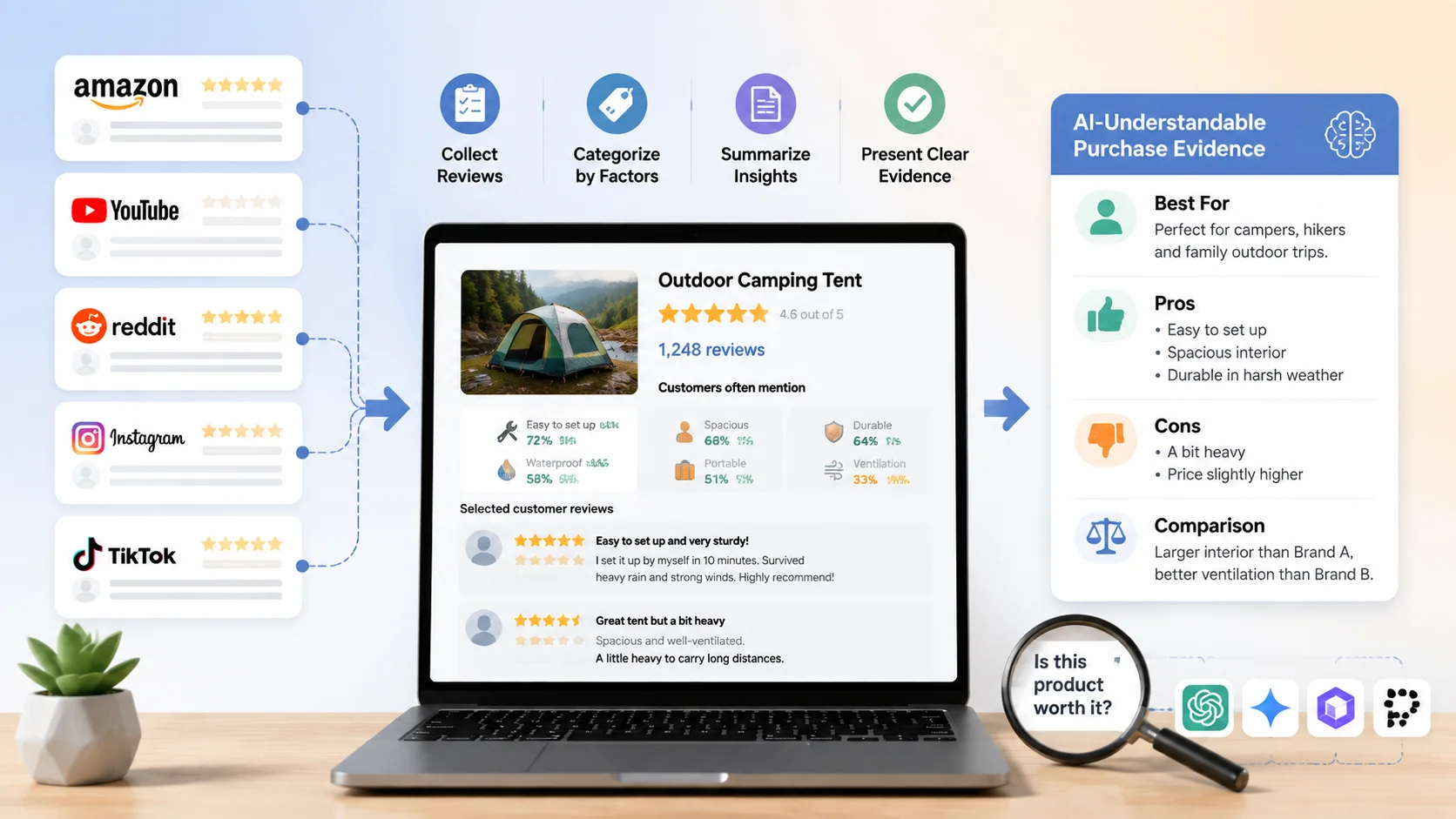
The Scenario — Having Many Reviews Doesn't Mean AI Understands "Why People Buy"
I've seen many cross-border B2C brands that don't lack reviews. Standalone sites have reviews, Amazon has accumulated a wealth of user feedback, YouTube has product reviews, and Reddit, Instagram, and TikTok also have discussions. But when consumers ask AI "Is this product worth it?", "Who is it suitable for?", or "What are the downsides?", what the brand's official website can often directly provide is still just a star rating, a set of product selling points, and a few carousel short reviews.
If you are a cross-border brand operating a standalone site, Amazon, and multiple social content channels simultaneously, this situation is common. Consumers' authentic feedback is constantly being generated, just scattered across different places: some discuss durability on Amazon, some show the installation process on YouTube, some share specific use cases on Reddit, and your own site's reviews record details about sizing, quality, and after-sales experience.
What companies accumulate is "review quantity," but what AI really needs for purchase decision questions is "what these reviews specifically prove."
Consumers typically don't ask "How many reviews does this product have?" but rather more specific questions: "Is this product worth it?", "What are the pros and cons?", "Is this good for outdoor use?", "Who is this product best for?", or "Product A vs Product B".
Behind these questions are purchase judgments: whether the size is suitable, whether installation is complex, whether it's durable for long-term use, what environments it's suitable for, what its standout advantages are, and what its limitations might be.
So, for this scenario, I wouldn't interpret GEO as "moving all reviews back to the official website." What's more valuable is: how to organize authentic feedback into an evidence structure with clear sources, clear purchase factors, and traceability — without fabricating or tampering with third-party evaluations — making it easier for machines to understand why consumers choose a product and who it's actually for. The scenario setting table also clearly breaks this challenge into three directions: dispersed review sources, missing purchase factors, and the lack of verifiable relationships between brand claims and third-party evaluations.
Problem Diagnosis — Why AI Answers Still Sound Like Brand Slogans Despite Plenty of Reviews?
What these companies typically lack isn't reviews, but the correspondence between "product — purchase factor — user feedback."
Problem 1: Reviews scattered across platforms lack a unified evidence structure
Suppose a cross-border brand operates both a standalone site and Amazon, and also has YouTube reviews and public discussions on Reddit, Instagram, and TikTok. Individually, each channel may contain valuable information.
Amazon users may repeatedly discuss durability; YouTube reviews showcase the actual installation process; Reddit users are more likely to discuss whether it works well in specific environments; your site's reviews might focus on sizing, shipping, and daily experience.
The problem is that brand websites usually don't organize further: which product corresponds to which purchase factor, and what specific feedback users have given.
As a result, machines can find plenty of "reviews," but it may not be easy for them to directly form judgments like "why this product is worth considering," "who it's suitable for," or "what its main limitations are."
Problem 2: Websites compress reviews down to a "star rating + positive comments"
Another common issue is that while product pages have a review module, the page prominently features only a 4.x-star rating, "Great product," "Highly recommended," or a few constantly rotating short comments.
This information can convey overall sentiment but compresses a lot of details relevant to purchase decisions.
For example, even among positive reviews, one user might find installation easy, another might be satisfied with the size, and another might comment on durability after continuous outdoor use. Conversely, negative or neutral reviews might reveal limitations like the product running large, being unsuitable for certain environments, or requiring two people for installation.
Star ratings help machines understand "reviews are generally positive," but they don't necessarily answer "why it's good, who it's for, and what its limitations are."
Problem 3: No verifiable link between brand selling points and third-party feedback
The official website might state "Suitable for outdoor use," "Easy to install," "Durable" — these are all product selling points. But if the page doesn't further present authentic first-party feedback, or reasonably cite public third-party reviews and discussions, AI looking at questions like "Is it worth buying?" or "What are the downsides?" will mainly see the brand's own claims.
This doesn't mean third-party reviews are always more important than the brand's website; it's that the two types of information serve different roles. Product specifications and official intended use should be accurately stated by the brand; user experience, common pros and cons, and practical scenarios need authentic feedback to provide another layer of evidence.
Judgment Logic — Don't Start with "Should Reviews Be Moved Back?" but First Determine What They Can Prove
When handling this type of scenario, I don't first ask "Can Amazon reviews be moved to the website?" Instead, I break the problem into three layers: Where does this feedback come from? What are they evaluating? And can this information be expressed authentically and traceably on the website?
Layer 1: What is the source of the reviews?
First, separate the standalone site's own authentic reviews, evaluations on third-party e-commerce platforms like Amazon, YouTube reviews, public Reddit discussions, and other public social content.
The point isn't to rank channels but to preserve source boundaries.
Reviews from your own site can be organized based on how they actually appear on the page; reviews on Amazon still belong to the Amazon source; YouTube reviews need to retain the corresponding video or creator attribution; public discussions on Reddit cannot be repackaged as the brand's own user reviews.
Different sources can collectively help explain the product, but they shouldn't be merged into a single "brand-owned rating."
Layer 2: Which purchase factor is the review actually evaluating?
The next step shouldn't just be classifying reviews as "positive" and "negative." That's too coarse for real purchase judgments.
In our methodology, it's more valuable to classify further based on factors like size, quality, installation, durability, use cases, after-sales support, advantages, and limitations.
For example, among dozens of reviews for the same outdoor product, some might discuss installation, some discuss use in wind and rain, some discuss sizing, and some feedback focuses on maintenance. After organizing, machines don't just see a bunch of isolated natural language but several relatively clear purchase decision dimensions.
Layer 3: Can the evidence be verified and traced?
This is a step that cannot be skipped in the entire process.
If the website concludes "Customers often mention easy installation," this judgment should be traceable back to first-party reviews actually displayed on the page. If content cites public third-party reviews, readers should know where the information came from, rather than rewriting third-party opinions into uncredited brand conclusions.
Similarly, off-site ratings cannot simply be repackaged as the standalone site's own AggregateRating for convenience.
So this judgment sequence can be summarized as: Clear source → Clear purchase factors → Traceable evidence → Then proceed with content organization and structured expression.
Key Method Breakdown — Reorganizing Scattered Reviews into Purchase Decision Evidence
Method 1: Establish a "Review Source — Product — Purchase Factor" Evidence Matrix
The first step can start with core products, inventorying standalone site reviews, Amazon user feedback, video reviews, and public social discussions, then categorizing them by specific product.
Next, don't just stop at "How many reviews does Amazon have?" or "What's the average star rating?" Continue adding purchase factor tags to the feedback, such as size, quality, installation, durability, use cases, and after-sales support.
What really matters during organization is answering: "What do users repeatedly say about installation for this product?" "Where does feedback on durability tend to concentrate?" "Which usage environments frequently appear?"
If some feedback appears only once, preserve that boundary. You can't write "users generally believe..." based on a single comment just because it aligns with a brand selling point.
The goal of this step is to transform "review quantity" into "what judgments the reviews can actually support."
Method 2: Transform authentic first-party reviews into crawlable product page content
Many Shopify, WooCommerce, Magento / Adobe Commerce, or custom standalone sites already have review systems installed, but important feedback may primarily exist within JavaScript carousels, interactive components, images, or third-party plugins.
For first-party reviews that genuinely exist on the page itself, you can further add clear text modules around recurring purchase factors, such as "Customers often mention…" or "Common use cases," or organize common experiences by theme like installation, sizing, or maintenance.
If authentic reviews consistently discuss installation time, product size, outdoor use, and daily maintenance, you can create summaries around these themes.
But here's a boundary: Summaries must be traceable back to feedback actually displayed on the page. You cannot write "users generally find installation very easy" for GEO purposes when the actual reviews don't support that judgment.
The value of this approach lies in moving core purchase evidence from scattered components into clear, continuous, crawlable product information, not replacing real Reviews with synthetic summaries.
Method 3: First-party reviews can be structured, but off-site ratings cannot directly become "your own rating"
If the product page genuinely displays first-party ratings and reviews, you can use applicable properties like review and aggregateRating from schema.org/Product, along with corresponding types like Review and Rating, to describe information that actually exists on the page.
Here, two things need to be checked simultaneously: what users can see on the page, and what the structured data expresses.
For example, if the page only displays reviews collected on the standalone site itself, the Schema should be consistent with this visible content. Ratings from Amazon, YouTube, or other off-site sources that cannot be verified on the current page should not be directly copied as the standalone site's own AggregateRating.
The role of Schema is to help describe information that genuinely exists on the current page, not to repackage evaluations from different platforms into a seemingly unified brand rating.
Method 4: Build "Evidence-Based Buying Guides," not review aggregation articles
Once product pages address the basic evidence, you can build more complete buying guides around high purchase-intent questions.
For example, "Is this product good for...?", "Pros and cons," "Who is this product for?", and "Product A vs Product B" can all be broken down into suitable use cases, common advantages, common limitations, product comparisons, which user types it fits, and what needs it might not suit.
This isn't about copying full review text from Amazon, Reddit, or YouTube back to your site, but about explaining a purchase judgment based on authentic evidence.
For example, if a product is officially positioned for outdoor use, but authentic user feedback centers on portability, installation, and daily maintenance, the buying guide can separately explain the official product conditions and the actual user experience. For public third-party reviews and discussions, retain citations or links to original sources where appropriate.
What consumers ask AI isn't usually "How many stars does this product have?" but "Is this product right for me?" Evidence-based content needs to be organized around this question.
Method 5: Establish GEO query monitoring for purchase decisions
After completing evidence organization, you need to validate it in the AI environment.
You can select around 15–30 high purchase-intent queries covering intents like worth it, reviews, pros and cons, best for, and vs. For example: "Is Product X worth it?", "What are the pros and cons of Product X?", "Who is Product X best for?", and "Product X vs Product Y".
When monitoring, don't just record "whether the brand was mentioned." More importantly, observe five things: Which sources does AI primarily base its purchase judgment on? Does it correctly summarize user feedback? Does it generalize individual opinions into overall conclusions? Does it identify correct common use cases? Is the website's buying guide or product page becoming a relevant information source?
These results should guide what to add to product pages and buying guides, rather than continually piling on reviews just to increase mention frequency.
Monitoring & Iteration — The Focus Isn't Making AI "Say Nicer Things," but Reducing Mischaracterizations
There's a key distinction between Review GEO and traditional word-of-mouth marketing: The goal isn't to polish reviews to be more positive.
Actual limitations, suitability conditions, and neutral feedback are also part of purchase evidence. For a consumer deciding "Is this right for me?," knowing when a product isn't suitable can sometimes be as important as knowing its advantages.
So during monitoring, I suggest adding several types of labels to your questions:
- Source bias: AI's judgments consistently rely primarily on one third-party channel, and the website itself lacks sufficient information to support purchase decisions.
- Overgeneralization: One or two user feedback points are expanded into "users generally believe."
- Missing purchase factors: Answers still only discuss brand selling points, without addressing practical factors like size, installation, or durability.
- Pros/cons imbalance: Answers only list advantages and don't present real usage limitations.
- Context mismatch: Feedback from a specific use environment is generalized to all consumers.
Once problems are identified, you can trace back through the sequence: "AI response → Sources used → Website buying guide → Product page reviews → Review evidence matrix → Schema."
For example, if AI consistently fails to answer "Who is this product for?", don't start by adding more five-star ratings. It's more worthwhile to check: Do the authentic reviews contain enough Use Case information? Has this information been organized? Do the product page and buying guide clearly express different use scenarios?
What GEO does here isn't change what consumers say, but reduce distortion that occurs during the organization and machine summarization of information.
Typical Impact Range — From "Having Many Reviews" to "Purchase Evidence Being Understandable"
| Observation Dimension | Common State Before Optimization | Reasonable Observation Direction After Optimization | Reference Timeline |
|---|---|---|---|
| Purchase evidence information structure | Reviews scattered across multiple platforms; website mainly shows star ratings or sporadic short comments | Core products form a relatively clear evidence structure of "Product — Purchase Factor — Authentic Feedback — Use Case" | Approx. 3–6 weeks |
| Product page comprehensibility | Pages primarily rely on brand selling point descriptions | Core product pages simultaneously include specifications, use cases, common pros/cons, and authentic user feedback for purchase decisions | Approx. 4–8 weeks |
| AI's summarization of user sentiment | Answers mainly repeat brand slogans or provide generic evaluations | Some highly relevant queries can relatively consistently summarize user-mentioned experiences, advantages, and limitations | Approx. 6–10 weeks |
| Performance on purchase-decision queries | Website information has weak presence for questions like "Is it worth buying?" "Who is it for?" "What are the downsides?" | Some queries begin to show descriptions or relevant page citations consistent with website product information and public third-party evidence | Typically approx. 8–12 weeks or longer |
These timelines are better viewed as windows for content and query monitoring, not guarantees that a specific AI platform will cite a page at a certain point. Actual changes are also influenced by product popularity, the volume of public reviews, page crawling conditions, third-party source distribution, and different AI search environments.
Reusable Action Checklist — 8-Point Self-Check for Product Review GEO
- Inventory standalone site reviews, Amazon reviews, video reviews, and public social discussions separately, preserving source boundaries and avoiding mixing different platform comments into a single brand-owned evaluation.
- Organize feedback by specific product rather than just tallying overall brand review counts and average star ratings.
- Further categorize feedback into purchase factors like size, quality, installation, durability, use cases, after-sales support, advantages, and limitations.
- Check whether authentic first-party reviews on product pages are mainly hidden within JavaScript carousels, images, or third-party review plugins.
- Extract traceable "Customers often mention…" or "Common use cases" content from authentic reviews, ensuring summaries can be traced back to actual feedback.
- Check whether structured data like product review and aggregateRating is consistent with what users can actually see on the current page.
- Don't package Amazon or other off-site ratings that can't be verified on the current page as the standalone site's own AggregateRating.
- Establish around 15–30 purchase-decision queries covering worth it, reviews, pros and cons, best for, and vs intents, and continuously check whether AI is mischaracterizing user feedback.
If you have many products, you don't need to reorganize all reviews for every SKU initially. You can start by selecting a core set of products that have more purchase-decision queries, relatively rich public reviews, or are key promotional focuses, build an evidence matrix and content templates, and then gradually expand based on monitoring results.
Related Questions
1. Amazon already has many reviews. Do we still need to organize them on our standalone site?
It's important to distinguish between "copying reviews" and "organizing purchase evidence." The point isn't to move Amazon reviews wholesale onto your website, but to identify the purchase factors users repeatedly discuss — like size, durability, installation, and use cases — and supplement your website's own decision information without changing the source attribution.
2. Can we directly put Amazon ratings into our standalone site's AggregateRating?
You should not package off-site ratings that cannot be verified on the current page as your own AggregateRating. Structured data should be consistent with what is actually displayed and verifiable on the page, clearly distinguishing between first-party reviews and third-party evidence.
3. Reviews are in JavaScript plugins. Will this affect AI understanding?
If important feedback relies mainly on interactive components, the page's main content may lack continuous, clear information about purchase factors. While preserving the authentic Reviews, you can organize the use cases and purchase factors repeatedly mentioned by consumers into crawlable content, but summaries must be traceable back to the actual comments.
4. Should GEO optimization for review content focus on highlighting positive reviews?
No. The focus of this type of optimization should be helping machines accurately understand real advantages, limitations, and use cases, not making reviews sound more positive. For purchase-decision queries, authentic information about limitations also helps form clearer product-fit judgments.
5. How should third-party discussions like Reddit and YouTube be used on our website?
Public third-party reviews and discussions can be used as external evidence within buying guides, cited or linked where appropriate, while preserving source boundaries. The website should not rewrite third-party opinions into uncredited brand conclusions, nor does it need to copy large volumes of third-party review text back onto the site.
6. After optimizing reviews and buying guides, how long will it take to see changes in AI responses?
The initial review inventory, evidence categorization, and first-round optimization of key product pages can typically be advanced in about 3–6 weeks; changes in AI's understanding of product sentiment, pros/cons, and use cases should be continuously observed for about 8–12 weeks or longer. Specific performance will be affected by factors like site crawling, public discussion volume, third-party source distribution, and different AI search environments.
If your brand has already accumulated a significant amount of authentic feedback across your standalone site, Amazon, YouTube, and social media, don't rush to gather more reviews. It's more worthwhile to first check: Can your existing reviews answer "why consumers buy, what scenarios they're suitable for, common advantages and limitations," and can these conclusions be traced back to real sources? Our team has years of practical experience in the GEO field. If you need further evaluation, we can conduct a baseline diagnostic combining your existing product pages, first-party reviews, public third-party evidence, and purchase-decision AI queries to determine priorities for evidence organization and content optimization.