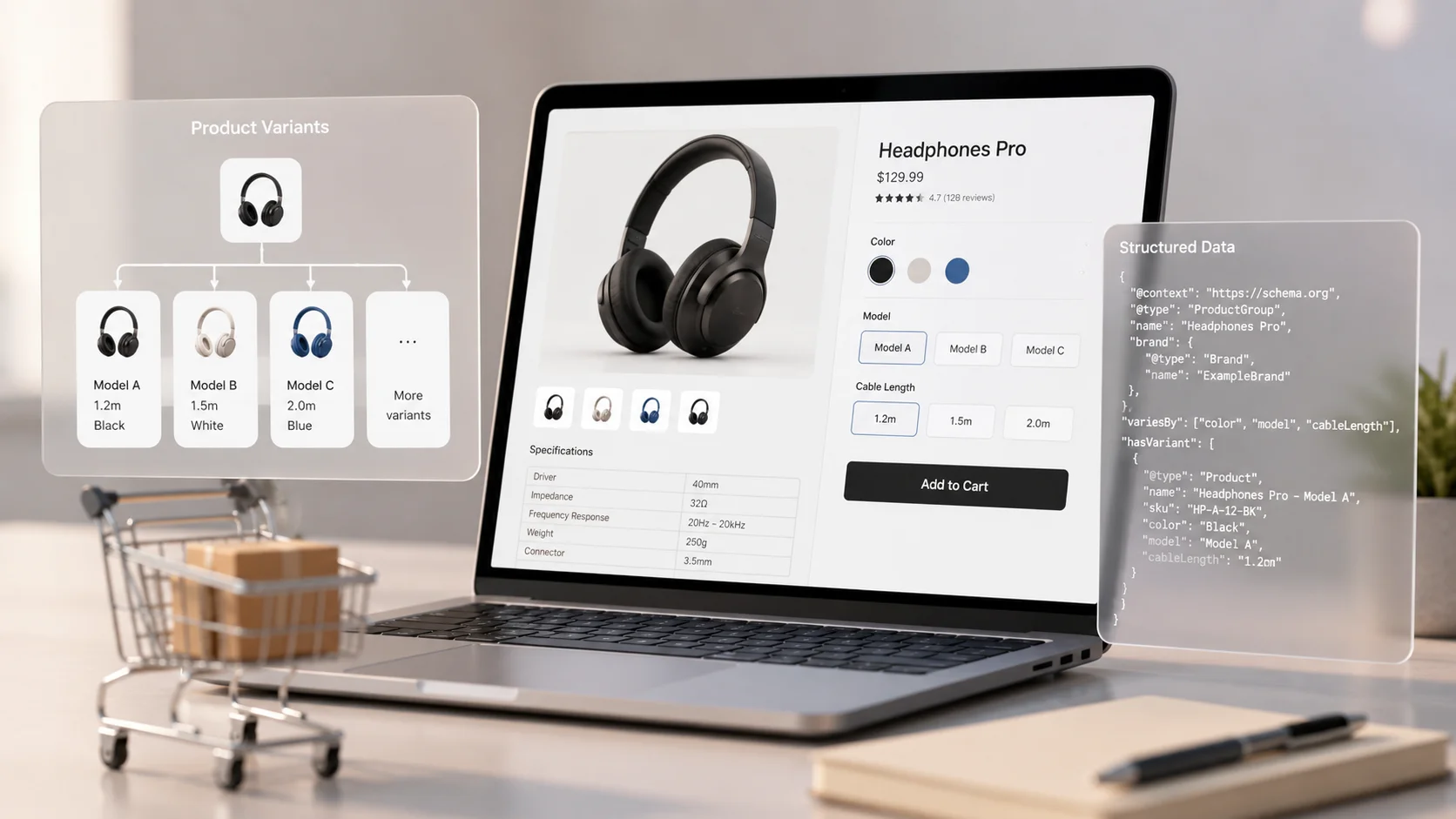
If you're a cross-border brand selling outdoor gear, consumer electronics, tools, or auto parts, a single product may come in a dozen or even dozens of SKUs. Shoppers can visit your independent site, click through size, color, material, capacity, power, or compatible model selectors, and gradually find the version that fits their needs.
But in an AI search environment, this product information isn't always understood with the same clarity.
Users might directly ask ChatGPT, Gemini, or Perplexity: “Which size is suitable for…?” “What's the difference between Model A and Model B?” or “Is this model compatible with…?” At that point, AI isn't dealing with a simple product description question — it needs to determine what each model is, how they differ, and which one fits the current scenario.
This is also a point that many Shopify, WooCommerce, Magento / Adobe Commerce, or custom cross-border independent sites with a large number of SKUs tend to overlook: traditional e-commerce pages mainly address “how users choose,” while GEO also needs to address “how machines understand the differences between these choices.”
The fact that shoppers can switch between variants on the page doesn't mean a machine has established a clear “product–variant–specification” relationship. For such sites, I usually don't start by discussing how much more content to add. Instead, I first assess how the product information is actually being expressed.
Why does AI tend to confuse different variants of the same product?
Based on our years of industry observation, many variant-related issues don't stem from a lack of product data. In fact, a lot of cross-border e-commerce backends have very complete information — SKUs, sizes, materials, stock, prices, and compatible models are all there.
The real problem is often that once this data reaches the front end, it doesn't form a sufficiently clear, readable, and mappable information structure.
Issue 1: Key variant information depends on front-end interactions
Let's say a product comes in Small, Medium, and Large sizes, plus different colors and materials. When shoppers click through the selectors, the price, images, and even some specs change. So from a human perspective, the page looks fine.
But when a machine crawls the page, it faces a different question: is this information stably present in the crawlable page content?
Some sites store variant data in JavaScript states. Some specs only appear after users toggle options. And some important differences are simply embedded in product images. If sizing, compatibility, model numbers, and other selection-critical details rely primarily on these presentation methods, the information boundaries between variants can become blurred.
Issue 2: The “product–variant–specification” mapping isn't clearly expressed
Another very common scenario: the page title introduces the entire product family, and the main body focuses on the primary product. There's a spec table further down, but data for several models is lumped together. And the structured data only describes one main Product.
As a result, the page looks information-rich, but when a machine needs to answer “What's the difference between Model A and Model B?”, it can't easily tell which specification belongs to which model.
This kind of problem shouldn't simply be dismissed as “AI doesn't understand the product.” More precisely, the official website hasn't given the machine a clear enough mapping to work with.
Issue 3: Parameters are there, but there's no answer to “how should users choose?”
A spec table can tell users what size Model A is or what capacity Model B has, but real search queries often go deeper.
Users ask: “Which one fits a small space?” “Which model is compatible with this device?” “What's the difference between these two materials for outdoor use?”
If the site only lists parameters without explaining differences between models, suitable use cases, and selection criteria, AI may only be able to produce a generic product description — even if it has read the specs.
For this type of GEO issue, don't rush to add more content
When I look at such sites, I don't start by asking “how many more articles should we write?” Instead, I check three things: whether the information exists, whether a machine can read it, and whether clear relationships can be established between different variants.
In my methodology, this breaks down into three layers.
Layer 1: Information completeness
First, identify the attributes that genuinely influence consumer purchasing decisions. For example, a product's decision path might look like:
SKU → Size → Material → Capacity → Compatibility → Use Case
The goal isn't to have as many attributes as possible, but to find out which ones truly determine which version a shopper should buy. Color might just be an aesthetic difference, while size, power, and compatible models can directly determine whether the product works at all. These types of information naturally have different priorities.
Layer 2: Machine readability
Next, check where these core attributes appear.
- Are they in the HTML body text?
- Do they appear in a clear spec table or product description?
- Is the same attribute consistently named across the page?
- Is any important information only present in images, selectors, or dynamic interactions?
Here, avoid a common assumption: just because users can see it after clicking doesn't mean a machine can reliably access it. The two are not equivalent.
Layer 3: Entity relationship clarity
Going one level deeper, I check whether the machine has the conditions to understand this type of relationship:
This is a product group → here are the specific variants underneath → each variant maps to these attributes.
Only at this point does it make sense to discuss structured expressions like Product, ProductGroup, hasVariant, and variesBy. Schema isn't the starting point — it's a machine-readable way of expressing the product information relationships after they've been mapped out.
From product information matrix to variant-level GEO testing: how to do it step by step
For this kind of scenario, I usually break the work down into five actions. Order matters: first organize the product data relationships, then handle pages and structured data, and finally move to AI query testing.
Step 1: Build a product variant information matrix
The first step isn't to modify Schema. Instead, organize all the attributes that genuinely affect user choices — SKU, size, color, material, capacity, compatible models, use cases — into a unified structure.
For example, the same size attribute might be called “Size” in the product title, “Dimensions” in the spec table, and “Product Size” elsewhere. Shoppers might still understand, but this creates additional mapping difficulty for machines that need to build relationships across a large number of product attributes.
So, I first unify the naming of core attributes, then check whether the body text, spec tables, and related data expressions all use the same set of terms.
This step solves the most fundamental issue: getting the website itself to clearly articulate its different variants.
Step 2: Re-examine how Product Schema expresses variant relationships
After organizing the product information, check the structured data.
Based on what's actually shown on the page, review whether applicable schema.org/Product properties like name, description, sku, brand, and offers are consistent with the page.
For pages that genuinely have both a product group and multiple variants, further evaluate expressions like ProductGroup, hasVariant, and variesBy based on the actual product structure. For example, if a product comes in multiple versions due to size differences, there needs to be a reasonable mapping between the product group, the specific variants, and the attributes that vary.
The focus here isn't on how many Schema fields you add, but on whether the structured data faithfully reflects the product relationships already present on the page.
If the page body discusses one model while the Schema describes another level, or if structured data only covers the main product while ignoring key variants, the machine will still have to infer these relationships on its own.
Step 3: Get key variant specs into crawlable HTML
Next, I go through each piece of information — size, material, model, capacity, compatibility — and check where it currently lives.
If an auto parts product only shows compatible vehicle models after users select their year and model, or if a consumer electronics product's power differences are only visible in images after toggling variants, evaluate whether this information should also appear in the spec table, product description, or corresponding variant content.
Not all dynamic content needs to be converted to static pages. But core information that influences purchase decisions shouldn't rely on a single front-end interaction to be expressed.
This step mainly addresses incomplete crawling of key information and the machine's difficulty in reliably mapping specific specifications to specific variants.
Step 4: Add “difference explanation” content
Once the specs are organized, the next move isn't to pile on more parameters, but to answer the questions users actually ask.
For example:
- Size A vs Size B
- Model A vs Model B
- Which model is suitable for…
- Which size should I choose…
- Is Model A compatible with…
Depending on product complexity, this content can go into spec comparisons, buying guides, compatibility notes, or page-level FAQs.
When the page actually has Q&A content, you can also use FAQPage structured markup to make the relationship between questions and answers clearer.
The reason is simple: spec tables address “what the data is,” while difference-explanation content helps answer “how should the shopper choose.” The latter tends to be much closer to the real questions asked in AI search environments.
Step 5: Build variant-level GEO query testing
After making page adjustments, move into continuous testing — don't treat launching Schema as the end of the project.
Select roughly 15–30 high-relevance queries from your core products, covering size selection, model comparisons, compatibility, use cases, and material differences.
On the international side, continuously observe answer changes in ChatGPT, Gemini, Google AI Mode, Perplexity, Google AI Overview, and other environments.
Don't just track “whether the brand name appears.” Instead, check four specific things:
- Does AI distinguish between specific variants?
- Are key specs described correctly?
- Do the pages cited in the answers align?
- Is the answer consistent with the current information on your official site?
For multi-SKU products, these metrics usually help teams identify where to make improvements more effectively than simply counting brand mentions.
Don't just count “how many times you were mentioned” — first track where AI gets it wrong
There's a clear difference between GEO monitoring for multi-variant products and standard brand exposure tracking: just because your brand is mentioned doesn't mean your product information was correctly understood.
For example, AI might mention your product, but if it attributes Model A's capacity to Model B, that result isn't very helpful for shoppers making a decision.
So I recommend building an “error type → page issue → corrective action” tracking framework.
- Variant confusion: Check whether information about Model A is being attributed to Model B, and whether the boundaries between the two models are clear in both the body text and structured data;
- Spec omission: Check whether key sizes, capacities, or compatibility details only exist in dynamic modules;
- Vague compatibility or selection guidance: Check whether the page lacks specific selection criteria and use-case explanations;
- Incorrect page mapping: Check the relationships between product groups, variant pages, and internal links;
- Inconsistent site information: Check whether the current HTML, Schema, and product information matrix still use the same version of the data.
During actual reviews, you can trace back along this path: “query → AI answer → citation/source → HTML body → Schema → product information matrix.”
The value of doing this is that it turns “why did AI get it wrong” into a locatable website issue. Updating Schema once doesn't end variant GEO. The real value lies in continuously identifying error patterns and then making corresponding fixes to how information is expressed.
From “information exists” to “AI can distinguish”: what changes can you observe?
These types of projects aren't suited to treating a single AI citation as the final result. I recommend observing in phases: first see whether product information has been organized clearly, then look at whether the machine's ability to distinguish variants improves, and finally check answer changes in specific product-selection queries.
| Observation dimension | Common state before optimization | Reasonable direction to observe after optimization | Reference period |
|---|---|---|---|
| Variant information completeness | Some key specs only exist in selectors, images, or scattered modules | Core size, material, model, and use-case info forms a clear mapping in body text and structured data | Approximately 3–6 weeks |
| AI's ability to distinguish variants | Easily confuses different specs of the same product | For some high-relevance queries, AI can more consistently distinguish between sizes, models, materials, or use cases | Approximately 6–10 weeks |
| Performance on specific selection queries | Mainly gives generic product introductions | For some spec comparisons, model selections, and compatibility questions, answers start to include differences consistent with the official site or citations to relevant pages | Typically around 8–12 weeks or longer |
These timelines are better viewed as monitoring windows, not promises about AI citation results. Different sites will vary depending on page volume, crawl status, product complexity, and content foundation.
Multi-variant product page GEO: start with these 8 self-checks
If your site has a large number of SKUs, you don't need to redo everything at once. Start by selecting a group of products that are business-critical, have complex variants, and are frequently compared by users. Then run through the following 8 checks.
- List the core variant attributes that actually influence consumer selection — don't just put every backend field on the page.
- Unify naming for core attributes like SKU, size, material, model, and compatibility, to avoid multiple expressions for the same concept.
- Check whether key specs only exist in images, JavaScript, or interactive selectors.
- Check whether the HTML body text and spec tables can clearly map specific specifications to specific variants.
- Check whether Product Schema is consistent with the information actually displayed on the page.
- Evaluate whether variant relationship expressions like ProductGroup, hasVariant, and variesBy are applicable based on the actual page structure.
- Add content covering model comparisons, size selection, compatibility, and use cases, so the page not only provides parameters but also explains the differences.
- Set up roughly 15–30 variant-level queries and continuously document whether AI confuses models, omits specs, or cites the wrong pages.
For this kind of scenario, I recommend treating GEO as a joint effort of product information governance, page expression, and continuous monitoring. The more complex your product data, the more important it is to first clarify the relationships, and only then think about how to help machines read and use that information.
If your independent site has already accumulated a large number of SKUs and product variants, but you're not sure whether the problem lies in page content, Schema, variant relationships, or how AI reads specifications, you can start with a variant-level diagnostic on a core set of products. Our team has years of hands-on experience in the GEO space. For cross-border independent sites with a large SKU count and complex product relationships, we can also help break down optimization priorities based on your site structure, product data, and target AI queries.
Related questions
1. Does having many SKUs affect how AI like ChatGPT understands my products?
SKU count itself isn't the problem. What matters is whether the attribute boundaries between different SKUs are clearly expressed. If differences in size, model, and material are mainly hidden behind selectors or dynamic content, AI may find it more difficult to accurately map between variants when answering specific product-selection questions.
2. Does every product variant need its own separate page?
Not necessarily. Whether to split variants into separate pages depends on factors like search demand, how different the variants are, site architecture, and maintenance costs. For GEO, the more important thing is that key specifications and product relationships remain clear and crawlable — whether on a single page with variants or across separate URLs.
3. Can Product Schema solve the problem of AI confusing different SKUs?
Schema shouldn't be treated as a standalone solution. It can help machines understand products and variant relationships, but it still needs to stay consistent with the HTML body, spec tables, product descriptions, and actual page content. Otherwise, the machine may still be dealing with conflicting information.
4. What do ProductGroup, hasVariant, and variesBy do respectively?
They can be used to express the relationship between a group of related products and their specific variants — for example, showing which versions exist under a product group and how they differ by size, color, or other attributes. In practice, they should be configured according to your website's real product structure and page content, not mechanically added just to increase Schema fields.
5. Why does AI still give generic answers even when I have a detailed spec table?
Because a spec table mainly answers “what are the parameters,” while users often ask “what's the difference between two models” or “which one should I choose for my scenario.” In addition to parameter data, you also need difference-explanation content covering comparisons, selection guidance, compatibility, and use cases.
6. After completing product page and Schema optimization, how long before AI answer changes are visible?
Product information cleanup and the first round of page and Schema changes can typically move forward in about 3–6 weeks. Changes in how AI recognizes different specs are more suitable for continuous observation over about 8–12 weeks or longer. Actual timelines will vary depending on site size, page crawling, product complexity, and different AI search environments, so it's not advisable to treat any specific timeframe as a promise of citations.