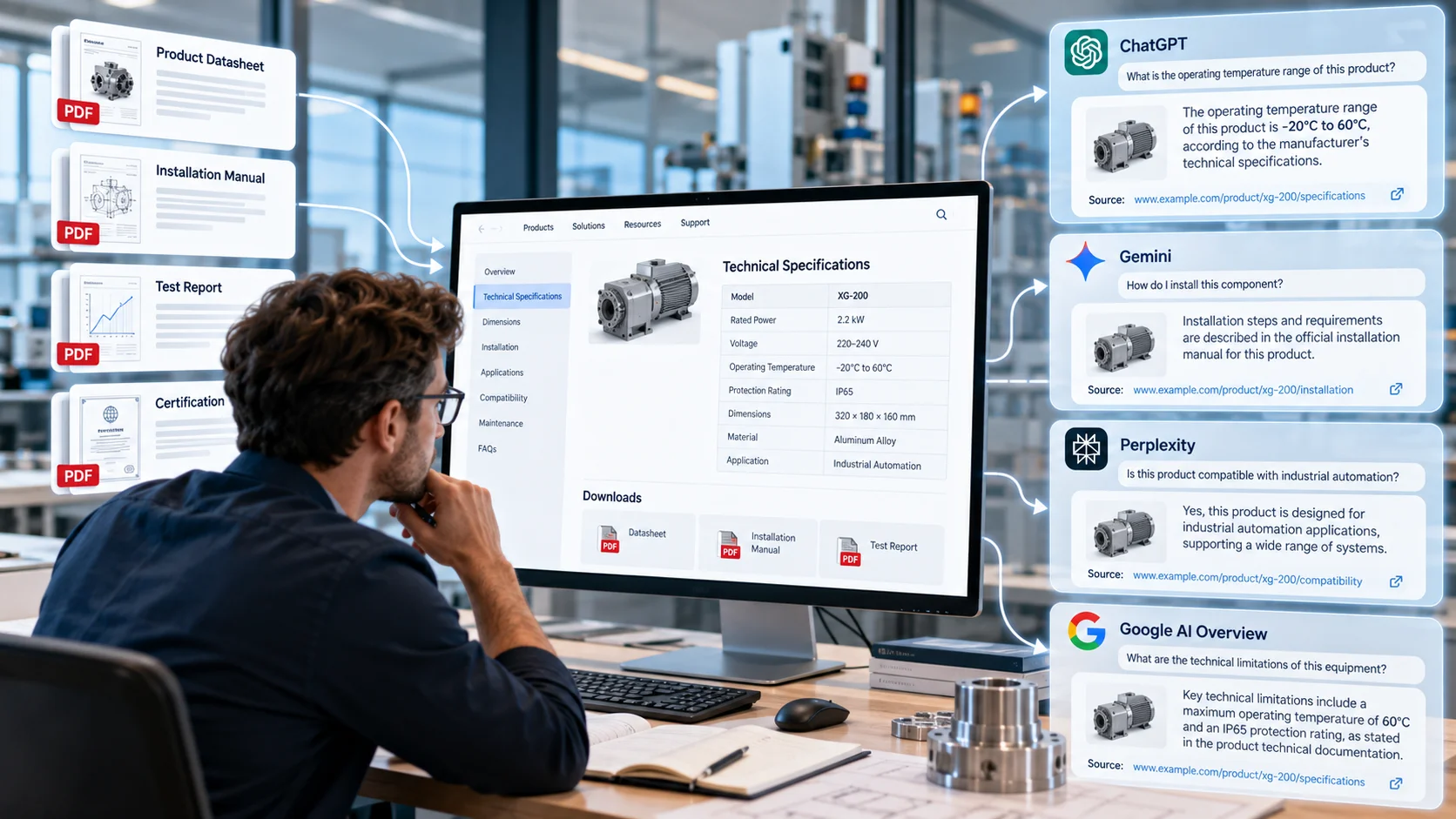
If you are a manufacturer selling industrial equipment or precision components to overseas markets, your website may already have product specification sheets, installation manuals, test reports, and certification documents uploaded. Engineers can download PDFs, and procurement staff can find corresponding materials by product model. However, product detail pages often contain only brief introductions and file download links.
When overseas buyers ask ChatGPT, Gemini, or Perplexity questions, what they need are specific technical answers:
- What is the operating temperature range of this product?
- How do I install this component?
- Is this product compatible with a specific application?
- What are the technical limitations of this equipment?
These questions involve operating temperature, installation steps, compatibility conditions, and usage limitations. They require specific parameters, applicable scope, and technical basis, not general product introductions.
For industrial equipment and component companies, the completeness of technical materials is important, but how the materials are organized, whether they can be accessed by search systems, and whether clear product and version relationships can be established between different documents also affect the discoverability of technical information.
Having technical materials does not mean the website has already formed a technical knowledge system that is easy to search and understand. The key to GEO optimization is not simply converting PDFs into web pages, but organizing verified technical parameters, applicable conditions, and document versions into an accessible, understandable, and sustainably maintainable knowledge system centered on product models.
When I analyze GEO content issues for industrial manufacturing companies, I first check whether existing technical materials are complete, whether parameters in different documents are consistent, and whether overseas engineers can directly find the information they need through product pages, before deciding which content should be converted into HTML technical knowledge pages.
PDF Materials Are Complete—So Why Does AI Still Struggle to Answer Specific Technical Questions?
Key Technical Information Is Concentrated in PDFs, While Web Pages Lack Specific Parameters
Operating temperature, rated voltage, load range, dimensions, installation requirements, and applicable limitations of industrial products are usually recorded in specification sheets or technical manuals. However, some product detail pages only have a product overview and PDF download link. Users need to download the file before they can find key parameters.
The readability of information in different PDFs also varies. Some files have clear text and table structures, while others are scanned copies, or use complex tables, images, and unclear heading hierarchies. Even if a PDF can be accessed by search engines, it cannot be assumed that all parameters can be stably extracted and accurately understood.
Therefore, PDFs can continue to serve as original technical materials, but core technical information should not be carried only through file download links. Product pages need to directly present the parameters, applicable conditions, and usage limitations that procurement staff and engineers frequently look up, based on actual materials.
Specification Sheets, Installation Manuals, and Test Reports Lack Unified Model and Version Relationships
The same product may have multiple models, hardware versions, or different applicable conditions. Specification sheets, installation guides, and test reports may also record different parameters and test conditions. If documents do not clearly indicate version numbers, effective dates, applicable models, and change records, readers will find it difficult to determine which information applies to the current product.
For example, a specification sheet records the operating temperature range of a certain model, while the installation manual corresponds to another version. If the website does not clearly distinguish the applicable scope of the two documents, users may mix parameters from different versions. When AI handles technical questions, it may also be unable to accurately determine the correspondence between parameters and models because information sources are scattered.
This type of problem is not just about a large number of documents, but about the lack of clear relationships between product entities, technical parameters, and document versions. Even if all files are uploaded to the website, technical information may still conflict without unified management rules.
The Website Is Centered on Product Catalogs and Does Not Organize Knowledge Around Engineers' Questions
Industrial manufacturing company websites usually organize content by product category, product model, and application industry. This structure helps users browse products, but engineers' search tasks are often more specific, such as confirming the installation requirements of a certain model, finding compatibility conditions, or determining whether equipment is suitable for a specified environment.
If operating temperature, installation steps, maintenance requirements, and compatibility descriptions are scattered across different files, users need to download multiple PDFs themselves and then search through them paragraph by paragraph. When the website lacks knowledge pages organized by technical tasks, selection guides, and FAQs, search systems also find it harder to establish complete information relationships from the website structure.
Therefore, technical documentation transformation should not focus only on file format. It also needs to address information accessibility, document consistency, and question organization.
Do Not Move All PDFs onto Web Pages—Build a Technical Knowledge System Centered on Product Models
I usually judge how technical materials should be transformed from three levels, rather than starting by planning how many new articles are needed.
Level 1: Which Technical Materials Deserve Priority Transformation?
Prioritize specification sheets, technical manuals, and installation guides for core products, as well as parameters frequently asked about by procurement staff and engineers. Materials involving installation, compatibility, usage limitations, test conditions, and certification scope should also be included in priority evaluation based on business needs.
If a company has a large number of historical files, it does not need to convert all of them into web pages at the start. It can first select models with clear procurement demand, concentrated technical questions, and relatively complete materials for currently sold products, complete the first batch of technical content organization, and then gradually expand to other products.
Level 2: Which Content Should Become Independent HTML Technical Knowledge Pages?
Page structure should be determined by the tasks engineers need to complete, rather than mechanically converting each PDF into one web page.
-
Product detail pages: introduce product positioning, core specifications, models, and application directions.
-
Technical parameter pages: present specific parameters, units, test conditions, and applicable models in a centralized way.
-
Installation and maintenance pages: explain installation steps, operating requirements, and maintenance precautions.
-
Compatibility or selection pages: explain adaptation conditions, model differences, and selection limitations.
-
Certification and test material pages: explain the applicable scope, versions, and related technical basis of documents.
If a PDF contains only a small amount of supplementary information, it can be integrated into a product detail page. There is no need to create a separate page just to increase the number of web pages. Only when a technical topic has independent information value and can solve a clear search need should an independent knowledge page be considered.
Level 3: How Can You Ensure AI Obtains the Correct Version?
A technical knowledge base must manage the relationships between products and parameters, web pages and documents, and information and time.
First, confirm that each parameter corresponds to the correct product model. Second, ensure that HTML content is consistent with the currently effective version of the PDF. Finally, clarify effective dates, version changes, and the status of discontinued models.
If there are parameter conflicts between a specification sheet and an installation manual, the product or engineering team should verify them first before updating web page content. Information involving safety, installation conditions, or usage limitations cannot be published solely through automated conversion.
Only by combining material verification, content organization, and version management can a technical knowledge base remain maintainable as products continue to be updated.
How Can PDF Technical Materials Be Transformed into an AI-Understandable Knowledge Base?
Method 1: Build a Technical Document Asset Inventory and Determine Priority Transformation Targets
The first step is to inventory existing technical materials and build a document list centered on product models, rather than directly converting PDFs in bulk.
In practice, you can organize specification sheets, technical manuals, installation guides, certification documents, and test reports by product model, and record file names, version numbers, release dates, applicable models, languages, and public URLs.
Then check whether the PDFs contain extractable text, clear heading hierarchies, and readable tables. For scanned copies, OCR can be used to recognize text, but key parameters, units, models, and special symbols must be manually verified. For files with parameter conflicts, unclear versions, or unclear model associations, mark them first and send them to the relevant team for verification.
The purpose of this is to distinguish which content can be used directly and which needs supplementation or re-verification, avoiding transferring outdated documents or incorrect parameters directly into web pages.
Method 2: Convert High-Value PDF Content into HTML Technical Knowledge Pages
Technical knowledge pages should reorganize information around engineers' search tasks, so that key parameters and usage conditions can be read directly on the web page.
For core products, content can be organized in product detail pages or an independent technical resource center according to the following structure:
-
Product overview and applicable models.
-
Technical parameters and units.
-
Test conditions and applicable scope.
-
Installation and maintenance requirements.
-
Compatibility and selection limitations.
-
Common technical questions.
-
Download links for the corresponding original PDF versions.
Technical parameters should preferably be presented in clearly structured HTML tables, with units, test conditions, and applicable models indicated. For example, a product specification should not only say "supports wide-temperature environments." Based on verified technical materials, it should specify the exact temperature range, test conditions, and applicable models.
At the same time, the original PDFs should be retained, and product pages, technical explanation pages, and original documents should be connected through clear internal links. This preserves formal technical documents while also providing users and search systems with another entry point to core information.
Note that an HTML page is not a simple copy of a PDF. Its value lies in reorganizing information so engineers can directly locate parameters, operating steps, and applicable conditions, reducing the need to download multiple files before finding an answer.
Method 3: Establish a Unified Product Parameter and Document Version Management Mechanism
After technical content goes live, unified data fields and version rules must also be established to ensure consistency among web pages, PDFs, and other sources of product information.
Centered on product models, fields such as operating temperature range, rated voltage, dimensions and materials, load range, compatible models, certification status, and installation and maintenance requirements can be managed uniformly. Each technical document should record version number, release or effective date, applicable product models, change records, and current effective status.
For discontinued models, historical models and corresponding materials should be clearly identified to avoid confusion with currently sold products. For parameter conflicts between specification sheets and installation manuals, the product or engineering team should verify them first, then update web pages and documents simultaneously.
If a company only organizes materials once at project launch but has no clear update responsibilities and version rules, inconsistencies between web pages and PDFs may still occur after product iterations. Therefore, a technical knowledge base should be incorporated into daily product material maintenance processes, rather than delivered as a one-time SEO project.
Method 4: Add Matching Structured Data to Product Pages and Technical Knowledge Pages
Structured data can help search systems understand the relationships between companies, products, and technical explanations, but it must be deployed according to the actual content of the page.
-
Product pages can use schema.org/Product according to actual content.
-
Company information pages can use Organization.
-
Explanation pages that fit the characteristics of technical articles can be evaluated for TechArticle.
-
Use BreadcrumbList according to the actual page hierarchy.
On applicable pages, fill in accurate product names, descriptions, manufacturer, and brand information, and check whether structured data is consistent with user-visible content. After product updates, related data also needs to be maintained in sync.
Structured data cannot replace missing technical parameter body content, nor can adding Schema alone guarantee that AI will cite the page. The correct approach is to first organize product information and technical explanations clearly, then use structured data to help express the entities and relationships described on the page.
Method 5: Build an AI Retrieval and Citation Testing System Around Technical Questions
After technical knowledge pages go live, fixed test questions should be used to check whether AI can correctly answer questions about parameters, installation, compatibility, and applicable conditions, rather than only confirming that the web page has been published.
A Query Set can be built around four types of technical questions:
Product parameter type:
-
What is the operating temperature range of [product model]?
-
What voltage range does [product] support?
Installation and maintenance type:
-
How do I install [product model]?
-
What maintenance requirements apply to [product]?
Compatibility and selection type:
-
Is [product] compatible with [application]?
-
Which [product type] is suitable for [specified operating condition]?
Applicable conditions and limitations type:
-
What are the operating limitations of [product]?
-
Under which conditions can [product] be used?
When testing on platforms such as ChatGPT, Gemini, and Perplexity, record whether the parameters in the answers are consistent with valid technical materials, whether product models are correctly identified, whether the answers cite HTML technical pages or PDFs, and whether outdated versions or model confusion appear.
At the same time, combine Google Search Console, website logs, and page crawl inspection results to determine whether the problem mainly comes from missing content, page accessibility, document versions, or the platform's information acquisition and citation methods. Different platforms have different retrieval and generation mechanisms, so continuous testing is needed. You cannot judge whether a technical knowledge base is effective based on a single answer.
How Can You Tell Whether a Technical Knowledge Base Is Truly Working?
I review from four dimensions: accessibility of technical information, parameter accuracy, cited pages, and document versions, and arrange the next round of optimization based on monitoring results.
Monitoring 1: Whether Technical Information Can Be Directly Accessed
Check whether the HTML pages of core products clearly present parameters, units, test conditions, and applicable models. If users still need to download multiple PDFs to find key answers, re-check whether the page content organization is complete.
Monitoring 2: Whether AI Correctly Understands Technical Parameters
Check whether AI answers about operating temperature, load range, installation requirements, compatibility, and other core parameters are consistent with valid materials. When errors appear, first verify the source documents, then determine whether additional web page explanations are needed.
Monitoring 3: Whether Cited Pages Correspond to the Correct Product and Version
Record whether AI cites a product page, technical knowledge page, or PDF, and verify the model, document version, and applicable conditions. Do not only look at whether there is a citation; also judge whether the cited content applies to the current question.
Monitoring 4: Whether Web Pages Are Maintained in Sync After Document Updates
When specification sheets, installation guides, or product models change, check whether related HTML pages, structured data, and downloadable files are updated in sync. For discontinued models, necessary historical materials can be retained, but their applicable status needs to be clearly identified.
Through fixed queries, cited URLs, parameter accuracy, and document version records, companies can determine whether the problem comes from content gaps, page organization, or material maintenance, and decide next steps accordingly.
From a Collection of PDF Files to a Searchable Technical Knowledge System: How Should a Reasonable Timeline Be Judged?
The following is a methodology projection for industry scenarios and does not represent fixed project results or AI citation commitments. Actual progress depends on the number of PDFs, the proportion of scanned copies, product model complexity, technical review processes, and platform information acquisition mechanisms.
| Optimization Dimension | Typical State Before Optimization | Reasonable Target State After Optimization | Reference Timeline |
|---|---|---|---|
| Technical Information Accessibility | Core parameters are mainly hidden in PDFs; product pages have only brief introductions and download links | Key products have accessible HTML technical explanations; parameters and applicable conditions can be viewed directly | About 4–8 weeks |
| Product and Technical Document Association | Specification sheets, installation manuals, and test reports lack clear model and version associations | Core products form a technical information system centered on product models and can distinguish applicable models and document versions | About 4–8 weeks |
| AI Answers to Technical Questions | Answers to parameter, installation, and compatibility questions are relatively general or lack corresponding technical sources | Some highly relevant queries can more accurately associate product parameters, applicable conditions, and related technical pages | Usually about 8–12 weeks or longer |
| Technical GEO Query Performance | Website content has weak presence in queries related to technical parameters, selection, and applications | Some highly relevant queries begin to show brand descriptions or technical page citations consistent with actual product specifications | Usually about 8–12 weeks or longer |
The roughly 4–8 weeks are mainly used for core technical material inventory, first-batch HTML knowledge page construction, parameter unification, and structured data deployment. Changes in AI understanding and citation of technical questions should be observed continuously for 8–12 weeks or longer.
PDF-to-HTML conversion will not automatically bring AI citations. Actual changes should be based on fixed queries, technical accuracy, and cited pages, and continuously evaluated in combination with website architecture, content quality, and material update status.
Checklist for Building a Technical Knowledge Base for B2B Industrial Companies
At the execution level, the following checklist can be completed collaboratively by overseas marketing, SEO/GEO, website operations, and engineering technical teams.
-
Inventory specification sheets, technical manuals, installation guides, certification documents, and test reports for core products.
-
Record product models, document versions, effective dates, languages, and public URLs.
-
Check PDF text extraction, table readability, and OCR results for scanned copies, and manually verify key parameters.
-
Prioritize converting technical parameters, installation requirements, and applicable limitations related to procurement decisions into HTML content.
-
Based on engineers' search tasks, determine whether content should be placed on product detail pages, technical knowledge pages, or selection guide pages.
-
Unify product models, parameter units, applicable conditions, and document versions, and correct conflicts between different materials.
-
Deploy structured data consistent with actual content for product pages and technical knowledge pages.
-
Build GEO Query Sets related to parameters, installation, compatibility, and applicable limitations.
-
Regularly check AI answers, actual cited URLs, technical parameter accuracy, and document update status.
For B2B industrial companies, building a technical knowledge base should start with governance of existing materials, then gradually advance web content organization, version management, structured data, and GEO monitoring. Rather than converting all PDFs at once, it is better to first establish clear relationships among core product parameters, applicable conditions, and document versions, then continuously expand based on actual queries and citation performance.
Related Questions
If product data is all in PDFs, can AI read it directly?
Some PDFs can be accessed and parsed by search systems, but the specific effect depends on whether the files are publicly accessible, whether text can be extracted, whether tables are clear, and the information acquisition mechanisms of the relevant platforms. For important product parameters and application conditions, it is recommended to also provide clearly structured HTML technical content.
Do B2B industrial companies need to convert all PDFs into HTML?
No. Priority should be given to transforming materials related to core products, high-frequency technical questions, and procurement decisions. A small amount of supplementary information can be integrated into product detail pages. Only technical topics with independent information value need to be considered for separate knowledge pages.
What technical information should a product detail page include?
Based on product type and actual materials, it should display product models, core specifications, parameter units, test conditions, applicable scope, installation requirements, compatibility, and usage limitations. Content involving different models or versions needs clear correspondence to avoid mixing parameters from different products.
After PDFs are converted to HTML, will AI cite the website content?
Not necessarily. HTML can provide another accessible, searchable content entry point, but whether AI accesses or cites a page also depends on page accessibility, content quality, specific queries, and platform mechanisms. Continuous testing through fixed technical questions should be used, rather than treating page launch as the final result.
What structured data should technical knowledge pages use?
Product pages can use Product according to actual content, company information pages can use Organization, pages that fit the characteristics of technical articles can be evaluated for TechArticle, and BreadcrumbList can be used according to page hierarchy. Structured data must be consistent with visible content and cannot replace technical parameter body content.
After building a technical knowledge base, how long does it take to observe changes in GEO performance?
According to methodology projections for this type of scenario, core technical material inventory, first-batch HTML knowledge page construction, parameter unification, and structured data deployment usually take about 4–8 weeks; changes in AI understanding and citation of technical questions should be observed continuously for 8–12 weeks or longer. Actual results depend on material quality, product model complexity, technical review processes, and platform information acquisition mechanisms.
If your company has already accumulated a large number of product specification sheets, technical manuals, and test reports, but the website still lacks technical content that can directly answer engineers' questions, you can first run a GEO baseline diagnosis. By checking core product pages, technical document accessibility, parameter consistency, and AI answers and citations to technical questions, you can then determine whether the current stage needs more HTML technical knowledge pages, unified document versions, or adjustments to the information structure of existing pages.