

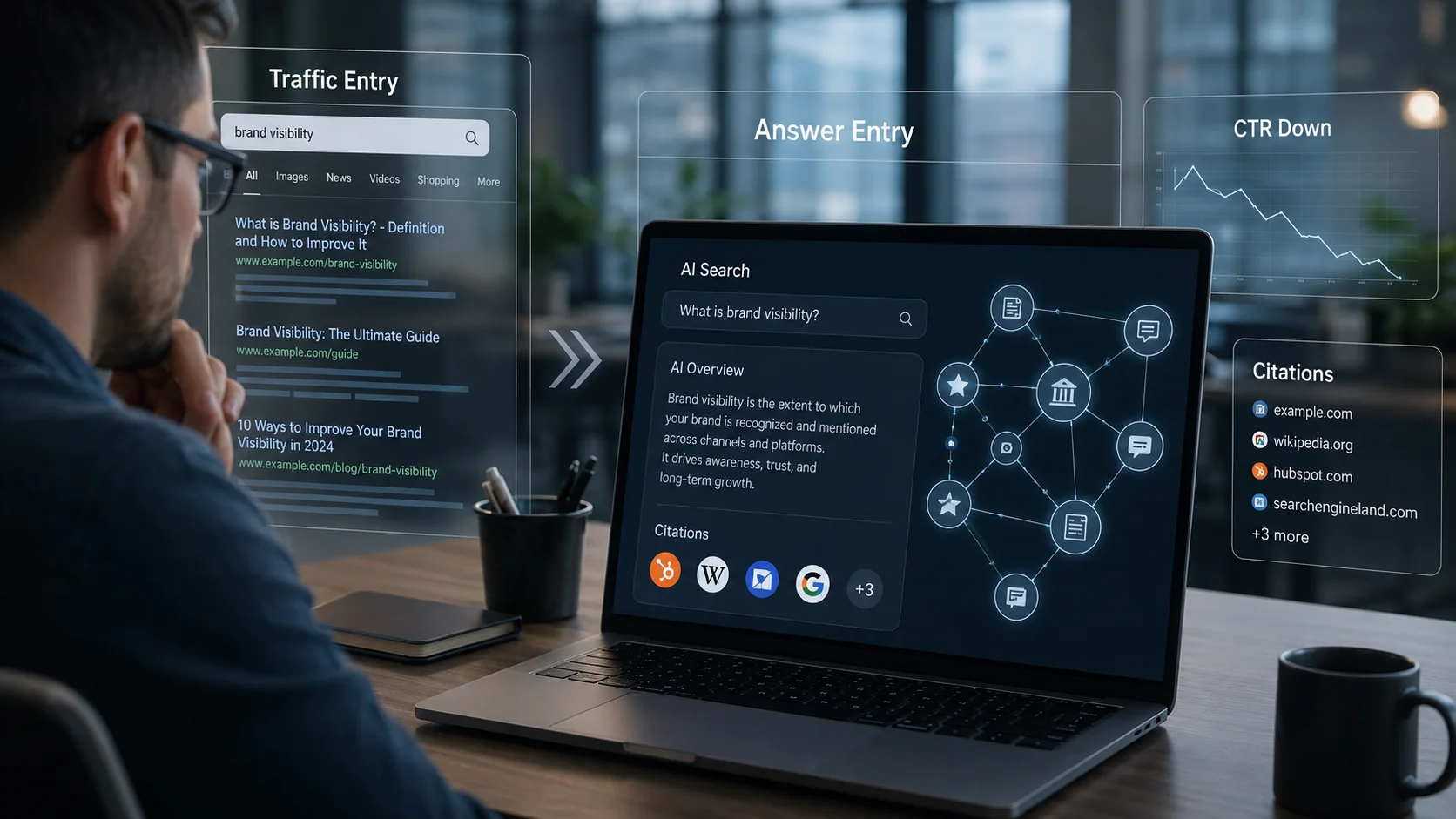
This report, based on the Stanford AI Index 2026 report, Arc Intermedia 2026 CTR case studies, and Omnibound AI Search Statistics, provides a comprehensive analysis of structural changes in brand visibility in the AI search era, covering a comparative observation of the overseas and Chinese GEO ecosystems.
Research Background
Over the past decade, brand digital exposure has primarily relied on ranking mechanisms in search engine results pages. However, as generative AI search becomes a key way for users to access information, the traditional path of "clicking to enter a website" is being replaced by the interaction of "directly obtaining answers." We observe that this change not only impacts traffic structures but is also reshaping how brand information is distributed across different platforms. This report analyzes the systemic impact of AI search on brand visibility from four dimensions: capability evolution, traffic structure, citation mechanisms, and platform ecosystems.
Finding 1: Continuous AI Capability Breakthroughs Shift Information Distribution Agents
According to the Stanford AI Index 2026, in 2025, the industry produced over 90% of frontier models. On benchmarks like SWE-bench Verified, AI performance improved from approximately 60% to near 100%, with multiple domains approaching or reaching human baselines. This means AI is no longer just an information processing tool but is gradually becoming an agent for information generation and distribution. As model capabilities increase, the information gateway shifts from "search engine indexing" to "direct model generation," laying the foundation for subsequent structural changes in GEO.
Finding 2: The Gap Between Chinese and US Large Language Models Narrows, Forming a Global Multipolar Landscape
As of March 2026, the AI Index 2026 shows that the performance gap between leading US models and leading Chinese models has narrowed to approximately 2.7%. Meanwhile, models like DeepSeek-R1 matched international top-tier levels on certain tasks in early 2025. This convergence of technological disparity makes the AI search ecosystem evolve from single-platform dominance to a multi-model coexistence, causing brand visibility across different AI engines to show characteristics of fragmentation.
Finding 3: The Zero-Click Effect is Restructuring Traffic Structures
Arc Intermedia 2026 CTR case studies show that when Google AI Overview appears, organic search click-through rates (CTR) drop by an average of 34.5%, and up to 64% in some scenarios. Meanwhile, Omnibound data indicates that referral traffic driven by ChatGPT is approximately 95%–96% lower than traditional search. This indicates that traffic has not disappeared, but has shifted from "click-through visits" to "direct answer consumption." User behavior is transitioning from "selecting a link" to "accepting generated results," significantly restructuring the traffic distribution capabilities of search engines.
| Dimension | Traditional Search | AI Search |
|---|---|---|
| User Behavior | Click link to enter website | Directly obtain generated answer |
| CTR Change | Stable baseline | Average 34.5% decrease |
| Traffic Structure | Website-driven | Answer system-driven |
| Conversion Path | Multiple redirect chains | Short chain or zero-click |
Finding 4: AI Visibility Shifts to Third-Party Content Network Structures
Omnibound data shows that approximately 85% of brand mentions in AI search originate from third-party pages, including media reports, review sites, and community content, rather than the brand's own website. Furthermore, about 44.2% of AI-cited content comes from the first 30% of an article, and approximately 59.6% of cited pages do not appear in the top 20 traditional search results. This phenomenon indicates that AI citation mechanisms are weakening the weight of traditional SEO rankings and strengthening the importance of content structure and external distribution.
| Citation Dimension | Data Insight | Implication |
|---|---|---|
| Third-party Source Share | 85% | External content becomes primary information source |
| Content Position | 44.2% from top 30% | Structure determines visibility |
| Search Rank Correlation | 59.6% not in top 20 | SEO ranking influence decreases |
| Citation Mechanism | Cross-domain crawling | Cross-platform content redistribution |
Trend Observations / Industry Implications
AI search is evolving from an information retrieval tool into an information distribution layer. The core logic of brand visibility is shifting from "ranking optimization" to "citation optimization." In the overseas ecosystem, ChatGPT, Gemini, and Perplexity form a multi-entry structure. In the Chinese ecosystem, Doubao, Kimi, Ernie Bot, and Tongyi Qianwen collectively create a multi-platform parallel landscape. The single-point optimization path of SEO is being replaced by the multi-node content network structure of GEO. Brands need to manage content consistency across their official websites, media outlets, communities, and Q&A platforms simultaneously.
Research Implications
Based on current trends, brands need to redefine "visibility" metrics. Instead of solely focusing on search rankings, they should focus on whether they are included in AI answer citation systems. Furthermore, content production requires stronger structural expressiveness to ensure key information appears early in the content. Additionally, the ability to distribute content across platforms will become a critical variable influencing AI visibility.
Related Questions
Is AI search replacing traditional SEO?
AI search is not entirely replacing SEO, but it is diminishing its role as the sole traffic gateway, shifting more towards "citation-layer optimization."
Why is a Google ranking no longer equal to visibility?
Because a significant amount of content in AI citation sources does not come from pages ranked in the top 20; there is a structural disconnect between ranking and citation.
How can brands enter AI citation sources?
The key lies in content structure optimization and exposure on third-party platforms, rather than just optimizing one's own website.
Why is third-party content more important?
AI tends to crawl multi-source information to enhance credibility, thus increasing the weight of external platform content.
What is the core difference between GEO and SEO?
SEO optimizes for "ranking," while GEO optimizes for "being cited by AI."
Is AI traffic higher quality than traditional traffic?
AI traffic typically has more explicit intent, but the overall traffic volume is still in a phase of structural restructuring.
As AI search restructures the path of information, brands need to reassess their actual exposure in generative engines and identify optimization opportunities within their content structure.