Last week, I was reading a September AI platform research report from QuestMobile.
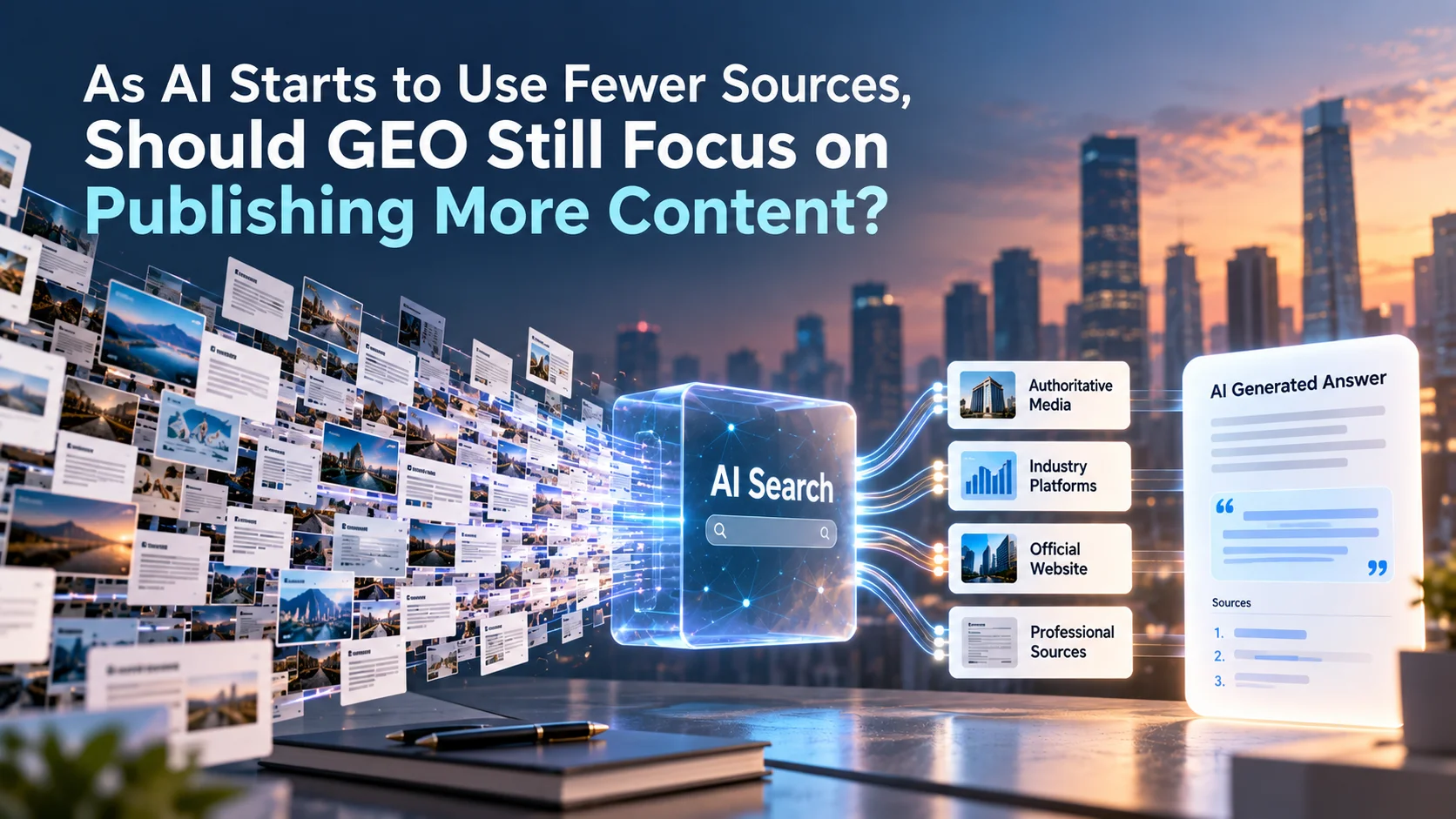
One set of data made me pause: In July 2026, the average number of sources cited per query on Doubao, Qwen, and Yuanbao decreased by 7.5%, 1.5%, and 3.6% respectively month-over-month. At the same time, the report observed that the TOP10 website content citation rate on these platforms had increased.
My first reaction wasn't "publish less content going forward," nor was it "AI now only trusts top-tier websites." What I thought of instead was a recurring pattern in the search industry over the past two decades: as information supply becomes increasingly abundant, the real problem platforms need to solve gradually shifts from "where to find information" to "whom to choose from all this information."
So what this data really warrants CMOs and GEO leads to ask is: as more and more information becomes available for AI to draw upon on the internet, why have some AI platforms actually started reducing the number of sources they call per query?
Does AI reducing citation sources mean fewer opportunities for GEO?
That concern is reasonable. But I think it's only half right.
If you only look at the data from Doubao, Qwen, and Yuanbao, it's easy to conclude that AI search is consolidating sources and that smaller brands will have increasingly less room.
But the same QuestMobile report also shows that citation strategies are diverging across platforms. In July 2026, Doubao and Qwen tightened multi-source citations, and Yuanbao also showed contraction, but platforms like Kimi and Wenxin still showed expansion.
So I wouldn't frame it as "Chinese AI search has fully entered a phase of source consolidation." A more accurate statement at this point is: Doubao, Qwen, and Yuanbao have shown signals of source concentration worth continued observation, and the degree of this change varies across platforms and scenarios.
Fewer sources doesn't mean fewer opportunities.
What's really changing is the filtering method for entering answers.
In the past, when doing GEO audits, we would easily start with one metric: whether the brand was mentioned, whether it was cited. Going forward, we should ask one more question——is this citation a one-off occurrence, or does it appear consistently across a set of related questions? Is AI drawing from the official website, or from media, vertical platforms, communities? Is the source structure different across platforms?
The GEO question is shifting from "did AI find my content" to "when AI finds many candidate pieces of content, why does it choose me."
From Yahoo and Google to AI, why does search always move from "coverage" to "filtering"?
I started doing SEO at a Hong Kong digital marketing company in 2005. Back then, working with Yahoo and early search optimization, the first thing businesses cared about was very straightforward: can my webpage get into the search engine?
As webpages multiplied, the question changed in the Google era.
Businesses were no longer satisfied with just "being indexed." People started researching: why do some indexed pages rank higher and others lower? Search competition gradually shifted from "can I get into the index" to "who deserves to appear at the top."
Now we've reached the third generation——AI search.
It's not simply a repeat of Google. Traditional search typically gives users a set of links for them to judge and click on; AI search may first retrieve multiple sources, then select, combine, and restate information, and finally generate an answer directly.
This means a new scarce resource is emerging.
It's not about whether the internet can host another new article, but about which sources can repeatedly enter the information set AI uses when generating answers, even when faced with a large volume of candidate information.
QuestMobile's previous research on scenarios like automotive, travel, and insurance also reveals this difference: different questions activate different source structures, and top-tier platforms have advantages, but that doesn't mean all content is monopolized by a few websites.
So I prefer to understand the change in the AI era as: businesses, beyond competing for content entry points, must also start competing for "the qualification to be repeatedly selected as a source."
Why might GEO's unit of competition shift from "content volume" to "source qualification"?
The "source qualification" I'm referring to here is not a certificate that AI platforms issue to businesses, nor is it a fixed set of rules where meeting a few conditions guarantees citation.
I use this term to describe a competitive state that is becoming increasingly important: when multiple sources all have relevant content, who can be more consistently called upon by AI.
| Questions businesses care about | Content coverage phase | Source competition phase |
|---|---|---|
| Core question | Can AI discover me | Why does AI choose me |
| Content goal | Expand coverage of relevant topics | Build continuously verifiable information assets |
| Observation metrics | Mentions, citations, Prompt coverage | Source stability, repeated calls, cross-question performance |
| Content judgment | Is there relevant content | Is the information clear, consistent, evidence-backed |
| GEO tasks | Increase retrievable information | Determine which content is forming credible sources |
These two states are not mutually exclusive.
Content coverage is still the foundation. If a brand has no sufficient information assets for a particular user question, it's hard to discuss AI search visibility beyond that.
But as candidate information becomes richer, mechanically adding more similar pages may yield diminishing marginal value. What businesses really need to distinguish is two things: how much content we've published, and which of that content is consistently entering AI answers.
This is also why GEO data analysis shouldn't just count "how many articles were published." Content planning, platform distribution, and performance monitoring should all ultimately return to the same question: which brand information has truly formed assets that can be continuously retrieved, verified, and called upon.
"So should we just publish content on top-tier platforms from now on?"
A few days ago, I was discussing this data with a marketing lead. After reading it, he asked me: "So isn't it simple? Since sources are becoming more concentrated, we just find these platforms and publish there, right?"
I didn't answer right away.
He paused for half a second, then added: "At least it's faster than slowly building content ourselves, right?"
I said: "If AI only recognized domains, this would indeed be much simpler. But what's more worth observing now is why, within the same platform, some content gets called upon and some doesn't."
This is where I'm very concerned about the market misreading "source concentration."
A higher content citation rate for TOP10 websites doesn't mean businesses automatically gain so-called "source qualification" just by purchasing placements on top-tier media. A single domain can host thousands of pieces of content, and their topic relevance, factual density, update frequency, and information structure all differ.
Moreover, source structures for different questions also change. QuestMobile's observations on automotive, travel, and insurance scenarios show that even on the same AI platform, different user intents may correspond to different source combinations.
So I wouldn't recommend simplifying GEO into media buying.
Media can be part of a brand's knowledge assets, and so can the official website. Industry vertical platforms, communities, and other third-party sources can also play a role. What really needs to be managed is: what information about your brand actually exists in these places, whether that information is consistent, and whether it can answer the questions users will actually ask.
If not just content volume, what should CMOs look at?
I would suggest CMOs and marketing teams first take stock of the brand's "callable assets."
This inventory doesn't need to be very complex at the start. Answer three questions first:
- In which real user questions does AI already call upon the brand?
- Does the called-upon information come from the official website, media, vertical platforms, communities, or other third-party sources?
- Is the same core fact expressed consistently, clearly, and verifiably across different sources?
Content gets a brand into AI's candidate pool; credibility determines whether a brand can repeatedly become part of the answer.
The "credibility" here is also not some platform score we can directly read. What I focus on more is its ultimate manifested result: whether a brand can consistently appear across a set of related Prompts, which sources it depends on to appear, whether those sources are stable, and whether there are obvious differences across AI platforms.
GEO is not just a content production issue.
It's increasingly a brand knowledge asset issue.
When my team and I proposed AIPO, we broke GEO work into interconnected stages——audit reports, data analysis, content planning, platform distribution, and performance monitoring——precisely for this reason.
For businesses at the MOFU stage, I usually don't recommend starting by deciding "let's produce 50 more pieces of content next month." A more reasonable sequence is to first run a GEO audit: see which user questions the brand appears in, on which platforms it appears, what sources support it, and which important questions it's consistently absent from.
Get the data first, then decide where to invest content resources.
What does continued GEO source concentration mean for brands?
If the source concentration trend currently shown by Doubao, Qwen, and Yuanbao continues to develop, I think there are three directions worth businesses continuously observing, rather than rushing to treat them as fixed platform rules.
- Big brands aren't necessarily naturally dominant in all questions. Brand awareness is one thing; whether there's clear, verifiable, callable information for a specific question is another.
- Vertical sources may still have room. In QuestMobile's observations on insurance and wealth management scenarios, vertical service platforms, professional information sources, and brand institutions are all different types of needs. This shows that "top-tier concentration" doesn't equal "only comprehensive mega-sites remain.
- Different AI platforms won't share an entirely identical source structure. Doubao, Kimi, Wenxin Yiyan, Tongyi Qianwen, Quark AI, and Yuanbao have different product positioning, content ecosystems, and user scenarios, making it hard for businesses to rely on a so-called "universal Chinese GEO source list" to solve problems across all platforms.
This also means GEO is increasingly difficult to complete through one-off content building.
The source structure called upon today may change in a few months; within the same platform, different Prompts like product recommendations, industry knowledge, and consumer decisions may also show different citation structures.
The significance of continuous monitoring lies here: not to chase every single AI answer change daily, but to see whether the brand's information assets are forming a stable trend.
Facing the source concentration trend, what can different teams do right now?
If you're a CMO or marketing director, I suggest not asking "how many pieces should we publish this year" first. Break down a few core business scenarios into real user questions, then look at the brand's source structure across these questions. What you need to know isn't how large your content inventory is, but which assets have actually entered AI's information environment.
If you're a GEO or SEO lead, I suggest adding a few observation dimensions beyond brand mentions: whom AI cites, which sources appear repeatedly, which core questions are consistently absent, and what differences exist across Doubao, Kimi, Wenxin Yiyan, Tongyi Qianwen, Quark AI, and Yuanbao.
If you're a brand lead, I suggest checking key sources like the official website, media reports, and industry vertical platforms. If important facts like product parameters, brand positioning, service scope, and core capabilities differ across channels, having more content makes it harder to form clear information assets.
This is also why AIPO's five rings——"GEO audit report → data analysis → content strategy & distribution → performance monitoring"——need to be viewed continuously. An audit is not the endpoint; its purpose is to tell the team where to invest content resources next.
First see clearly why AI finds you, then decide what to write next.
If you're developing a China GEO strategy and aren't sure whether to keep expanding content volume or first adjust your existing source structure, you can start with a GEO Audit to break down brand performance on Doubao, Kimi, Wenxin Yiyan, Tongyi Qianwen, Quark AI, and Yuanbao by question and source. Making decisions based on data first is more informative than simply chasing publication volume.
From competing for indexing to competing for sources, what should businesses build in advance?
Looking back over these twenty years, the search question has actually been constantly changing.
In the 2000s, we asked: how do I get search engines to index me?
Later we asked: why does Google rank this page higher?
Now in the AI search phase, I think the question is continuing to move forward: why does AI, faced with so much usable information, ultimately choose this source?
The July 2026 QuestMobile data is just a trend signal. It's not enough to prove that all Chinese AI platforms will move toward the same source structure, let alone judge that only a few top-tier websites will have opportunities in the future. The report itself already shows that source strategies differ across platforms.
But this signal is worth CMOs thinking about in advance.
What truly has long-term value isn't guessing what a platform will adjust next, but building a set of brand information assets that can still be understood, verified, and called upon across platforms.
Related Questions
What does GEO source mean?
A GEO source can be understood as the information sources that AI retrieves, references, or cites when generating answers, including official websites, media, vertical platforms, communities, etc. For businesses, the key isn't just "having content," but also observing whether that content can consistently become usable information for AI in related questions.
Does fewer AI search citation sources mean it's harder for small and medium brands to do GEO?
You can't directly judge that. QuestMobile's data reflects source narrowing on some platforms during a specific period, and changes vary across platforms; what small and medium brands should focus on more is whether they can build clear, professional, verifiable information assets in niche user questions.
Is more GEO content always better?
It's not a simple quantity relationship. Sufficient topic coverage is still important, but if a large amount of content is repetitive, lacks factual basis, or brand information contradicts itself, increasing publication volume doesn't equal increasing the chance of being called upon by AI.
Which websites does AI prefer to cite?
There is currently no fixed website list applicable to all AI platforms, industries, and questions. Existing research already shows that different platforms and user intents correspond to different source structures, so rather than seeking a "universal source," it's more important to continuously observe actual citation results in your own industry.
How should businesses judge whether they are a trusted source for AI?
You can observe citation frequency in core user questions, source types, repeated appearances, and differences across platforms. This data reflects trend performance and doesn't mean the AI platform has granted the business some fixed "trust certification."
Which AI platforms should Chinese businesses monitor for GEO?
You should choose based on your target users' actual usage scenarios. In the Chinese market, you can observe platforms like Doubao, Kimi, Wenxin Yiyan, Tongyi Qianwen, Quark AI, and Yuanbao, then compare brand appearances, citation sources, and answer performance across business-relevant Prompts, rather than looking at just one platform.