

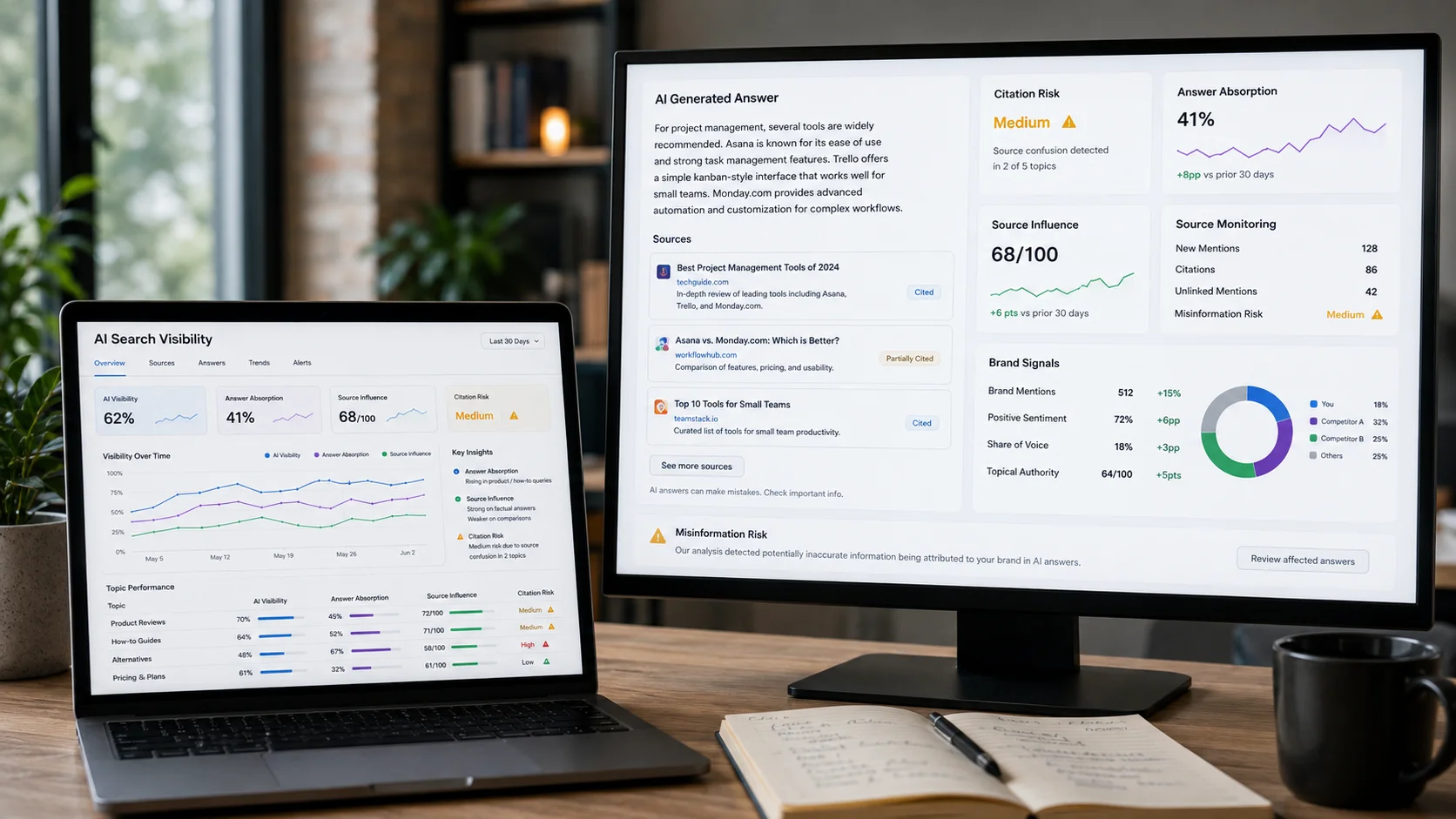
This report is compiled based on the user-provided "GEO Research Report - Report Outline" and 4 public research documents, including the 2024 KDD paper "GEO: Generative Engine Optimization," "From Citation Selection to Citation Absorption" (April 29, 2026), "Structural Feature Engineering for GEO" (2026), and "Diagnosing and Repairing Citation Failures in GEO" (March 11, 2026). The question I am focusing on is: When AI responses begin to cite, paraphrase, and absorb web content, how should a GEO monitoring system identify the risk of citation poisoning?
Research Background
AI search has changed how brand visibility is assessed. In the past, companies could more easily judge search performance through rankings, click-through rates, indexed pages, and keyword coverage. Now, ChatGPT, Gemini, Google AI Mode, Perplexity, Google AI Overview, and in China, Doubao, Kimi, ERNIE Bot, Tongyi Qianwen, Kuaike AI, and Yuanbao, all reorganize sources, summaries, and entity relationships in their responses. The risk of citation poisoning has therefore become more complex: the issue is not just whether the brand appears in the response, but whose sources the AI uses, which content it absorbs, whether it misclassifies the brand, or whether it mixes competitor descriptions into the brand's answer.
Based on public research, GEO has moved from "is content cited?" to "how does content influence the answer?" A list of citations only indicates that a page entered the candidate pool, not that the page's information actually shaped the response. Therefore, a GEO monitoring system needs to place source, position, influence, structure, semantic shift, and reasons for citation failure within a single observation framework.
Citation Poisoning Risk: It's Not Just About "Being Cited," But Whether Content is Deeply Absorbed by AI
Being cited and being absorbed are two different levels of signal. Being cited usually means a web page enters the source list of an AI response. Being absorbed means the page's content actually participates in answer generation and influences the definitions, judgments, comparisons, or recommendation paths in the response. According to the April 29, 2026 study "From Citation Selection to Citation Absorption," based on 602 prompts, 21,143 valid search-level citations, and 23,745 citation-level feature records, it distinguishes between the citation selection and citation absorption stages. In the study, ChatGPT had 3,323 fetch-ok citations with an average influence of 0.2713; Google had 6,385 / 0.0584; and Perplexity had 8,443 / 0.0646.
This data indicates that citation breadth and answer influence are not always synchronized. In the study sample, Perplexity and Google had higher citation counts, but the average influence of individual sources was lower; ChatGPT had fewer citations, but the average impact of a single source on the answer was higher. For businesses, if they only look at whether their official website was cited, they may underestimate the risk. The official website might appear in the source list, but the main judgment in the AI answer could come from third-party pages, outdated information, or competitor sources.
Overseas, a GEO monitoring system can place citation count, citation position, and influence score for ChatGPT, Gemini, Google AI Mode, Perplexity, and Google AI Overview on the same trend chart for observation. In China, it is necessary to observe whether Doubao, Kimi, ERNIE Bot, Tongyi Qianwen, Kuaike AI, and Yuanbao cite brand information, paraphrase official website descriptions, or make incorrect attributions. The focus of citation poisoning monitoring is not a one-time snapshot, but the continuous change in sources, paragraphs, phrasing, and entity relationships under the same set of prompts.
| Monitoring Dimension | Research Data | Meaning | Risk Signal | Overseas & China Observation Points |
|---|---|---|---|---|
| Citation Selection | 21,143 valid search-level citations | Whether the page enters the AI source list | Sources suddenly shift from official site to low-quality third-party pages | Overseas: monitor citation count & position; China: check if brand source path is stable |
| Citation Absorption | 23,745 citation-level feature records | Whether page content affects answer generation | Official site listed, but answer content primarily from other pages | Overseas: monitor influence score; China: check if brand definition is incorrectly paraphrased |
| Platform Differences | ChatGPT 3,323 / 0.2713; Google 6,385 / 0.0584; Perplexity 8,443 / 0.0646 | Different engines vary in citation breadth and absorption depth | Same prompt yields opposite conclusions on different platforms | Overseas: compare across platforms; China: avoid using a single platform's conclusion to cover all engines |
Traditional SEO Surface-Level Optimization Signals Have Limited Explanatory Power in Generative Engine Citation Scenarios
Keyword frequency cannot be directly equated with AI citation quality. According to the 2024 KDD paper "GEO: Generative Engine Optimization," the GEO-bench includes 10K queries, 25 domains, and 9 query types, of which 80% are informational, 10% transactional, and 10% navigational. The study shows that methods like citing sources, adding citations, and adding statistics led to a 30%-40% relative improvement in the Position-Adjusted Word Count metric and a 15%-30% relative improvement in the Subjective Impression metric; however, keyword stuffing performed 10% worse than the baseline in Perplexity.ai tests.
This means generative engines don't simply read word frequency; they care more about whether content can be integrated into the answer structure. For citation poisoning monitoring, risks can be divided into three categories. First, Lack of Evidence: the page has brand slogans but lacks definitions, data, cases, steps, or verifiable explanations. Second, Weak Source Connection: there is no clear relationship between the official website and product categories, making AI more likely to cite directory pages, encyclopedia pages, or third-party review pages. Third, Content Miscompression: AI compresses the brand's differentiating descriptions into generic terms, causing the answer to retain only industry tags without the brand's own boundaries.
Overseas, Perplexity and Google AI Overview can be used to observe whether cited sources favor pages with data, citations, definitions, and steps. In China, the focus should be on whether AI responses compress brand descriptions into generic terms, mix in competitor descriptions, or cite non-official website content. For businesses, a GEO monitoring system cannot just record "whether a keyword appears"; it must also record the differences between page evidence density, source relationships, citation statements, and answer summaries.
Page Structure Itself Has Become a Signal That GEO Monitoring Systems Need to Quantify
Page structure is influencing the probability that content is extracted and cited by AI. According to the 2026 study "Structural Feature Engineering for GEO," GEO-SFE increased the overall citation rate from 45.0% to 52.8% across six types of generative engine architectures, a +17.3% improvement; subjective perception quality increased by an average of +18.5% overall, with influence up +32.0% and click probability up +31.4%; ablation analysis showed the contributions of macro-structure, meso-structure, and micro-structure were 44.9%, 39.7%, and 15.4%, respectively.
I observe that this type of research pushes GEO from "semantic rewriting" to "structure monitoring." Heading hierarchies, paragraph chunking, list density, and the use of tables and steps all affect whether AI can stably extract information. If pages contain long, dense blocks of text, mismatched headings and content, missing product definitions, or confusing entity aliases, AI might only absorb partial content or misclassify the page into a broader category, even if it is crawled.
Overseas, different generative engines may have varying preferences for long text, lists, and evidence blocks, so structural responses for ChatGPT, Gemini, Google AI Mode, Perplexity, and Google AI Overview need to be monitored separately. In China, monitoring needs to incorporate variables like Chinese semantic chunking, entity aliases, mixed Chinese/English brand names, and product category attribution. A GEO monitoring system should not just check if the brand appears, but also if the "extractable information units" are stable.
Citation Failures Need Diagnosis Before Repair; General Rewriting May Mask the True Risk
Citation failure doesn't necessarily mean the entire page content is of poor quality; often it is a local signal breakdown. According to the March 11, 2026 study "Diagnosing and Repairing Citation Failures in GEO," which proposes AgentGEO, experiments showed that AgentGEO achieved a relative improvement in citation rate of over 40% while modifying only about 5% of the content, compared to a baseline average of about 25%. The study also established a citation failure classification based on 949 contrastive pairs, covering issues like technical completeness, semantic alignment, content quality, and systematic exclusion.
This data has direct implications for citation poisoning monitoring. When businesses encounter an incorrect AI answer, they shouldn't just rewrite the entire page. A more advisable approach is to first determine if the risk is due to crawling failure, semantic shift, insufficient content evidence, or replacement by a competitor source. Crawling failure might stem from HTML parsing issues, page noise, or invisible content; semantic shift might come from mismatches between titles, paragraphs, and user intent; insufficient content evidence might come from incomplete definitions, statistics, steps, or comparison dimensions; competitor source replacement might occur because other sources for the same question are more easily extractable by AI.
Overseas, citation mechanisms differ significantly between platforms, so conclusions from one set of prompts cannot be applied to all engines. In China, public research still lacks sufficient platform-level, industry-level, and time-series data. Therefore, the report should honestly retain the judgment that "public benchmark data is insufficient" and not fabricate platform-level figures. For a GEO monitoring system, diagnostic classification is more important than general rewriting, because misclassification could lead a business to fix the page's surface without addressing the true citation risk.
| Risk Type | Research Basis | Typical Manifestation | Quantifiable Metric | Monitoring Action |
|---|---|---|---|---|
| Crawling Failure | AgentGEO citation failure classification covers technical completeness issues | Page exists but doesn't enter candidate sources | Crawl status, citation occurrence rate, page readable area ratio | Check HTML parsing, text visibility, and interfering modules |
| Semantic Shift | 949 contrastive pairs used to identify citation failure patterns | AI misclassifies brand into wrong category or scenario | Entity match rate, category consistency rate, prompt-page semantic distance | Compare official website definitions, AI summaries, and third-party source phrasing |
| Insufficient Evidence | GEO research shows citing sources, citations, and statistics bring 30%-40% relative PAWC improvement | Brand mentioned, but answer lacks evidence from official website | Data density, citation density, number of steps and tables | Add verifiable definitions, comparisons, data, and process explanations |
| Competitor Source Replacement | AgentGEO relative improvement >40%, but only modified ~5% of content | Competitor or directory page becomes the main source | Source share, influence score, answer source body | Identify replaced problem paragraphs, perform targeted repair and continuous monitoring |
Trend Observations / Industry Implications
The focus of GEO monitoring is shifting from "Did AI mention me?" to "Whose information did AI use to explain me?" This is also the main difference between citation poisoning risk and traditional search risk. Traditional SEO focuses more on whether pages can be retrieved, if they rank high, and if users click. AI search goes further by deconstructing, compressing, and combining source content to form new brand descriptions in the answer.
Based on public research, overseas GEO has already developed reusable metrics, including citation count, citation position, influence score, Position-Adjusted Word Count, Subjective Impression, structural hierarchy contributions, and citation failure classifications. These metrics allow GEO monitoring systems to move from screenshot records to time-series analysis. Businesses can observe changes in sources, absorption, and entity relationships for the same set of prompts over different periods, instead of just saving a single AI response.
Chinese GEO is still in a data supplementation phase. The response mechanisms, citation presentation methods, and source visibility of Doubao, Kimi, ERNIE Bot, Tongyi Qianwen, Kuaike AI, and Yuanbao are not entirely consistent, and public benchmark data remains limited. Therefore, monitoring in China should more carefully record brand categorization, product descriptions, entity aliases, Chinese semantic chunks, and source paths. The report should not directly transfer platform figures from overseas papers to Chinese engines, but should use public research as a metric framework and gradually calibrate with local monitoring data.
Overall, citation poisoning is not a single error, but the result of the interaction of three layers: source selection, content extraction, and answer synthesis. When a business sees an incorrect response, it needs to ask: Did the error come from a low-quality source being selected, the official website content not being absorbed, or the AI mixing up multiple entity relationships when synthesizing the answer? The value of a GEO monitoring system will also expand from "finding out if something appeared" to "explaining why it appeared that way."
Research Implications
When implementing GEO monitoring, businesses should first establish a set of stable prompts covering brand name, product category, purchase scenarios, competitor comparisons, problem-solving, and industry definitions. Each round of monitoring should record whether the brand appears, if the sources are credible, if the answer absorbs official website information, if incorrect entities are mixed in, and if the brand is replaced by competitor content. Overseas, the focus should be on citation differences among ChatGPT, Gemini, Google AI Mode, Perplexity, and Google AI Overview. In China, the focus should be on brand categorization, product descriptions, and source paths within Doubao, Kimi, ERNIE Bot, Tongyi Qianwen, Kuaike AI, and Yuanbao.
After monitoring, decide on the repair sequence. If the problem is crawling failure, address page readability and structure first. If the problem is semantic shift, prioritize correcting titles, definitions, categories, and entity relationships. If the problem is insufficient evidence, supplement data, citations, steps, and comparisons. If the problem is competitor source replacement, analyze the specific information units absorbed from the competing page, rather than simply adding keywords. In this way, GEO monitoring will not remain at the level of superficial visibility but will enter the realm of risk diagnosis and continuous iteration.
If your business has observed brand confusion, misclassification, or low-quality citations in AI responses, start with a visibility and citation diagnosis using aipogeo. Check your real visibility across 6 major AI engines in 1 minute, then decide if you need custom monitoring and fixes.
Related Questions
Can a GEO monitoring system detect citation poisoning risks in AI responses?
Yes, it can detect some observable risks such as source shifts, whether official website information is absorbed, whether the brand is misclassified, and whether competitor descriptions are mixed into the answer. Deeper judgment requires combining multiple rounds of prompts, different platforms, and time-series data.
If an AI response cites the official website, does that mean the brand's information is safe?
Not necessarily. The official website appearing in the citation list only means the page was selected. It's also necessary to check whether the AI response actually absorbed the official website content and whether the answer's main body is still dominated by third-party sources.
What are the differences in citation risks among ChatGPT, Perplexity, and Google AI Overview?
Different platforms have different citation breadths, source presentations, and content absorption methods. According to the sample in "From Citation Selection to Citation Absorption," ChatGPT's average influence is higher than Google's and Perplexity's, but it has fewer citations. Therefore, monitoring needs to be recorded per platform.
Why is keyword stuffing not suitable as a GEO citation optimization method?
According to the 2024 KDD paper "GEO: Generative Engine Optimization," keyword stuffing performed 10% worse than the baseline in Perplexity.ai tests. Generative engines care more about whether content is explainable, citable, and absorbable, rather than simple word frequency.
What signals should Chinese AI engines focus on for citation poisoning monitoring?
Focus should be on brand categorization, product descriptions, source paths, entity aliases, and mixed Chinese/English brand names within Doubao, Kimi, ERNIE Bot, Tongyi Qianwen, Kuaike AI, and Yuanbao. Current public benchmark data is still limited, so platform-level figures should not be fabricated.
How can a business determine whether an AI citation issue is a content problem or a platform preference problem?
Use the same set of prompts to compare multiple platforms and observe the citation, absorption, and paraphrasing of the same page in different responses. If multiple platforms fail to absorb the official website information, content structure and evidence density need to be checked first. If only a single platform shows anomalies, it might be related to that platform's source selection or answer synthesis methods.