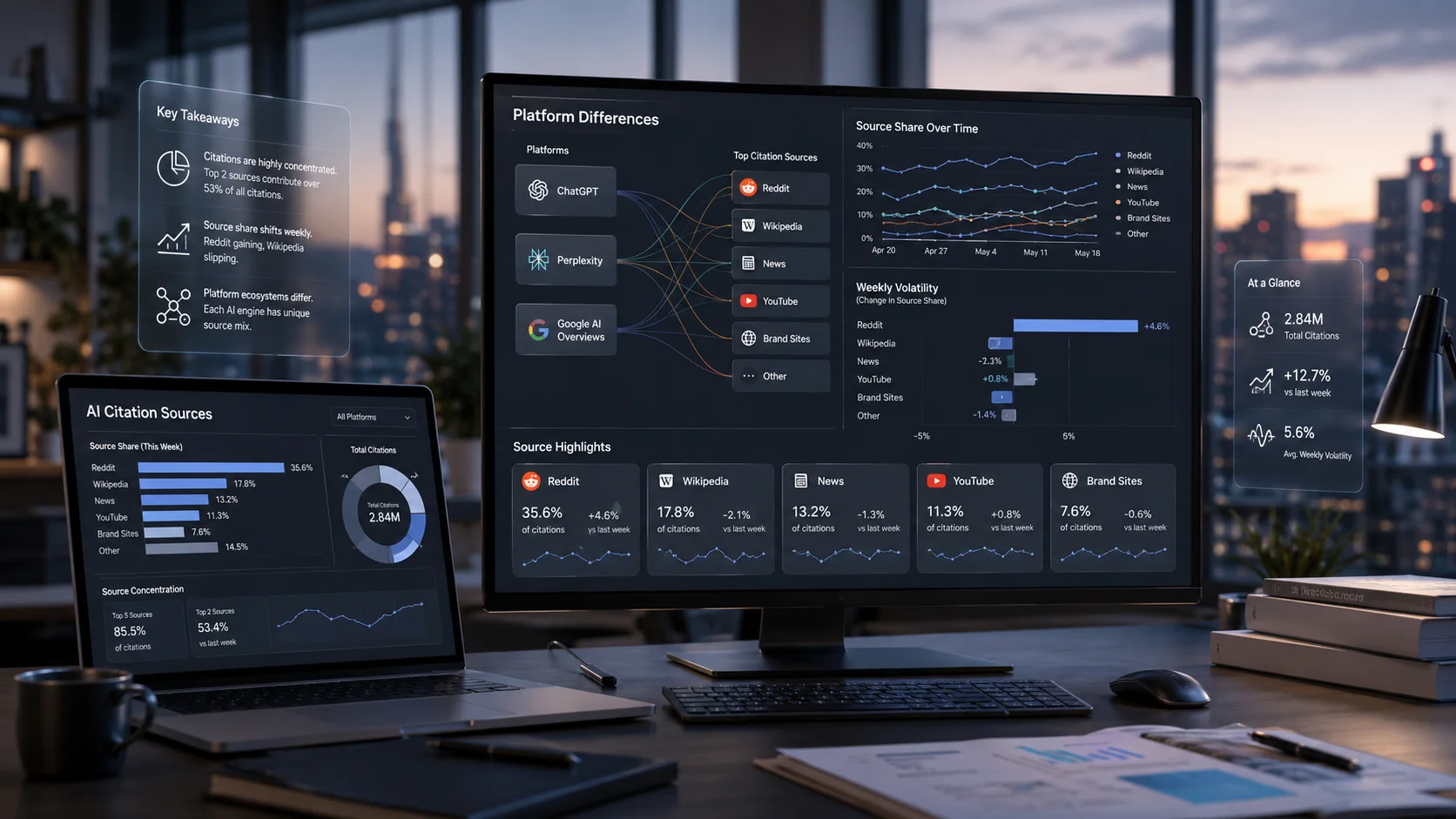
From August 2024 to April 2026, 5W's aggregated cross-platform public research covered over 680 million AI citation records. After organizing this data, we observed that the source systems of overseas AI engines are simultaneously undergoing three types of changes: citations are concentrating among a few top-tier domains, different platforms are forming different source combinations, and the citation share of a single website can change noticeably within weeks.
This report primarily draws on the "AI Platform Citation Source Index 2026" and "The State of AI Citations 2026," both published by 5W in May 2026, combined with platform monitoring results from OtterlyAI and Tinuiti. It should be noted that the 5W data is a comprehensive cross-study index, not a single test conducted under identical timing, prompts, and experimental conditions. Sampling platforms, regions, question categories, and statistical methods also vary across different reports. Therefore, the data below is intended for observing trends, not for inferring long-term stable platform rules.
Research Background
In traditional search, research typically revolves around page rankings, click-through rates, and organic traffic. In the era of AI-generated answers, the questions have shifted: when users ask ChatGPT, Gemini, Google AI Overviews, or Perplexity to explain, compare, or recommend certain products, which web pages do the answers draw upon, is the brand mentioned, and can users see clickable source links?
Here, "AI citation" specifically refers to observable web sources within answers. It does not represent the complete composition of model training data, nor is it directly equivalent to search engine result page rankings. The Reuters Institute's "Digital News Report 2025" shows that the proportion of Americans getting news via social media and video networks has reached 54%, surpassing television (50%) and news websites or apps (48%) for the first time. The fragmentation of information consumption entry points provides a broader content base for community, video, and creator content to enter AI source systems. However, this does not mean a specific source type will consistently maintain a fixed share.
Overseas AI Citations Concentrate Among Top-Tier Domains, But Top Sources Aren't Limited to News Media
Conclusion first: Overseas AI citations do demonstrate high concentration, but the top sources include community discussions, encyclopedia references, news editorial, video platforms, professional materials, and business review sites.
According to the composite index published by 5W in May 2026, the top 15 domains account for 68% of the cross-study composite citation share. Reddit is reported as a high-frequency source across major AI engines, with a composite citation frequency of approximately 40%. Wikipedia's estimated share among ChatGPT's top ten sources ranges from 26% to 48%. News media accounts for approximately 27% of all citations, rising to 49% for time-sensitive queries. These figures are aggregated from various public studies and do not represent identical distributions across every platform, industry, and question type.
This data shows that "top-tier concentration" doesn't mean all AI engines rely on the same set of sources. Reddit provides extensive experience, comparisons, and discussions centered on specific questions; Wikipedia organizes entities, concepts, and references within relatively stable page structures; news media supplements recent events and traceable reporting; YouTube hosts demonstrations, product experiences, and visual explanations. Different content formats address different information needs.
Therefore, domain share in AI citations and traditional search rankings should be understood separately. Search rankings reflect a page's position in a results list, while AI citations reflect which sources are actually displayed or used during answer generation. A page not ranking at the top of search results doesn't mean it won't be used by AI answers; conversely, pages performing well in search won't necessarily receive citations across all AI engines.
Different AI Engines Form Different Source Combinations; Cross-Platform Averages Are Insufficient for Describing Brand Visibility
Differences between platforms extend beyond citation volume to include which types of websites are cited, whether brands are directly mentioned, and whether users are shown clickable links.
Research published by OtterlyAI in early 2026 analyzed over 1 million website citations. In their sample, brand domain citations accounted for 59.8% for Google AI Overviews, 44.7% for ChatGPT, and 28.9% for Perplexity. Perplexity's share of community forum sources reached 16.9%. OtterlyAI also observed that Google AI Overviews offers relatively more clickable source links, while in ChatGPT, mentions of brand names and links to brand websites are not always synchronized.
| AI Engine | Brand Domain Citation Share | Community or Forum Source Characteristics | Link Presentation Characteristics | Data Period & Source |
|---|---|---|---|---|
| Google AI Overviews | 59.8% | Relatively diverse source structure | More clickable links in the sample | 2025–2026 research sample, OtterlyAI |
| ChatGPT | 44.7% | Reddit, Wikipedia, and news sources common | Brand mentions and official site link citations are not fully synchronized | 2025–2026 research sample, OtterlyAI |
| Perplexity | 28.9% | Community forum sources account for 16.9% | Citations usually accompanied by accessible sources | 2025–2026 research sample, OtterlyAI |
This implies that "whether the brand appears," "whether the brand's website is cited," and "whether users get clickable links" should be treated as three separate metrics. Results observed in ChatGPT cannot be directly extrapolated to Perplexity or Google AI Overviews. Cross-platform averages are useful for assessing overall trends but cannot replace single-platform detection.
AI Citation Share Can Change Within Weeks; Periodic Leadership Doesn't Equal Stable Placement
AI citation sources are not a static list. 5W's composite research records show that in the second half of 2025, Reddit's citation share in ChatGPT answers dropped from nearly 60% to approximately 10% in about six weeks. During the same period, Wikipedia's share in ChatGPT also showed noticeable changes, while Perplexity and Google AI Mode did not exhibit identical trends.
Public data confirms that shares changed but is insufficient to attribute the change to any single factor. Retrieval system adjustments, crawling permissions, content partnerships, question structure, time sensitivity, and sample composition can all influence observed results. A decline in a domain's overall citations also cannot be directly interpreted as a simultaneous decline in content quality for all brands on that domain.
Tinuiti's Q2 2026 report similarly observed a significant decline in the citation share of social media sources in Perplexity, with Reddit's change being particularly notable. The report covers ChatGPT, Perplexity, Google AI Mode, Google AI Overviews, Gemini, Microsoft Copilot, and Meta AI, indicating that temporal changes and platform differences need to be tracked simultaneously.
A single detection only reflects the answers at that specific time. Trend analysis requires fixed questions, fixed platforms, and fixed time intervals, comparing changes in brand mentions, official website citations, and third-party sources.
Content Format, Query Category, and Platform Mix Jointly Influence Citation Sources
Beyond platform preferences, content format and question category also alter source distribution. Video, community, and e-commerce sources don't appear uniformly across all queries; they vary with the information task.
The 5W composite index shows that YouTube's citation frequency among video sources is approximately 200 times that of other video sources, holding a dominant position in Google AI Overviews' video sources. Tinuiti's Q2 2026 research further indicates that YouTube's share in Google AI Mode citations grew by more than 3 times. Amazon captured 19% of Microsoft Copilot's citation share. For apparel-related prompts, social media sources accounted for 13% of AI citations.
These differences are tied to the query task. For questions requiring steps, visuals, or usage experience, videos can convey information more directly. Product comparisons and shopping queries are more likely to involve e-commerce, review, and brand pages. Knowledge explanations and time-sensitive events may lean more heavily on encyclopedias, institutional materials, and news reports. An overall decline in social sources doesn't mean they lose their role in specific categories like apparel.
| Time | Platform | Source or Content Type | Observed Change | Applicability | Data Source |
|---|---|---|---|---|---|
| H2 2025 | ChatGPT | Dropped from nearly 60% to approximately 10% within about six weeks | Cross-public-study composite observation | 5W, May 2026 | |
| Q2 2026 | Google AI Mode | YouTube | Citation share grew by more than 3 times | Nine categories tracked by Tinuiti | Tinuiti, Q2 2026 |
| Q2 2026 | Microsoft Copilot | Amazon | Accounted for 19% of citation share | Commercial and product-related source observation | Tinuiti, Q2 2026 |
| Q2 2026 | Cross-platform apparel prompts | Social Media | Accounted for 13% of citation share | Apparel category only | Tinuiti, Q2 2026 |
Therefore, different queries require different source combinations, and current data is insufficient to support a one-size-fits-all content distribution formula for all platforms and industries. A more verifiable approach is to observe platform, question category, content format, and source type separately.
Trend Observation: Source Concentration and Citation Volatility Are Happening Simultaneously
Overseas AI source systems exhibit two simultaneous characteristics: a large volume of citations concentrates among a few domains, yet the share of these domains can change across specific platforms and time windows. AI citations are not a fixed list but a set of source relationships continuously reshuffled by platform, time, and content type.
This makes platform differences an independent research dimension. Cross-platform composite indices can show the overall structure but cannot replace detection for individual platforms, industries, or question types. Future analysis should track at least three dimensions: which platform the brand appears on, which question types trigger brand or website citations, and whether citations originate from brand websites, news media, communities, encyclopedias, videos, or business review sites.
Source crawlability, page structure, and third-party information distribution can all influence brand visibility, but public research cannot yet prove that any single factor alone determines citation outcomes. More valuable future research should adopt continuous monitoring with fixed prompts, fixed platforms, fixed regions, and fixed time intervals to reduce interference from differing research methodologies.
Industry Significance: AI Citation Research Is Shifting from Source Lists to Dynamic Monitoring
Existing research can identify top-source concentration, platform preference divergence, and citation share volatility but still cannot fully reconstruct the internal retrieval and ranking mechanisms of each platform. The research focus is shifting from "which websites are frequently cited" to "why different sources appear on specific platforms, times, and questions."
For businesses, AI visibility is better understood as a continuously changing data metric rather than a one-time position achieved. A single search provides a sample but is insufficient to represent a brand's overall performance across multiple platforms, question types, and time periods.
Research Implications
- Establish cross-platform baselines. Select a fixed set of questions relevant to the brand, product, and industry, and record results from ChatGPT, Gemini, Google AI Mode, Perplexity, and Google AI Overviews separately.
- Break down visibility metrics. Distinguish between brand name mentions, brand website citations, third-party source citations, and clickable links. Don't merge different signals into a single "appeared or not" metric.
- Retest at fixed intervals. Since some source shares can change within weeks, periodic recording should be conducted under identical platform and question conditions.
- Analyze by question category. Observe knowledge explanations, product comparisons, brand recommendations, and time-sensitive news separately to identify source differences in each scenario.
- Preserve verifiable samples. Record the answer time, platform, question, cited URLs, and answer screenshots to provide evidence for subsequent data comparisons.
When citation sources vary by platform, question type, and time, a single search rarely represents a brand's overall performance. Use the free GEO Audit from aipogeo to see your actual visibility across 6 major AI engines in 1 minute and establish the baseline needed for future comparisons.
Related Questions
Do ChatGPT, Gemini, and Perplexity cite the same information sources?
Not exactly. Public research shows that platforms have different distributions across brand websites, community forums, encyclopedias, news, and clickable links, and these distributions change over time and with question types.
What types of websites do overseas AI engines typically cite?
Common sources include brand official websites, community forums, encyclopedia references, news media, video platforms, professional institutional materials, and business review sites. The specific mix depends on the platform and the query task.
Why do Reddit and Wikipedia frequently appear as citation sources in AI answers?
Both types of sites have accumulated vast amounts of information organized around entities and specific questions. Reddit offers experiential discussions, while Wikipedia provides structured concepts and references. However, frequent appearance doesn't guarantee long-term stable share.
How quickly can the share of AI citation sources change?
5W's composite research recorded a case with significant changes within about six weeks. The rate of change is not fixed, so continuous retesting under identical conditions is necessary.
If a brand's website isn't cited by AI, does it mean the content quality is poor?
Not necessarily. Platform source preferences, crawling conditions, third-party information, question type, and statistical timing can all influence results. Analysis should combine multiple metrics.
How can companies continuously monitor brand visibility across different AI engines?
Establish a fixed set of questions, record brand mentions, official website links, third-party citations, and source types across platforms at a fixed frequency, and save timestamps, URLs, and screenshots for comparison.
Compliance self-check: The report strictly adheres to the reviewed outline and its four core findings, the H2 sequence, two tables, and six related questions, without adding new core conclusions lacking source support. For instance, statements like "the 5W composite index covers over 680 million citations" and "brand domain share for the three platforms in the OtterlyAI sample" clearly specify the figures, time windows, and sources. The text uses only one instance of insight-based bolding and avoids platform superiority judgments, citation outcome promises, prohibited advertising language, or unverified precise improvement data.