How to Read GEO Company Rankings: The Real Criteria Behind the Lists (2026 Edition)
Search for "GEO optimization company rankings," and you'll get a dozen lists. Rephrase your query to "GEO optimization service provider leaderboard," and you'll get a whole new set. More interestingly, you'll notice the #1 ranking on each list just happens to be the company that published it.
This isn't an industry anomaly; it's the inevitable state of a new service category lacking a third-party evaluation system. GEO (Generative Engine Optimization) has only existed as a service category for a couple of years. There's no industry association for certification, no public standards for verifying effectiveness, and anyone can publish a ranking.
But this doesn't mean the rankings are entirely useless. They still serve as an entry point to understand who the players are in the market—they just shouldn't be treated as a definitive conclusion. This article covers two things: how these rankings are created, and the five dimensions you should consider if you were to create your own.
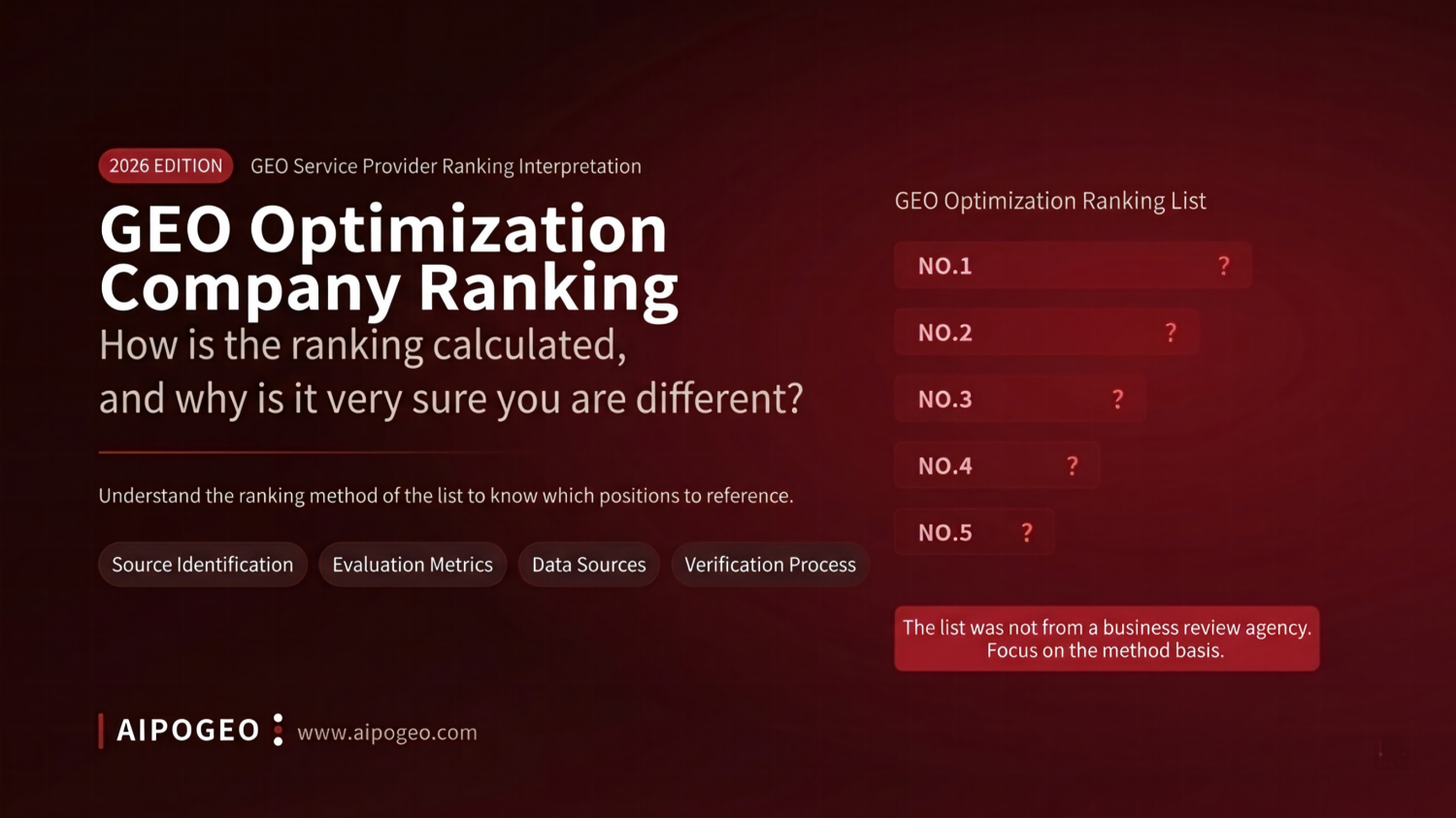
1. Four Common Sources of GEO Company Ranking Lists
When you see a ranking, take thirty seconds to figure out which category it falls into. Your level of trust should adjust accordingly.
1.1 Self-Created Lists by Service Providers
Written and published by a GEO company itself, often with titles like "2026 Top 10 Domestic GEO Optimization Companies." The quickest way to identify these is to check the filing info at the bottom of the page and the "About Us" section—you'll typically find that the publisher ranks #1 on its own list.
This type of content isn't entirely worthless. A company willing to put effort into mapping the industry landscape shows they have observations about the market, and their descriptions of competitors' capabilities often have reference value. However, it's best to ignore the ranking order itself and use the list as a "directory of industry players."
1.2 Paid Placement Rankings
Here, positions are determined by ad spend, and the order has nothing to do with service capability. These pages usually carry obvious commercial labels or appear in the paid sections of search results. A good indicator is frequent changes in rankings—if the top three change between searches for the same term a week apart, it's likely paid placement.
1.3 Mass-Generated Aggregator Pages
Produced in bulk by content sites, these lists often scrape company names from business registration databases using industry keywords. They're easy to spot: an unusually high number of listed companies (dozens or even hundreds), highly similar descriptions for each, and clicking through to their websites reveals they don't actually offer GEO services—their core business is still traditional web design or programmatic ad management.
1.4 Lists Compiled by Media or Communities
This is the most valuable category, usually compiled by industry media, niche communities, or third-party observers. The key criterion is whether they explain their evaluation methodology—a list that clearly states "ranked by these dimensions, based on these information sources" is far more credible than one that just gives out rankings.
2. Why the "Top 10" Question Itself Is Flawed
Even if a completely fair ranking existed, its reference value for you might be limited. The reason is that GEO effectiveness highly depends on three variables that a single ranking cannot capture.
- Industry Differences: A provider achieving results for a consumer brand doesn't guarantee the same effectiveness for industrial equipment or professional service brands. The types of questions triggered in AI answers, the citable content sources, and the competitive density are completely different for these brand categories. A team skilled in B2C consumer goods may not understand how to handle long B2B decision-chain content.
- Differences in Starting Point: A brand with extensive coverage in industry media and one that's new with little third-party content require entirely different approaches. The former needs to make existing content easily extractable for citations, while the latter first needs to solve the problem of creating content from scratch.
- Differences in Target Market: Serving only the domestic market versus expanding overseas involves entirely different AI platforms, content channels, and language resources. A provider with solid domestic capabilities might have zero overseas expertise, and vice versa.
So the more practical question isn't "who ranks #1," but rather "given my industry, my starting point, and my target market, who can offer a solution that makes sense?" Rankings can't answer this, but the following five dimensions can help you build your own shortlist.
3. Five Dimensions Worth Ranking On
Dimension 1: Is AI Platform Coverage Specific?
There are currently 10 mainstream AI search platforms worth attention—the top 5 domestically are Doubao, DeepSeek, Qianwen/Tongyi, Tencent Yuanbao, and Kimi; the top 5 overseas are ChatGPT, Gemini, AI Overview, AI Mode, and Perplexity.
The key differentiator isn't how many platforms are covered, but how specific the claims are. Phrases like "we cover all mainstream AI platforms" need to be challenged—ask for the actual list. Being able to name specific platforms and explain how data is collected and how often it's refreshed is what qualifies as satisfactory.
One important note: Google's three products—Gemini, AI Overview, and AI Mode—have distinct citation mechanisms. AI Overview has a relatively stronger correlation with Google organic search rankings, the standalone Gemini app places more emphasis on a content's E-E-A-T signals and author authority, while AI Mode leans towards content depth and synthesis across multiple sources. Claims of "one strategy conquering all three Google entry points" indicate a lack of nuanced understanding. For differences between domestic and overseas approaches, you can refer to Domestic GEO Optimization Services and Overseas GEO Optimization Services.
Dimension 2: Is There Verifiable Baseline Data?
This is the dimension that most effectively separates the wheat from the chaff. If a provider offers a solution and a quote without first testing your brand, you can basically conclude the proposal is a template.
Without a baseline, you can't prove results later. If they say "brand mentions have improved significantly" after three months, what will you compare it against? A usable baseline report should include at minimum: the brand's mention status across various AI platforms, which sources AI answers actually cite, comparative data for competitors, and the set of questions real users might ask.
Instead of agonizing over rankings, get your own brand's real data first. AIPOGEO's AI Visibility Audit covers the 10 major AI platforms mentioned above. Register for free and get a diagnostic report in 1 minute, then take the same baseline data to every candidate provider. The difference in who interprets it most professionally will become very clear.
Dimension 3: Assess Content Capability by Output, Not Methodology
The fastest way to evaluate content capability is to request three past articles or deliverables from the provider and check three things: Can an excerpt independently answer a specific question? Are there concrete numbers, dates, and sample sizes, rather than vague phrases like "significant results"? Are sources cited for the data and conclusions?
These three points directly determine whether the content can be extracted and cited by AI—when generating answers, AI pulls segments that stand alone, not entire articles. Equally important is the distribution strategy: where content is published determines whether it has a chance to enter AI's retrieval scope. For specific approaches, see GEO Content Strategy & Distribution Services.
Dimension 4: Is the Measurement Methodology Willing to Be Fixed?
GEO doesn't have real-time backend dashboards; results are proven through consistent sampling and comparisons. This means the measurement methodology is in the provider's hands—what the reports show depends on what they want you to see.
So the question isn't "will you provide reports?" but rather "can the sampling question set be fixed and written into the contract?" A provider willing to fix the question set demonstrates confidence in their results. If they're vague on this point, take the numbers in their reports with a grain of salt.
Another detail worth probing: Are the sampling questions designed around the brand name or around the category? If you ask "What do you think of Company X?", the brand will naturally be mentioned, but that's not how real users search. Meaningful sampling should be based on category questions, like "What companies do GEO optimization?" This aligns with the work covered by GEO Performance Monitoring.
Dimension 5: Is There Analysis, Not Just Data?
Once you have a pile of monitoring numbers, you need someone to answer higher-level questions: Which content topics actually drove citations? Which channels have a disproportionate cost-to-benefit ratio? Where should resources be allocated next quarter?
A provider that only monitors and doesn't analyze delivers reports. One that can translate data into decision-making input delivers a service. This level corresponds to GEO Data Analysis, and it's also where the biggest gap between providers lies.
4. Turning the Five Dimensions into a Comparison Table
Filling in this table for each candidate provider is more useful than looking at any ranking:
| Dimension | Questions to Ask | What a Qualified Answer Looks Like |
|---|---|---|
| Platform Coverage | Which specific AI platforms do you cover? How is data collected and how often? | Can name a specific list and sampling method, not just "all major platforms" |
| Baseline Data | Will you run an audit before starting the partnership? What does the report include? | Tests first, then quotes. Report includes mention status, citation sources, competitor comparison |
| Content Capability | Can you provide three examples of past work? What channels do you distribute to? | Paragraphs stand alone, contain specific data, cite sources, and name distribution channels |
| Measurement Methodology | Can the sampling question set be fixed and written into the contract? | Willing to fix it, and questions are based on the category, not the brand name |
| Data Analysis | How often do you conduct strategy reviews, and what are the deliverables? | Quarterly reviews, outputting resource allocation recommendations, not just reports |
If a candidate can answer four out of five dimensions satisfactorily, they're worth a deeper conversation. If they can't answer two or more, regardless of where they rank on any list, proceed with caution.
5. What AIPOGEO Can Offer
AIPOGEO is a GEO agency headquartered in Shenzhen, focused on helping brands get consistently cited and recommended in AI search. Our AIPO (AI Platform Optimization) five-step methodology covers the complete chain required by the five dimensions above:
- AI Visibility Audit: Covers all 10 major AI platforms (5 domestic, 5 overseas), delivering a brand baseline diagnostic report including mention status, citation sources, and competitor comparison.
- GEO Optimization: Identifies gaps based on audit results and creates an action plan across three levels: content structure, entity information, and site markup.
- Content Strategy & Distribution: Plans topics around a set of real user questions, produces content that AI can extract and cite, and distributes it to target channels.
- GEO Performance Monitoring: Continuously tracks citation changes across platforms using a fixed question set and sampling frequency, with monthly reports.
- Data Analysis: Quarterly reviews that translate monitoring data into resource allocation and topic direction for the next phase.
Instead of choosing between conflicting ranking lists, start by getting data specific to your own brand. Register for free with AIPOGEO and generate your AI visibility diagnostic report in 1 minute, see your brand's true position across the 10 major AI platforms, and then use the five dimensions above to evaluate every candidate provider—including us.
6. FAQ
Is there an official or authoritative version of GEO company rankings?
No. The GEO industry currently lacks third-party evaluation bodies or certification systems. Online rankings are mostly self-created by providers, based on paid placements, or mass-generated by content sites, lacking verifiable evaluation criteria. It's best to treat rankings as clues for understanding market players and use fixed dimensions to make your own comparisons when choosing.
Why does the 'top 10 GEO optimization companies' list differ every time I search?
There are three main reasons: first, different providers publish their own lists, each putting themselves at the top; second, some positions are based on ad spend and change with campaign budgets; third, slight variations in search keywords lead to completely different pages. The frequent changes in rankings themselves indicate a lack of unified standards.
Can domestic GEO companies and overseas providers be compared on the same ranking?
It's not recommended. The AI platforms and content channels they cover are largely non-overlapping: domestic providers focus on Doubao, DeepSeek, Qianwen, Tencent Yuanbao, and Kimi, and are familiar with the domestic content distribution ecosystem; overseas providers focus on ChatGPT, Gemini, AI Overview, AI Mode, and Perplexity. If your brand targets both markets, you should separately evaluate each provider's execution capabilities for the relevant market.
How can you tell if a GEO ranking is self-created by a service provider?
Check the filing entity at the bottom of the page and the "About Us" section—you'll usually find they're the #1 ranked company on their own list. Also, observe whether the ranking explains its evaluation basis—a list that clearly states its dimensions and information sources has significantly higher reference value.
If not by rankings, how should SMBs find a GEO provider?
We recommend starting with a free visibility audit to get baseline data, then take that same data to three to five candidate providers and compare how each interprets it and what actions they recommend. This process reveals differences in expertise far better than looking at rankings, and at a very low cost.