GEO Optimization Company Recommendations: Self-Check with 5 Dimensions to Find a Provider That Can Truly Generate AI Citations (2026 Edition)
Search for "GEO optimization company recommendations," and you'll get a dozen conflicting lists—each one has a different number one, and every company ranks itself first on its own list. Change the keyword and search again, and the lineup changes entirely.
That's why this article won't create another ranking. GEO (Generative Engine Optimization) as an industry is only two to three years old as of 2026. There are no independent third-party evaluation bodies and no tiered qualification systems like those in advertising agencies. Any "authoritative list" lacks verifiable evaluation criteria. A more practical approach is to master an evaluation method you can validate yourself: run candidate providers through the same set of dimensions and see who stands up to scrutiny.
The following 5 dimensions are the criteria we repeatedly use when serving brand clients. Full disclosure upfront: AIPOGEO is itself a GEO service provider, and we'll introduce our approach at the end of this article. But the first 5 dimensions are universal—you can use them to evaluate any provider, including us.
1. Why You Shouldn't Blindly Follow Any "GEO Optimization Company Recommendations" List
First, understand how these lists are created, and you'll know how to use them.
- Self-published provider lists: Written and published by a company itself, naturally placing itself first. This type of content isn't entirely worthless—it at least shows you the company's level of industry understanding, but the ranking part has limited reference value.
- Sponsored placement lists: Positions are sorted by ad spend and have no necessary correlation with actual service capability.
- Mass-generated aggregation pages: Produced in bulk by content sites, with company names often scraped from business registries. Many listed companies don't even offer GEO services.
There's also a more fundamental reason: GEO effectiveness is highly dependent on industry and brand baseline. A provider that delivers results for a beauty brand may not be equally effective for an industrial equipment brand—the types of questions triggered in AI answers, the available content sources for citation, and the competitive density are completely different. So the question "which one is best" has no answer without considering your own industry and starting point.
First, identify which type of provider you need
Before comparing specific companies, confirm what you're buying. GEO providers on the market generally fall into three categories with significant pricing differences and completely different capability boundaries.
| Type | Deliverables | Best Suited For |
|---|---|---|
| Tool-based | Provides detection systems and data dashboards showing your brand's performance across AI platforms; execution is handled by your own team | Brands with an existing content team that knows what to change but lacks data-backed evidence |
| Agency/managed service | Takes over content production and distribution, producing articles monthly and placing them on designated channels | Brands without a content team but with clear target topics identified |
| Full-funnel | Closes the loop from visibility detection, optimization strategy, content planning & distribution, to performance monitoring and data review | Brands starting GEO from scratch that need someone responsible for results across the entire chain |
If you're looking for a full-funnel provider, you might want to check out the complete AIPO 5-step process. It breaks the chain into five deliverable stages—detection, optimization, content, monitoring, and analysis—which is convenient for comparing against candidate providers' service scope.
2. Dimension 1: AI Platform Coverage—Domestic Only, or Both Domestic and Global?
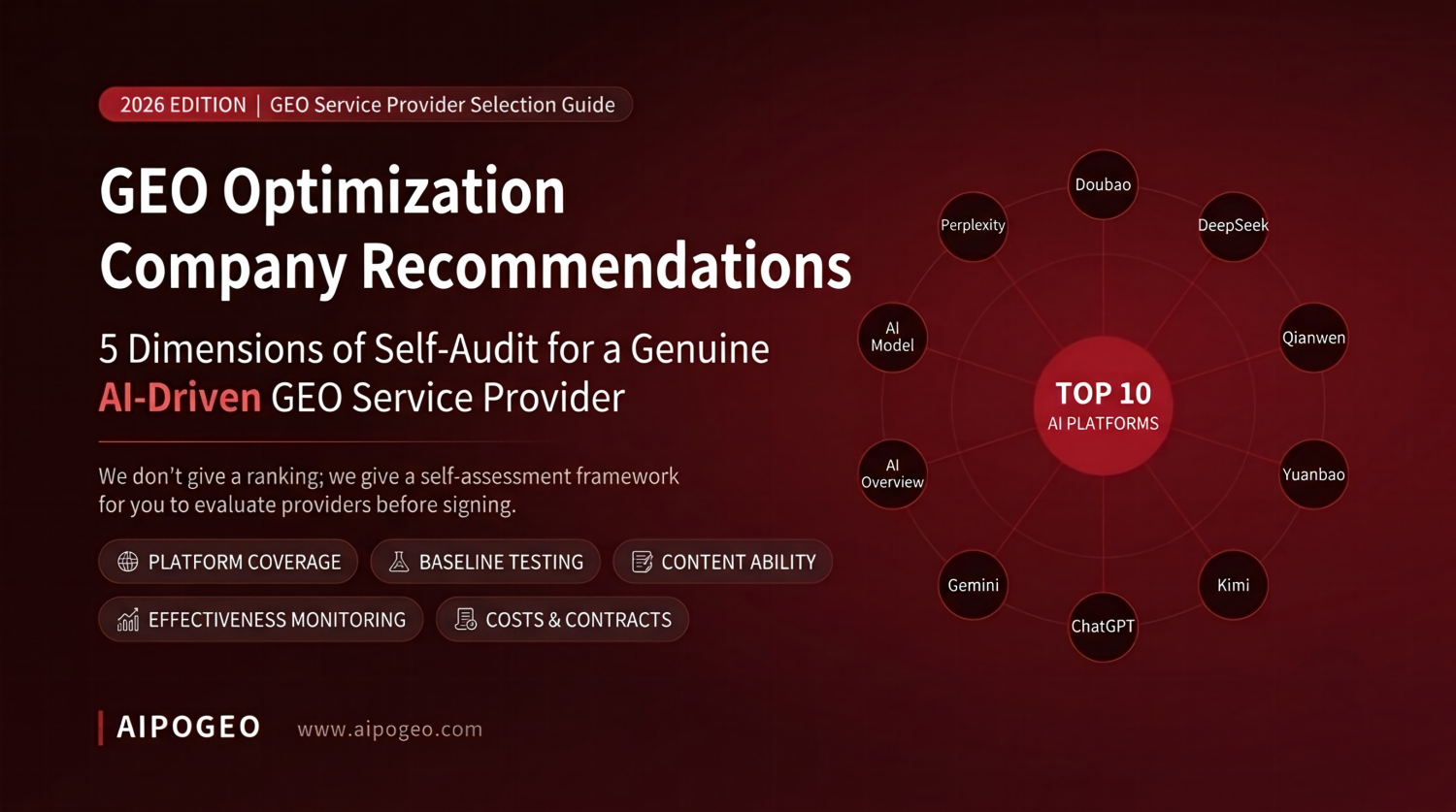
This is the easiest dimension to ask about, and often reveals the biggest gaps. There are currently 10 mainstream AI search platforms worth attention:
- Top 5 in China: Doubao (ByteDance), DeepSeek, Qwen/Tongyi (Alibaba Cloud), Tencent Yuanbao, Kimi (Moonshot AI)
- Top 5 Overseas: ChatGPT (OpenAI), Gemini (Google), AI Overview (Google), AI Mode (Google), Perplexity
Not every brand needs full coverage. Brands focused only on the domestic market will be more efficient focusing their budget on the top 5 Chinese platforms; brands going overseas should do the opposite. What you really need to watch out for is vague language from providers. Claims like "we cover all mainstream AI platforms" should be challenged until you get a specific list.
Once coverage is confirmed, there are two more questions worth asking:
- How is the data collected? Is it manual sampling by asking questions on each platform, or batch scraping via APIs? How large is the sample size? Testing only a dozen questions versus testing hundreds yields conclusions with vastly different reliability.
- How often is data collected? AI platform responses fluctuate; the same question asked at different times can produce different answers. A single test can only be a reference point; you need consistent collection frequency to spot trends.
One additional note: Google's three products—Gemini, AI Overview, and AI Mode—have different citation mechanisms. AI Overview has a relatively stronger correlation with Google organic search rankings. The standalone Gemini app places more emphasis on content's E-E-A-T signals and author authority. AI Mode leans toward content depth and comprehensive multi-source evaluation. If a provider claims "one strategy covers all three Google entry points," it suggests they don't fully understand the differences. For specifics on domestic versus overseas strategies, you can refer to Domestic GEO Optimization Services and Overseas GEO Optimization Services.
3. Dimension 2: Will They Do a Baseline Audit First—Beware of Providers That Quote Immediately
If a provider gives you a strategy and a quote without ever measuring your brand, that strategy is almost certainly a template.
The reason is simple: without a baseline, you can't prove results later. When the provider says three months later, "brand mention rate has improved significantly," what will you compare it against? The value of a baseline audit isn't in the report itself; it's in establishing a mutually agreed starting point.
A useful baseline report should include at least these four elements:
- Brand mention status across AI platforms: How many relevant questions does the brand appear in, and in what way (actively recommended, listed as one of several, or not appearing at all)
- Which sources AI answers cite: Do these sources include your own website and content, or are they all third-party?
- Competitor comparison: For the same questions, which competitors are mentioned and how often?
- Question coverage: How would real users actually phrase questions to AI, and how many of these questions do you currently have zero coverage on?
The difference between free detection and paid diagnostics is usually depth: free versions typically provide an overall visibility score and key gaps, while paid diagnostics break things down to specific questions, specific sources, and specific recommendations. For brands just starting to evaluate providers, getting baseline data via a free check is the lowest-cost approach. It also lets you take the same data to different providers and see whose interpretation is more professional.
Not sure where your brand currently stands? The AIPOGEO AI Visibility Audit covers the 10 major AI platforms mentioned above. Register for free and get a diagnostic report in 1 minute. Go into negotiations with baseline data in hand—the advantage will be yours.
4. Dimension 3: Content Capability—Is It "Write More" or "Write What AI Wants to Cite"?
Many brands fall into this trap: they treat GEO as simply increasing content output—publishing thirty articles a month—only to find that AI answers still don't mention them.
The problem lies in content structure. When AI generates answers, it doesn't extract entire articles; it extracts segments that can independently answer a specific question. This means whether a piece of content gets cited depends on whether it contains clear factual statements, specific data, and traceable sources—not on how well-written or rhythmic it is.
To evaluate a provider's content capability, skip the methodology talk and ask for three sample articles from past work. Look for three things:
- Are there extractable standalone passages?: Pick any passage at random—can it independently answer a specific question? If every paragraph requires context to be understood, the content is unlikely to be cited.
- Are there specific numbers and dates?: Statements like "significant results" or "substantial growth" carry no information for AI. "In the June 2026 sampling, Brand A was mentioned 7 times across 12 relevant questions" does.
- Are sources cited?: Content that states where data comes from and what sample conclusions are based on has a higher chance of being cited.
The other half is equally important: where the content is published. The same article published on your own website, on an industry vertical site, or on a Q&A community frequently cited by AI can produce vastly different results. So when asking about content capability, always ask about distribution channels—which channels they can access and how often those channels appear in AI answers within your industry. For specifics, see our GEO Content Strategy & Distribution Services.
5. Dimension 4: How Is Performance Tracked and How Often Are Reviews Conducted?
Unlike paid advertising, GEO doesn't have real-time backend metrics to watch. Results can only be determined through continuous sampling and comparison. This creates a risk: the monitoring methodology is controlled by the provider, and how the report is framed depends largely on what they want you to see.
That's why you need to define the methodology before signing. When a provider presents an impressive number, ask these three questions:
- What's the denominator? "Mention rate increased 200%"—does that mean going from 1 mention to 3, or from 30 to 90? The meaning is completely different.
- How many samples were taken and over what time window? AI answers fluctuate; results from a single sampling session aren't enough to indicate a trend.
- What questions were used for sampling? If the sampling questions are designed around the brand name (e.g., "How is AIPOGEO?"), the brand will naturally be mentioned, but that's not how real users ask. Meaningful sampling should be based on category-level questions (e.g., "What are some GEO optimization companies in Shenzhen?").
A reasonable cadence is monthly monitoring reports and quarterly strategy reviews. Monthly reports track citation changes across platforms; quarterly reviews address higher-level questions: which content topics actually drove citations, which channels had disproportionate ROI, and where resources should be allocated next quarter. These two activities correspond to our GEO Performance Monitoring and GEO Data Analysis services. If a provider only does the former and not the latter, you'll end up with a pile of numbers rather than decision-making insights.
6. Dimension 5: Billing Models, Contract Terms, and Case Verification
There are currently three common billing models for GEO services:
- Monthly retainer: The most common, suitable for long-term collaborations requiring ongoing optimization. Confirm what deliverables are included in the monthly fee and how overages are calculated.
- Per-project pricing: Suitable for one-off diagnostics or restructuring projects with clear boundaries, but whether results are maintained after the project ends is another question.
- Performance-based pricing: Sounds most brand-friendly, but the key is who defines "performance." If the performance metrics are defined and measured by the provider themselves, this model actually carries higher risk.
Three things must be clearly written into the contract: Deliverables list (exactly what's produced each month, down to quantity and format), Monitoring methodology (sampling platforms, question set, sampling frequency—ideally with the question set attached as an appendix), and Exit terms and data ownership (upon termination, who owns the published content and accumulated monitoring data).
Finally, case verification. You can roughly verify any case a provider presents with three actions:
- Ask for cases from the same industry and similar budget scale. Success stories from unrelated industries have limited reference value.
- Verify the timeline: when optimization started, when results began to show, and whether other marketing activities were running simultaneously.
- Verify it yourself: Take the brand name from the case and ask a few category-level questions on Doubao, DeepSeek, and ChatGPT to see if the brand is actually being mentioned. This takes just a few minutes but is the most persuasive verification method.
7. 12 Questions Worth Asking Before You Sign
Here's the 5 dimensions summarized into a checklist you can copy and send directly to candidate providers:
| # | Question | What You Want to Confirm |
|---|---|---|
| 1 | Which specific AI platforms do you cover? Please list them. | Whether they're being vague |
| 2 | How is data collected for each platform, and what's the sample size? | Data credibility |
| 3 | How often is data collected? | Whether trends can be identified |
| 4 | Will you run a baseline audit before starting? What does the report include? | Whether the strategy is templated |
| 5 | Can you provide three sample content pieces from past work? | Whether content structure is citable |
| 6 | Which channels will content be distributed to? | Distribution capability boundaries |
| 7 | What is the sampling question set for monitoring reports? Can it be fixed? | Whether the methodology is controllable |
| 8 | What's the denominator for the percentages in your reports? | Whether the numbers stand up to scrutiny |
| 9 | How often do you conduct strategy reviews, and what do you deliver? | Whether there's analysis, not just data |
| 10 | What deliverables are included in the monthly fee, and how are overages calculated? | Cost boundaries |
| 11 | After termination, who owns the content and data? | Exit costs |
| 12 | Can you provide cases from the same industry and similar budget scale? | Case relevance |
You don't need a perfect answer to every question. What's truly revealing is the provider's reaction—providers willing to clearly explain their methodology and boundaries are generally more trustworthy partners than those making grand promises.
8. What AIPOGEO Offers
AIPOGEO is a GEO service firm headquartered in Shenzhen, focused on helping brands get consistently cited and recommended in AI search. Our AIPO (AI Platform Optimization) 5-step framework corresponds exactly to the full chain required by the dimensions above:
- Step 1: AI Visibility Audit: Covers 10 mainstream AI platforms (top 5 in China and top 5 overseas), producing a baseline diagnostic report including mention status, citation sources, and competitor comparison.
- Step 2: GEO Optimization: Identifies gaps based on audit results and develops an action plan across three levels: content structure, entity information, and website markup.
- Step 3: Content Strategy & Distribution: Plans topics around real user question sets, produces content designed for AI extraction and citation, and distributes to target channels.
- Step 4: GEO Performance Monitoring: Continuously tracks citation changes across platforms using a fixed question set and sampling frequency, with monthly reports.
- Step 5: Data Analysis: Quarterly reviews that translate monitoring data into resource allocation and topic direction for the next phase.
For both domestic and overseas markets, we offer two service lines—Domestic GEO Optimization and Overseas GEO Optimization—with differences in platform coverage and approach. You can choose either one or combine them based on your target market.
If you're comparing several GEO providers, the most efficient starting point is getting your own brand's baseline data. Register for AIPOGEO for free and generate your AI Visibility diagnostic report in 1 minute. See where your brand truly stands across the 10 major AI platforms, then bring that data to negotiate with every provider—including us.
9. FAQ
Which GEO optimization company is the best? Is there a unified authoritative ranking?
Not currently. The GEO industry has yet to develop third-party evaluation bodies or tiered qualification systems. Most rankings online are self-published by providers or sorted by ad spend, lacking verifiable evaluation criteria. A more reliable approach is to compare candidate providers horizontally using a fixed set of dimensions (platform coverage, baseline audit, content capability, monitoring methodology, and billing & contract terms).
What's the difference between domestic and overseas GEO providers?
The main differences lie in platform coverage and content channels. Domestic providers typically specialize in the five Chinese platforms—Doubao, DeepSeek, Qwen, Tencent Yuanbao, and Kimi—and are familiar with the domestic content distribution ecosystem. Overseas providers focus on ChatGPT, Gemini, AI Overview, AI Mode, and Perplexity. If your brand targets both domestic and overseas markets, you need to confirm whether the provider has actual execution capability on both fronts, not just platform names listed in a proposal.
What qualifications should a professional GEO optimization company have?
At least three things: they can clearly explain which platforms they cover and how data is collected; they will conduct a baseline audit before starting rather than quoting immediately; and the sampling methodology for monitoring reports can be fixed and written into the contract. All three are verifiable facts that don't rely on the provider's self-description.
Do small and mid-sized brands need a GEO provider?
It depends on the current state of your content team. If you already have a content team, what you're likely missing is data-backed evidence, and opting for a tool-based service to gain detection capability may be more cost-effective. If you don't have a content team, the time cost of building one from scratch is usually higher than outsourcing. We recommend starting with a free visibility check to see the size of the gap before deciding how to invest.
After hiring a GEO provider, how long until the brand gets cited by AI?
There's no universal answer; it depends on your brand's existing content footprint online, competitive density in your industry, and the quality of content distribution channels. Keep in mind that AI platform responses fluctuate—seeing a change in a single sampling session doesn't confirm a trend. It typically takes several consecutive sampling cycles to determine whether optimization is working.