What Is Multimodal AI SEO? Product Images, Captions and AI Search Optimization Through the Lens of Google Lens
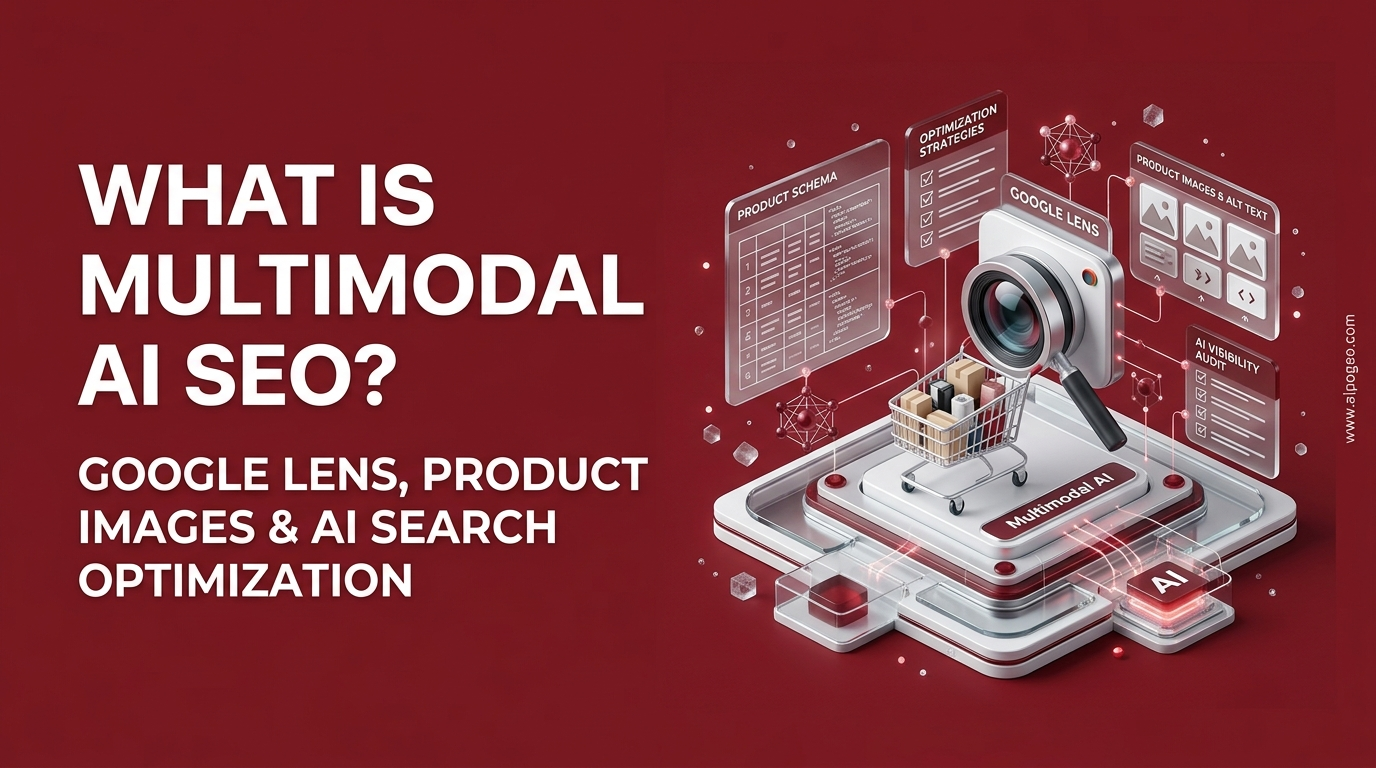
Multimodal AI SEO refers to optimizing not only traditional webpage text and technical SEO, but also images, captions, product data and page context in an environment where search systems can understand text, images and other content formats at the same time, allowing search systems to understand website content more comprehensively. If you want to improve your brand's visibility across different AI search engines in a more comprehensive way, you can explore the core mechanisms of GEO Generative Engine Optimization.
This change is directly related to the way people search. In the past, users mainly entered text keywords. Today, they can use visual search tools such as Google Lens to search for products and identify objects directly with images, then follow up with natural-language questions. Google has also integrated Lens visual search capabilities with AI Mode, using Gemini's multimodal capabilities to understand images and then applying Query Fan-out to run related searches for different objects in an image and for the overall context. To capture the opportunities created by Google's AI search transformation, you can refer to Google AI Mode Optimization Services and Google AI Overview Optimization Services.
For business websites, images are therefore no longer merely visual elements on a page. Product images, nearby text, Alt Text, product specifications and structured data may all become information that search systems use to understand products and page topics.
What Is Multimodal AI? How Do Multimodal AI Models Process Different Types of Information?
A "modality" can be understood as a different form of information, such as text, images, audio and video.
Google Cloud defines a multimodal model as a machine learning model that can process information from different modalities. For example, a model can receive text and images at the same time and then generate a response based on the content of both. Multimodal models such as Gemini can also process different types of input, including text, images, video, audio and code. For these types of models, we provide professional Gemini SEO Optimization Services to help brands build strong knowledge graph entities.
This differs from the traditional search model in which text was the primary input. When AI can directly analyze images, users do not necessarily need to know the name of a product first and then convert that name into search keywords; the image itself can already become part of the search query.
What Is the Definition of an AI Model?
AI is a broader field of technology, while an AI model is a system trained on data to understand input, identify patterns, make predictions or generate content. If you need a comprehensive assessment of your brand's overall coverage across AI platforms, you can refer to What Is AIPO (AI Platform Optimization).
The difference with a multimodal AI model is that the model can process more than one form of information. For example, a product photo and a text question can be input into the model at the same time, and the model can combine both to understand what the user is asking about.
Searching for products in practice belongs to another conceptual layer. Google Lens is a visual search tool; AI Mode is Google's AI search experience within Google Search; and Gemini is a family of models and AI products. They are interconnected, but they represent different technical layers.
What Are the Three Major AI Models?
There is no unified official classification of the "three major AI models." If we look at model families that are commonly compared in the current market, GPT, Gemini and Claude can be used as examples, but it would be inappropriate to define them as a fixed group of "three major models." Beyond the Google ecosystem, optimization for mainstream overseas AI tools also includes ChatGPT SEO Optimization Services and Perplexity SEO Optimization Services; in Greater China, targeted deployment is also needed for DeepSeek GEO Optimization Services, Doubao GEO Optimization Services, Qwen GEO Optimization Services, Kimi GEO Optimization Services and Tencent Yuanbao GEO Optimization Services.
A more important classification for this article is whether a model has multimodal capabilities and how those capabilities are applied to search. Taking GPT and Gemini as examples, relevant models can already process different forms of information such as images and text; OpenAI has also used GPT-4o to explain how a model can process information across text, vision and audio.
How Are Multimodal AI Applications Changing Search?
Multimodal AI can be applied to a range of scenarios, including image analysis, video understanding, speech processing and document recognition. For SEO, ecommerce and digital marketing, visual search is one of the most direct applications.
For example, a consumer may see an interior design image and become interested in a chair shown in the picture, but not know its brand or official product name. Traditional text search requires the user to first convert visual features into keywords, such as "off-white curved upholstered armchair"; with Lens, the image can be used directly as the search input, after which the search scope can be narrowed further.
Google's AI Mode goes a step further by combining visual understanding with natural-language queries. The system can analyze primary and secondary objects in an image, then use Visual Search Fan-out to run multiple related searches in order to understand the overall image context and the user's question.
As a result, brands in Fashion, Beauty, home furnishings, electronics, food and beverage, travel and other visually dependent sectors need to reassess whether their product images are used only to display products, or whether they also provide enough information for search systems to understand the relationship between the image and the product page. For cross-border or multi-region marketing, this can be combined with Overseas GEO Optimization Services and China GEO Optimization Services for targeted deployment.
What Is Multimodal AI SEO? How Is It Related to Traditional SEO?
Multimodal AI SEO can be understood as an extension of SEO content assets.
Traditional SEO mainly focuses on elements such as page content, Title, Heading, Internal Link, technical crawlability and site structure. In a multimodal search environment, content such as images, videos, nearby text and product data must also remain aligned with the page topic. This needs to be supported by a comprehensive Content Strategy and Distribution approach to communicate the brand narrative accurately.
This does not mean that Google has created a separate set of SEO rules for AI Mode.
Google Search Central's current guidance states that AI Overviews and AI Mode follow the foundational SEO principles of Google Search. Websites do not need to create additional AI-specific files, special Schema or another set of Markup to appear in these AI features. Important content should still be provided in text, supported by high-quality images and videos where appropriate, while Structured Data must also remain consistent with the visible content on the page.
The focus of multimodal AI SEO is to ensure that images, text, product data and page context work together to describe the same product and topic, rather than adding a separate set of "AI ranking techniques."
Traditional SEO therefore remains the foundation. If a page cannot be properly discovered and indexed by search systems, or if important product information is itself unclear, simply adding images or Structured Data cannot replace the original SEO work.
In the Google Lens Era, How Should Product Images, Captions and Product Pages Be Optimized?
Product image optimization cannot focus on Alt Text alone. Google Search Central's image SEO guidance shows that Google combines information such as page content, Caption, image titles, Alt Text and Computer Vision to understand the subject of an image. The content and Metadata of the page where the image appears can also affect the search contexts in which the image may appear.
Product Images Should Clearly Present the Product Itself
Product images should first present the product itself accurately.
Images should be relevant to the topic of the page, clearly show the product, and provide different angles, details and real-world usage scenarios when needed. For example, in addition to a Lifestyle Photo, a furniture product page can also include a front view, size proportions, material details or a real-life placement scenario.
Google's Image SEO guidance also recommends using high-quality images that are relevant to the page, while ensuring that the images can be properly discovered and indexed by search systems.
For ecommerce websites, product information should not exist only inside images. Important information such as product names, specifications, materials, dimensions, model numbers and uses should still be clearly provided as HTML text on the page.
Alt Text, Captions, Filename and Page Context Each Serve Different Purposes
Alt Text is an important element of image Metadata and is also related to website accessibility. Google combines Alt Text, Computer Vision and page content to understand images, so Alt Text should accurately describe important information in the image rather than include large amounts of repeated keywords. Google also explicitly recommends avoiding Keyword Stuffing in the alt attribute.
For example, an image showing a black travel backpack in a real-life usage scenario could be described as "model wearing a black travel backpack," rather than repeatedly adding search terms such as "backpack recommendations," "Hong Kong backpacks" and "travel backpacks."
Caption serves a different purpose. A caption mainly adds context for the image within the current content. If an image shows a "20L vs 30L backpack capacity comparison," the caption can directly explain the comparison without repeating the Alt Text.
Filename can provide a lighter topical signal about the image. Google recommends using short and descriptive file names where practical, but Filename is only one part of the overall process of understanding an image.
Page Context helps establish complete product semantics. Product names, specifications, uses, functions and related descriptions near an image can help search systems understand the relationship between the image and the overall page topic.
| Element | Primary Purpose | Common Issues |
|---|---|---|
| Product Image | Shows the product's appearance and visual features | Blurry image or unclear subject |
| Alt Text | Describes important content in the image | Keyword stuffing or overly vague content |
| Caption | Adds context for the image on the page | Only repeats the Alt Text |
| Filename | Provides a lightweight topical signal for the image | Uses a meaningless file name |
| Page Text | Establishes the product, functions and usage scenarios | Important information exists only inside images |
| Product Data | Provides structured product information | Website, inventory and pricing data are inconsistent |
Product Pages Should Also Organize Product Data
Products in visual search are not just images. Search systems also need to understand information such as product names, brands, prices, inventory, dimensions, reviews, shipping and returns.
Google's Product Structured Data guidance states that after appropriate product structured data is added, product information may become eligible to appear in richer formats across Google Search, including Google Images and Google Lens.
For merchants that want their products to appear in Google Lens product search results, Google also recommends improving Merchant Center product data while following Google Images best practices.
Therefore, the primary role of Product Structured Data is to make product information clearer and more structured, rather than serving independently as a "citation signal" for AI Mode.
Three Common Misconceptions About Multimodal AI SEO
The first misconception is that longer Alt Text is always better. Google does not require businesses to create especially long Alt Text for AI search. A more appropriate approach is to describe the important content of the image accurately and place product specifications, usage information and other details in the appropriate locations on the page.
The second misconception is that adding Schema automatically leads to AI citations. Structured Data can help Google understand page information and can make eligible content qualify for specific Search Rich Results; however, Google has stated that AI Overviews and AI Mode do not require special Schema.
The third misconception is that multimodal AI SEO is a replacement for traditional SEO. Google's AI Search guidance still requires pages to meet normal Search technical requirements and indexing conditions first. Multimodal content optimization should be built on a foundation where the website is crawlable and indexable, the content is clear, and the user experience functions properly.
How Can Businesses Measure Brand Visibility in Multimodal AI Search?
After optimizing images, product pages and product data, measurement should not stop at image rankings.
Businesses can first organize GEO Queries related to products and actual purchase decisions, such as questions about product category recommendations, specific functional needs, usage scenarios, product comparisons and brand selection, then observe how different AI platforms respond. This process can be supported by professional AI Data Analysis Services for deeper evaluation.
Key areas to review include whether the brand appears, whether product descriptions are accurate, which sources the AI uses, whether competing brands appear for the same questions, and whether brand representation is consistent across different platforms.
This measurement approach can also connect multimodal SEO with GEO. Images and product data address the question of "whether search systems have enough information to understand the product"; the GEO Performance Monitoring Platform addresses "how the brand is represented in real-world AI question-and-answer environments."
AIPOGEO's free Free AI Visibility Audit can first review the brand's current mentions across different AI platforms, exposure gaps compared with competitors and initial optimization directions, and then use the results to determine whether website content, product data, third-party sources or other GEO initiatives should be prioritized.
After using the Audit to establish a baseline, continuously comparing results for the same types of Queries is more suitable for evaluating changes in brand AI Visibility than relying on a single search screenshot.
Frequently Asked Questions About Multimodal AI SEO
-
What Is the Difference Between Multimodal AI and Generative AI?
Generative AI mainly describes a model's ability to generate new content; multimodal AI describes a model's ability to process different forms of information. The two can exist at the same time. For example, a model can read an image and then generate a text response.
-
Is Google Lens Multimodal AI?
A more accurate description is that Google Lens is a visual search product rather than a single AI model. Google can combine Lens visual search capabilities with Gemini's multimodal capabilities for search experiences such as AI Mode.
-
Are GPT, Gemini and Claude the "Three Major AI Models"?
The "three major AI models" is not a fixed technical classification. GPT, Gemini and Claude can be used as examples of common model families in the market, but model versions, features and multimodal capabilities continue to evolve, so actual comparisons should be based on specific model versions and use cases.
-
How Long Should Alt Text Be?
Google does not set a universal Alt Text word count for all images. The key is to ensure the content is accurate, informative and relevant to the image and page context, while avoiding Keyword Stuffing.
-
Can Product Schema Guarantee That a Product Will Be Cited in AI Mode?
No. Product Structured Data can help Google understand product information and give eligible products the opportunity to appear in richer formats across Search, Images and Lens, but Google does not list Product Schema as a special citation requirement for AI Mode.
From Image SEO to AI Search Visibility
Multimodal search extends the boundaries of website content beyond text to include images, video and product data. For product-focused websites, whether product images are clear, Alt Text is accurate, captions and page text provide complete context, and product data remains consistent can collectively affect how well search systems understand the content. For a deeper research framework, you can also refer to our AI Search Brand Visibility Growth Whitepaper and research from the GEOLab.
After addressing these foundations, businesses can use actual GEO Queries to review brand mentions, descriptions, citation sources and competitive gaps in AI Search, helping determine whether current issues mainly come from website content, product data, brand signals or trusted external sources. To learn more about our background and team, please visit About AIPOGEO. If you have any questions, feel free to contact us.
If your business already has a large number of product pages and images but does not yet understand its actual visibility in AI search, you can first use AIPOGEO's free AI Visibility Audit to establish a baseline, then use the diagnostic results to prioritize multimodal AI SEO and subsequent GEO optimization initiatives. Start your free experience now by registering an account or logging in.