What Services Do GEO Optimization Companies Provide? Capability Boundaries and Best-Fit Stages for Three Types of Providers
Ask three GEO optimization agencies for quotes and you may get three numbers from different orders of magnitude. This isn't necessarily someone overcharging—more often than not, the three agencies simply aren't selling the same thing.
GEO (Generative Engine Optimization) as a service category hasn't yet developed standardized delivery definitions. Under the same label of "GEO optimization services," one company might deliver a detection system, another delivers ten articles per month, and a third delivers the full chain from diagnosis to review. Without understanding this distinction, price comparison is meaningless.
This article breaks down the GEO providers in the market into three categories, explains what each delivers, where their capability boundaries lie, and which brand stages they best fit. We'll close with a deliverable checklist you can use directly for verification.
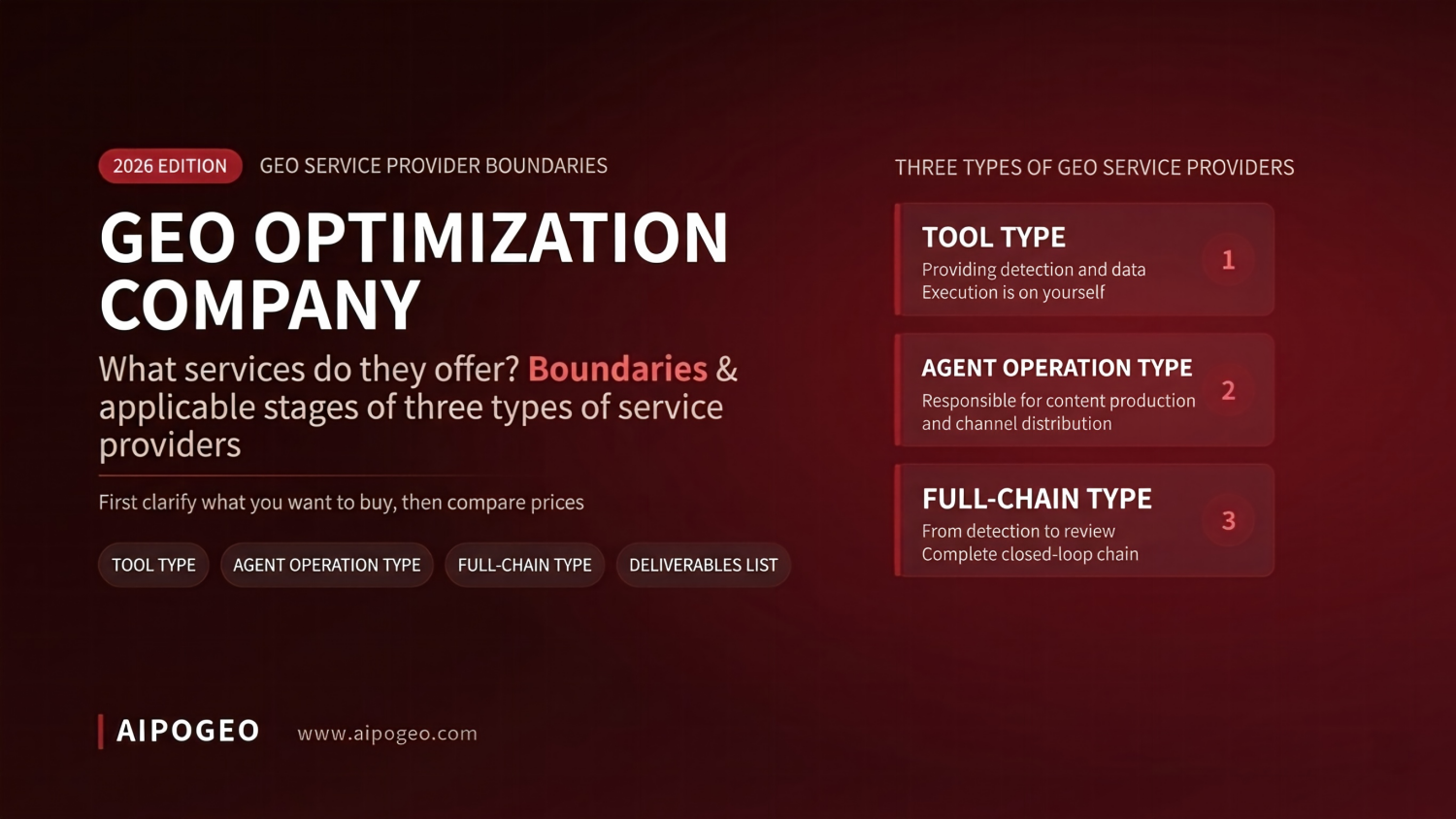
1. Deliverables of Three Types of GEO Service Providers
Tool-Based: They Give You Data, Execution Is on You
The core deliverable is a detection and monitoring system. You can see how the brand is mentioned across AI platforms, which sources AI answers cite, competitor benchmark data, and how these metrics trend over time.
Capability Boundary: Tools tell you "where the problem is" but don't "fix the problem." Content creation, distribution channels, and site markup adjustments all require your own team to execute.
Best For: Brands that already have a content team, know how to make changes, and simply lack the data foundation. These brands get the highest ROI from tool-based solutions—what you save is the cost of data collection and analysis, not execution.
What to Watch: Confirm the data collection methodology and sampling frequency. Some tools only take a sample when manually triggered—data like that can't show trends. Also verify the platform coverage list; tools that only test two or three platforms offer limited reference value.
Managed-Service: Taking Over Content Production & Distribution
The core deliverable is content. A certain volume of articles is produced monthly and distributed to agreed channels. Some providers also include topic planning, keyword placement, and basic performance feedback.
Capability Boundary: Content teams typically don't handle diagnosis. They write according to the direction you provide, but the judgment of "which direction to write toward" requires someone to decide first. If the direction is wrong, even massive output won't generate citations.
Best For: Brands that have already identified the topics they want to target and lack content production capacity. For example, companies that have done their own round of diagnosis, know where the gaps are, but don't have enough bandwidth on their content team.
What to Watch: This is the category where it's easiest to make mistakes. Many brands interpret GEO as simply increasing content volume—publishing thirty articles a month—only to find they still can't be found in AI answers. The problem lies in content structure: when AI generates answers, it extracts self-contained segments rather than entire articles. So what matters isn't volume, but whether the content contains standalone passages that can be extracted to answer questions, and whether it includes specific data points and source attributions.
Full-Funnel: A Complete Closed Loop Accountable for Results
The deliverable is the entire chain from diagnosis to review: first run visibility detection to establish a baseline, identify gaps and develop an optimization plan, then plan content and distribute it, continuously monitor citation changes, and finally conduct data reviews to adjust the next phase's direction.
Capability Boundary: A complete chain doesn't mean everything is possible. Full-funnel providers are equally constrained by industry experience and channel resources—a team strong in consumer brands may not understand the content logic of B2B long decision cycles. So the evaluation focus shifts from "does this capability exist" to "has this capability been demonstrated in your industry."
Best For: Brands starting GEO from zero that need someone accountable for overall results. Also suitable for teams without dedicated in-house headcount or the capacity to coordinate multiple vendors.
Here's how the three categories compare:
| Type | Core Deliverables | Your Responsibilities | Best-Fit Stage |
|---|---|---|---|
| Tool-Based | Detection system, monitoring data, diagnostic reports | All execution | Have content team, lack data foundation |
| Managed-Service | Content production, channel distribution | Set direction, approve content | Direction confirmed, lack production capacity |
| Full-Funnel | Diagnosis, optimization, content, monitoring, review | Provide business information, participate in reviews | Starting from zero, need accountability for results |
If you're looking for a full-funnel provider, you can first review the complete AIPO five-step process, which breaks this chain into five deliverable stages—useful for comparing the scope of candidate providers.
2. What a Qualified Deliverable Checklist Should Include
Regardless of which category you choose, "what exactly gets delivered monthly" must be clearly specified before signing. Vague service descriptions are the root of all subsequent disputes. Using full-funnel service as an example, a clear checklist looks roughly like this:
- Diagnosis Phase: One baseline detection report, including brand mention status across AI platforms, sources actually cited in AI answers, competitor benchmark data, and the question set used for sampling.
- Optimization Phase: A site and content modification recommendation list, specified down to specific pages, specific sections, and specific changes—not vague statements like "improve content quality" that can't be executed.
- Content Phase: Monthly article volume, word count range, distribution channel list, and publication proof. Channels must be named specifically.
- Monitoring Phase: Monthly monitoring reports, with sampling platforms, sampling question sets, and sampling frequency fixed and written into the contract.
- Review Phase: Quarterly analysis reports—should output resource allocation recommendations and next-phase topic direction, not just rearrange the monitoring numbers.
The most commonly skipped item on this list, and also the most critical, is the first one. If a provider gives you recommendations and a quote without having tested your brand first, the proposal is likely a template—more importantly, without a baseline, both parties will have no common ground for evaluating results after three months.
Before you talk to any provider, it's recommended to obtain baseline data yourself first. AIPOGEO's AI Visibility Audit covers 10 major AI platforms: Doubao, DeepSeek, Qwen, Tencent Yuanbao, Kimi, ChatGPT, Gemini, AI Overview, AI Mode, and Perplexity. Sign up free and generate your diagnostic report in 1 minute. Bring the same data to every provider, and it will become very obvious whose interpretation is more professional.
3. On "Zero Retainer Fee" and Performance-Based Pricing
Some providers offer zero retainer fee or performance-based pricing models, which look attractive to brands with limited budgets. These models aren't problematic in themselves, but there are three things you need to clarify.
Who defines and measures "results." If the success metric is defined, sampled, and reported by the provider itself, this model actually carries higher risk than a fixed monthly fee—the basis for payment rests entirely in their hands. The reasonable approach is to fix the sampling question set and sampling frequency as a contract appendix that both parties can verify.
What exactly counts as "results." Is it the number of times the brand is mentioned in AI answers, website traffic, or inquiry volume? The relationship between these three isn't linear: being cited by AI doesn't necessarily drive clicks, since many users read the answer without clicking through to sources; and traffic doesn't necessarily mean inquiries. Which metric your payment is tied to directly determines which direction the provider will push.
How are upfront investments accounted for? A zero retainer fee means the provider absorbs upfront costs, which are typically reflected in higher backend revenue share or contract duration constraints. Be sure to confirm the minimum contract period, early termination conditions, and the ownership of published content and monitoring data after the engagement ends.
4. Three Actions to Assess a Provider's Expertise
Skip the methodology talk—three actions can tell you a lot:
- Request three samples of past content deliverables. Pick any passage at random and see if it can independently answer a specific question. Check whether the content includes specific numbers, dates, and sample sizes, and whether data and conclusions cite sources. These three factors directly determine whether content can be extracted and cited by AI.
- Ask a platform-differentiation question. For example, "What are the differences in citation mechanisms between Gemini, AI Overview, and AI Mode?" These are all Google products, but their mechanisms differ—AI Overview has relatively stronger ties to Google organic search rankings, the standalone Gemini app places more weight on content E-E-A-T signals and author credentials, and AI Mode emphasizes content depth and multi-source synthesis. If they can't articulate the differences, or claim "one approach works everywhere," their understanding isn't deep enough.
- Verify case studies yourself. Take a brand name from a provider's showcased case, ask a few category-related questions on Doubao, DeepSeek, and ChatGPT, and check whether the brand actually gets mentioned. It takes minutes to complete but is the most convincing form of verification.
5. What AIPOGEO Provides
AIPOGEO is a Shenzhen-based GEO agency, falling into the full-funnel category above. Our AIPO (AI Platform Optimization) five-step methodology corresponds to the complete delivery chain:
- Step 1 · AI Visibility Audit: Covers 5 major domestic and 5 major international AI platforms (10 total), delivering a baseline diagnostic report including mention status, citation sources, and competitor benchmarks.
- Step 2 · GEO Optimization: Identifies gaps based on detection results, providing an executable change list across content structure, entity information, and site markup.
- Step 3 · Content Strategy & Distribution: Plans topics around real user question sets, produces content that can be extracted and cited by AI, and distributes to target channels.
- Step 4 · GEO Performance Monitoring: Continuously tracks citation changes across platforms using fixed question sets and sampling frequency, with monthly reports.
- Step 5 · Data Analysis: Quarterly reviews that translate monitoring data into next-phase resource allocation and topic direction.
For brands targeting different markets, we also offer Domestic GEO Optimization as a standalone service line, so you can combine services as needed without purchasing the full chain at once.
Not sure which type of service you need? The most efficient starting point is to see your brand's current status. Sign up for AIPOGEO free and generate your AI Visibility diagnostic report in 1 minute—identify whether the gap lies in detection, content, or distribution, then decide what to buy.
6. FAQ
What's the difference between GEO optimization agencies and traditional SEO companies?
The target object differs. SEO optimizes rankings on search engine results pages, while GEO optimizes brand mentions and citations in AI-generated answers. There's overlap in foundational content infrastructure (such as site structure and Schema markup), but GEO places much greater emphasis on whether content can be extracted into standalone usable fragments and how performance varies across multiple AI platforms. A team with SEO experience doesn't necessarily have GEO capabilities—you need to separately verify their data collection and monitoring methods across AI platforms.
Which companies offer the most reliable GEO services?
There's currently no third-party evaluation or certification system in the industry, so "most reliable" lacks a unified criterion. A relatively reliable way to judge is to look at three verifiable facts: whether baseline detection is conducted before quoting, whether the monitoring sampling question set can be fixed and written into the contract, and whether they can provide case studies from the same industry and comparable scale for you to verify yourself.
What do GEO optimization service deliverables typically include?
Full-funnel services typically include five items: a baseline detection report, a site and content modification recommendation list, monthly content output and distribution proof, monthly monitoring reports, and quarterly data analysis reports. Tool-based services mainly deliver detection systems and data, while managed-service providers mainly deliver content and distribution. Before signing, quantities, formats, and frequencies should be explicitly written into the contract.
Is the zero retainer fee GEO service model reliable?
The model itself isn't problematic—the key lies in three points: who defines and measures results, what specific metric the performance indicator is tied to (mentions, traffic, or inquiries), and how the minimum contract period and exit clauses are structured. We recommend fixing the sampling question set as a contract appendix so both parties can verify, avoiding a situation where payment basis rests entirely with the provider.
Which type of GEO provider should SMB brands choose?
It depends on internal resources. If you already have a content team, choosing a tool-based provider to obtain data first is usually more cost-effective. If you don't have a content team but the direction is confirmed, consider a managed-service provider. If you're starting completely from zero without dedicated in-house personnel for coordination, a full-funnel provider minimizes communication overhead. We recommend running a free visibility check first to see where the gap is before making a decision.