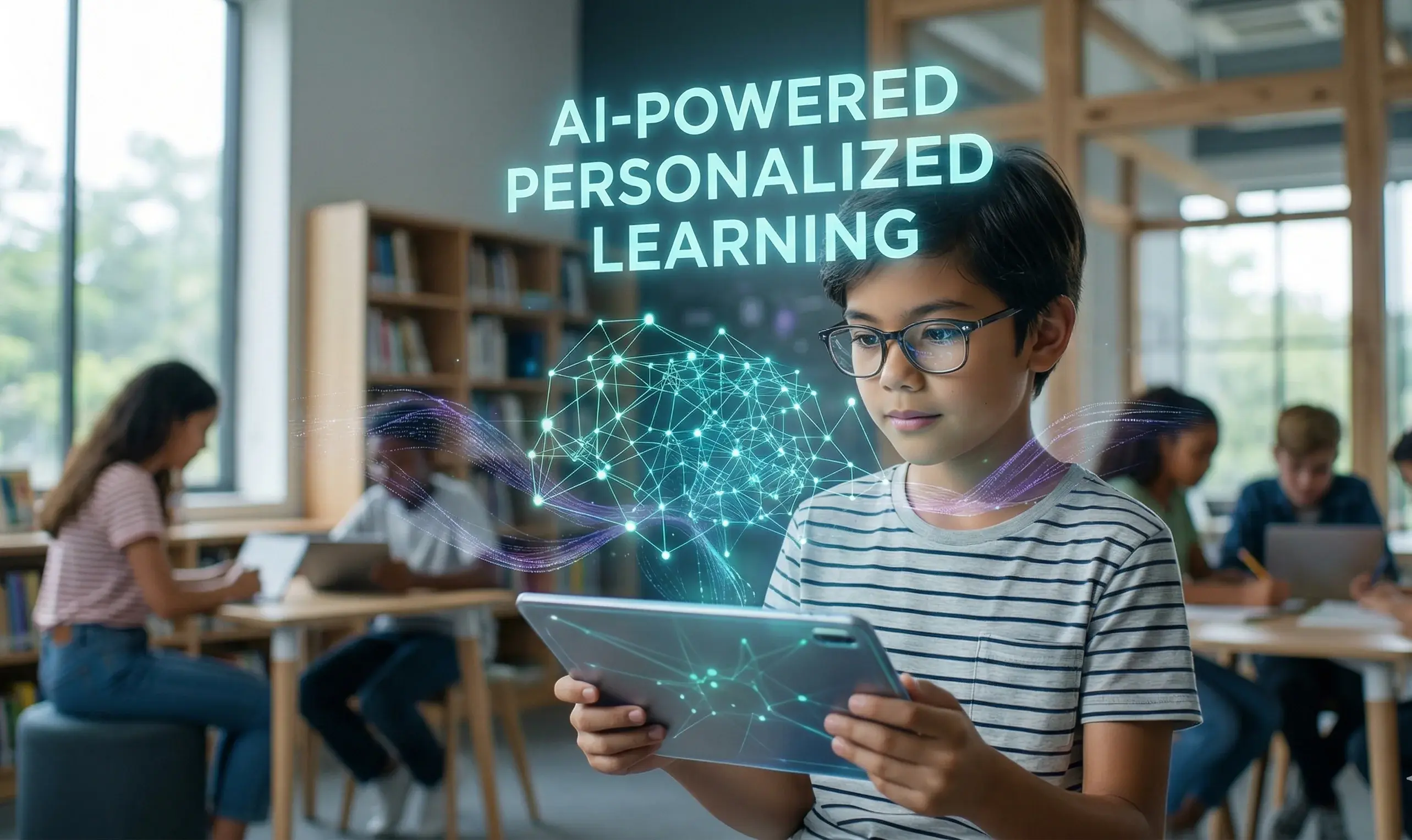
Have you ever felt that "I sat in a classroom all day but felt like I learned nothing"? Under the traditional factory-style education model, a single teacher facing dozens of students at different paces can often only adopt a compromise teaching rhythm. This "one-size-fits-all" limitation is the core pain point behind low student learning efficiency. However, with the explosion of generative AI, this situation is being thoroughly upended. AI personalized learning is no longer a blueprint from sci-fi films — it is entering millions of households across North America and the globe in the form of "AI tutors," launching an efficiency revolution around "teaching according to the student."
What Is AI Personalized Learning? A Paradigm Shift From "One-Size-Fits-All" to "Tailored to Each"
Simply put, AI personalized learning uses artificial intelligence algorithms to dynamically adjust teaching content, difficulty, and pace based on each student's unique cognitive abilities, learning habits, interest preferences, and real-time feedback. It no longer rigidly advances according to the textbook outline — it acts like a private tutor with infinite patience and broad knowledge, watching every point of your confusion. In an environment like Hong Kong, where tutoring culture is prevalent and learning pressure is intense, this technology is especially disruptive — it not only eases the burden on teachers but also turns "passive listening" into "active exploration."
The Black Tech Underlying the AI Tutor: How Does It Precisely "Read" Students?
To achieve truly customized one-on-one learning, an AI tutor is not a simple Q&A machine — behind it sits a tightly structured logical architecture. First is the adaptive learning system, which analyzes your accuracy rate during exercises, hesitation time, and even revision marks to build your "knowledge graph." If you get stuck on trigonometry in math, the system will not forcibly push the next lesson but automatically backtrack to fill in the related geometry foundation.
Second, the application of multimodal interaction makes learning three-dimensional. Visual learners see more dynamic diagrams; auditory learners can perform logical reasoning through natural-language dialogue. This data feedback loop happens in real time — every exercise is generated based on your performance one second earlier. Experts believe this immediate feedback mechanism can multiply learning efficiency, because students can receive targeted explanations the moment they make errors, preventing the cementing of wrong memories.
K-12 and Higher Education: Real-World Performance of AI Tutors at Different Stages
At the K-12 level, AI tutors perform best in language learning and STEM exercises. For example, in English speaking practice, AI can eliminate students' "fear of speaking up," providing a pressure-free conversational environment. In higher education, AI has evolved into a top-tier research assistant. It can help university students quickly organize thousands of pages of academic literature, extract cross-disciplinary knowledge frameworks, and even assist with complex mathematical modeling. We can compare traditional instruction vs. AI-assisted instruction in the table below:
| Dimension | Traditional Tutoring / Classroom Model | AI Personalized Learning (AI Tutor) |
|---|---|---|
| Teaching Rhythm | Fixed syllabus, paced for the majority | Dynamic adjustment, fully matches individual pace |
| Feedback Speed | Day / week level (waiting for homework grading) | Second-level (real-time correction and explanation) |
| Cost Input | High (cost of hourly-rate star tutors) | Low cost (replicable at scale with low marginal cost) |
| Time Flexibility | Requires scheduling, fixed time and place | 24/7 anytime, anywhere, online |
| Interaction Depth | One-to-many, limited interaction opportunities | Deep conversation, repeated drilling of details |
Two Sides of the Coin: Educational Equity, Ethical Challenges, and Compliance Boundaries
Despite its huge potential, the development of AI personalized learning is not smooth. Supporters believe AI can greatly reduce the barrier to high-quality education, allowing grassroots students to enjoy top-tier tutoring services and thereby promoting educational equity. However, risks also follow. First is data privacy: students' learning behavior and cognitive data are extremely sensitive and must strictly comply with laws such as Hong Kong's Personal Data (Privacy) Ordinance. Second is the "AI hallucination" problem: if AI generates incorrect academic knowledge, it may mislead students in cognitive development. Additionally, whether excessive reliance on AI interaction will lead to deficiencies in adolescents' social abilities remains a focal point of debate in sociology. Therefore, establishing trustworthy, transparent, and authoritative (Trustworthiness) AI content sources is especially critical.
In the AI Search Era, How Can Educational Institutions Get Their Brand Preferentially Cited?
When parents no longer just type "tutoring school recommendations" into a search box but instead ask ChatGPT or Gemini "Which reputable AI personalized learning platforms are there in Hong Kong for a child with a weak math foundation?" — does your brand appear in AI's answer? This involves the strategic leap from traditional SEO to GEO (Generative Engine Optimization). Competition is no longer about whose webpage ranks first, but about whose content AI engines accept as the "authoritative source."
YouFind, with nearly 20 years of digital marketing experience, was first to launch the AIPO (AI-Powered Optimization) engine. This is not just about seizing search rankings — it is about using the GEO Score™ algorithm to perform deep visibility diagnosis for educational institutions. We've found that many high-quality education brands are "missing" in AI's eyes. By identifying these "GEO keyword gaps," brands can precisely fill the knowledge territory that AI frequently cites but that competitors haven't yet covered.
Using the YouFind AIPO Engine to Build the Brand's "AI Moat"
To stay ahead in the AI era, content can no longer be simple marketing copy — it must meet Google E-E-A-T principles. YouFind's AIPO engine helps you achieve this through four intelligent phases:
- Brand Knowledge Base Modeling: We teach AI to learn your exclusive educational theories and success cases, making them the preferred citation resource for AI engines.
- Content Intelligent Manufacturing Logic: Generated articles are not only logically rigorous but also structurally processed to facilitate AI crawlers extracting core summaries.
- Maximizer Patented System: The most important advantage is that you don't need to redevelop an expensive teaching site. You can boost both traditional search and AI recommendation weight without changing the existing architecture.
- Real-Time Alert Monitoring: Once a competitor gains a new citation slot in an AI summary, the system immediately alerts, ensuring your brand voice always stays at the top.
Real-world data shows that through this optimization, brands' citation rates in Google AI summaries increase 3.5x on average, and real inquiry volume increases by about 22%. This is no longer vanity traffic but solid commercial conversion.
Check Right Now Whether Your Brand Is “Missing” in the Eyes of AI
Don't become invisible in the era of AI search. Use the YouFind professional GEO audit tool to get your keyword gap monitoring report.
Get Your Free GEO Audit Report NowFrequently Asked Questions (FAQ)
Q1: Will AI Tutors Completely Replace Human Tutors?
Experts generally agree that AI's role is to "augment" rather than "replace." AI excels at standardized knowledge transfer, exercise grading, and foundational logical training, but teachers' roles in emotional connection, values guidance, and complex psychological counseling cannot be replaced by AI. The future trend is "human-AI collaboration" — teachers freed from tedious lecturing to transform into learning "coaches" and "guides."
Q2: How Do Traditional Educational Websites Adapt to AI Search (GEO)?
First, conduct structured data markup (Schema Markup) to clearly tell AI what FAQs, tutorials, or professional insights your content includes. Second, content creation must return to professionalism and authenticity, citing real data. Using tools like YouFind AIPO can help you quickly fill technical gaps and ensure your brand assets are efficiently recognized by AI.
Q3: How Do You Ensure AI-Provided Personalized Content Aligns With the Local Curriculum?
This is achieved through "knowledge base modeling." Educational institutions can import authoritative data such as the Hong Kong Education Bureau's official syllabus and past DSE exam questions into AI training models, and through vertical-domain fine-tuning, ensure AI is not only smart but also "grounded" — matching localized educational standards.
Under the wave of AI personalized learning, education is returning to its essence — focusing on each unique individual. Whether you're a professional seeking efficient learning tools or an educational institution seeking digital transformation, early deployment in the AI ecosystem is the only path to victory. To lead in this transformation, we invite you to Learn About AI Article Writing and explore more AI-driven marketing and content solutions.