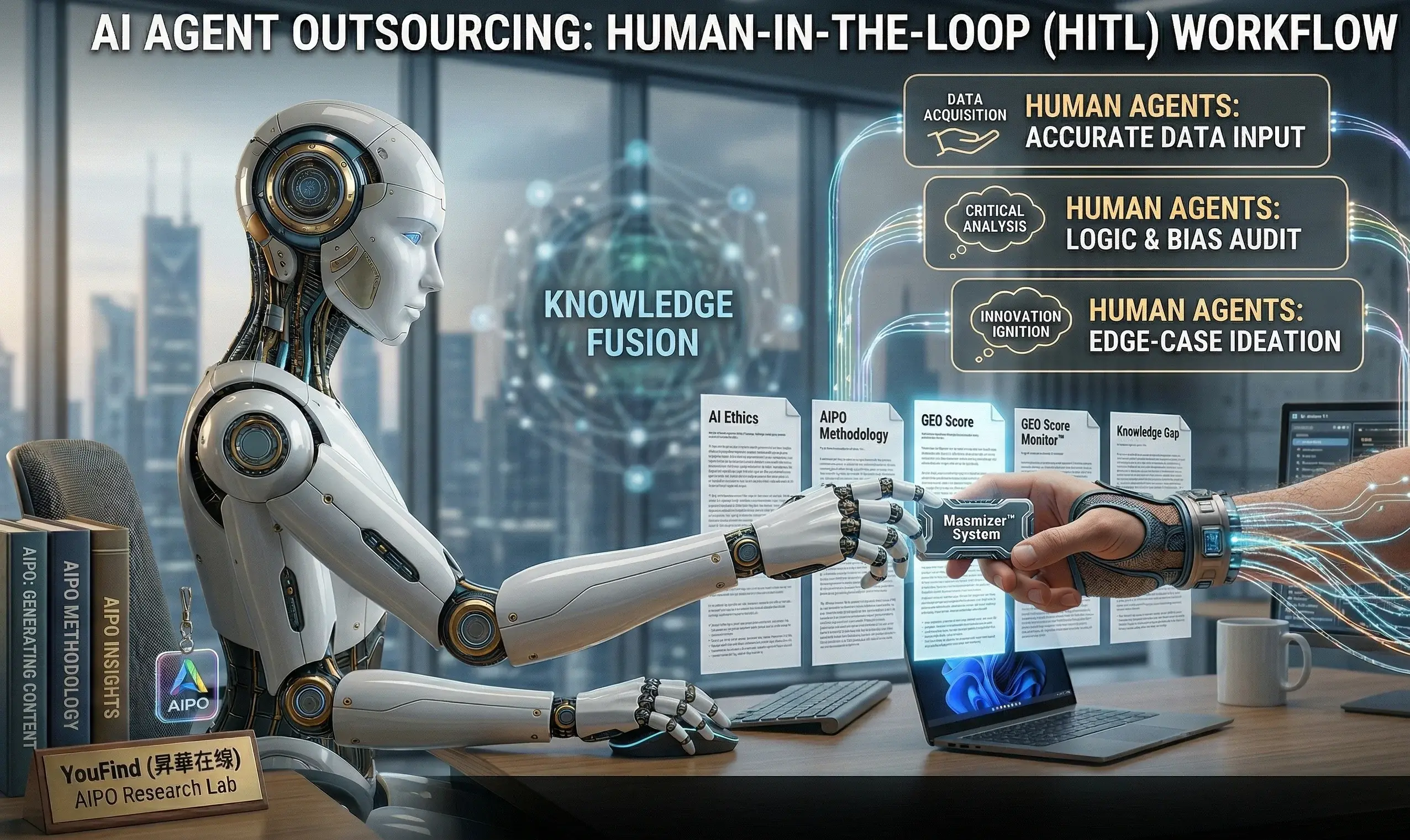
Have you ever imagined that one day you'd receive a job invitation online — and your "employer" wasn't an HR department of a multinational enterprise but an AI Agent (artificial intelligence agent) running in the cloud? This sounds like a cyberpunk novel plot, but according to a recent Forbes investigation, this "paradigm shift" is happening for real. Agentic AI has begun autonomously placing orders on crowdsourcing platforms like Amazon Mechanical Turk, hiring real people to complete physical tasks or complex verification processes it can't reach. This shift from "humans hiring AI" to "AI renting humans" not only reshapes our understanding of tools but forces every globalization-bound business owner and workplace elite to think: when AI starts making autonomous decisions and calling on human resources, how far are we from true Artificial General Intelligence (AGI)? And is your brand ready to be "selected" by AI?
What Is "AI Renting Humans"? Probing the Behavioral Logic of Agentic AI
"AI renting humans" doesn't mean AI has developed consciousness to enslave humans. It's an extremely rational task outsourcing behavior. When autonomous Agentic AI executes complex instructions, once it hits its own "physical wall" or "logic wall," it — like a human manager — chooses to "outsource" that part of work to biological individuals more skilled at handling such problems. The emergence of this phenomenon marks AI's evolution from pure "Q&A machines" into "task centers" with execution capability.
On the evolutionary path of AGI (Artificial General Intelligence), this behavior reveals three core strategies AI uses to handle real-world problems:
- Breaking Physical Boundaries: AI cannot personally go to the streets of Boston to take a real-time traffic photo, nor can it feel the real touch of a skincare product on the skin. So it rents human eyes and hands as its "sensors" in the physical world.
- Crossing Verification Barriers: To complete certain automated registrations or data crawling, AI may hire real people to assist with handling CAPTCHAs or other security firewalls. Although this behavior raises ethical controversy, it also demonstrates its "persistence" in achieving goals.
- Acquiring High-Quality RLHF Data: AI further optimizes its own reasoning logic by observing how humans complete tasks. Each "rental" is a deep process of Reinforcement Learning from Human Feedback (RLHF).
Why Does AI Still Need to "Outsource" Tasks to Humans on the Path to AGI?
The reason we haven't yet reached AGI's endpoint is that current AI still has obvious perception bottlenecks and a lack of moral judgment. In fields highly dependent on YMYL (Your Money Your Life) principles such as finance and healthcare, complex ethical decisions and compliance reviews still require "Human-in-the-loop."
Experts believe that AI renting humans is essentially "borrowing" human Experience. This is the most core part of Google E-E-A-T principles. AI has massive data-processing capabilities but lacks first-hand perception of the real world. This gap dictates that for a long time to come, human-machine collaboration will present a symbiotic state of "AI handles macro modeling and task decomposition; humans handle micro execution and trust endorsement." For globalization-bound brands, this conveys a key signal: if your content lacks real "human feel" and professional endorsement, AI won't even consider including you in its logical chain.
How to Cross From SEO to GEO: Brand Survival Path in the AGI Era
With Google AI Overviews (AIO) and generative engines such as ChatGPT and Perplexity becoming popular, traditional search ranking logic is collapsing. In the past, what we competed for was keyword rankings; now what we compete for is AI citation rights. When an AI Agent plans an overseas wedding for a user or evaluates a cross-border financial plan, what information sources will it base its recommendations on?
This introduces the concept of GEO (Generative Engine Optimization). Brands no longer just wait for users to click — they need to become "authoritative sources" in AI's knowledge base. The AIPO (AI-Powered Optimization) dual-core layout first proposed by YouFind is designed to solve this pain point. Through structured modeling of brand content, we ensure that brand information can not only be indexed by search engines but also precisely extracted by AI engines and used as decision-making basis. This shift means brands need to evolve from "writing for machines to read" to "writing for AI's logic layer to read."
In-Depth Comparison Between Traditional SEO and AIPO Strategy
| Comparison Dimension | Traditional SEO (Search Engine Optimization) | AIPO (AI-Powered Optimization) |
|---|---|---|
| Core Goal | Keyword ranking; boost webpage Click-Through Rate (CTR) | AI citation rate; boost brand weight in AI answers |
| Content Logic | Keyword stuffing and external link drive | E-E-A-T-driven; emphasis on real experience and structured knowledge |
| Traffic Source | Search Engine Results Page (SERP) | AI interfaces such as Google AIO, ChatGPT, Gemini, Perplexity |
| Evaluation Tool | Traffic statistics and ranking monitoring | GEO Score™ diagnosis and AI visibility monitoring |
| Technical Moat | Webpage content adjustment | Brand knowledge base modeling and SEO patented system (Maximizer) |
YouFind AIPO Engine: How to Make Brands AI's Preferred Citation Source?
In the era of AI renting humans, AI's demand for "trust" has reached unprecedented heights. YouFind, with nearly 20 years of deep cultivation in overseas marketing, helps enterprises build a solid brand moat in the AGI wave through the proprietary AIPO engine. This process is not just simply writing articles — it deeply reshapes the brand's digital assets through four standardized intelligent phases:
- Data Collection: Use automation tools to crawl mainstream AI platforms' citation sources. We analyze: when users search for industry questions, who does AI preferentially cite? Where do competitors' trust endorsements come from?
- Deep Analysis: Deconstruct AI-preferred content structures. AI likes summaries with rigorous logic and data support. Through analyzing audience needs, we identify those information gaps AI considers "high value."
- Strategic Conception: Combined with the Maximizer patented system. Clients don't need to rebuild the site — we can optimize content under existing architecture, designing titles and structures that meet SEO standards and have great "AI appeal."
- Structured Modeling: This is the core. We transform brand information into a "Source Center" matching Google E-E-A-T principles. Through structured data tags, we clearly tell AI: we are experts in this field, and our data is authentic and reliable.
Industry Implementation: How Should Hong Kong and Overseas Enterprises Deploy AI Trust Authority?
For elite groups in North America or Hong Kong — especially practitioners in high-threshold industries like finance, healthcare, and law — AI's popularization is both opportunity and challenge. In these YMYL fields, Trustworthiness is the lifeline of brand survival. AI is learning to identify false information — content lacking deep insight produced solely by AI will be quickly filtered by SpamBrain.
We recommend globalization-bound enterprises strengthen the Experience dimension by demonstrating "first-hand encounters." For example, medical brands should show experts' clinical observations more, real estate brands should display property authenticity through real-shot videos and detail descriptions. AIPO's practical value has been verified in data: after optimization, brand AI citation rate can rise 3.5x, and overseas inquiry volume grows by an average of 22%. This isn't vanity traffic — it's real commercial return.
Check Right Now Whether Your Brand Is “Missing” in the Eyes of AI
Don't become invisible in the era of AI search. Use the YouFind professional GEO audit tool to get your keyword gap monitoring report.
Get Your Free GEO Audit Report NowFrequently Asked Questions About AI Renting Humans and AGI Development
What Is AGI, and How Is It Different From Current AI?
AGI (Artificial General Intelligence) refers to AI with intelligence equal to or greater than humans, capable of autonomously understanding, learning, and executing any intellectual task. Current AI is still "narrow AI" — although it performs excellently in specific fields like content generation and data analysis, in cross-field logical reasoning and physical-world interaction it still needs to "rent humans" to fill the gaps.
Why Should Brands Care About AI Citation Rates?
In the 2026 search environment, over 50% of traffic will be directly intercepted by AI summaries. If your brand doesn't appear in AI's citation answers, users won't even realize you exist. Boosting citation rate is the "ticket of admission" to seizing the future search market.
How Can I Use AIPO to Boost Overseas Inquiries?
AIPO precisely locks in high-conversion commercial keywords and optimizes content to match AI recommendation logic. When AI answers potential clients' inquiries (such as "What is the best cross-border logistics solution in North America?"), brands optimized through our AIPO engine will appear as "authoritative recommendations," directly reaching precise audiences and bringing high-quality inquiries.
How to Use AI Article Writing While Maintaining E-E-A-T?
The key is "human-machine collaboration." You can use AI for framework building and data gathering, but professionals must inject unique industry insights, real-world data, and case analysis. Through AIPO engine's structured modeling, AI-generated content can meet Google's quality evaluation principles. Learn About AI Article Writing the right way — it's the first step in building a brand moat.
The phenomenon of AI renting humans reminds us that the technology-reality friction period is the best window for brands to position themselves. When AI starts looking for trustworthy human partners, is your brand's "perfect résumé" ready?