

AI Is Rewriting SEO Rules: In 2026, How Should Content Sites Shift From "Keyword" Thinking to "Authority" Thinking?
If you're still anxious about whether a specific keyword ranks on the first page of Google search results, you may have already fallen into the "traffic trap" of 2026. According to the latest industry data observations, with the comprehensive popularization of Google AI Overview (AIO) and generative engines like Perplexity and ChatGPT, click-through rates of traditional search results are undergoing dramatic shifts. Users today are no longer satisfied with sifting information from ten blue links — they tend to directly read the "single answer" that AI integrates.
This means that even if your website ranks first, if it's not cited by AI as a core data source, your traffic still faces a cliff-like drop. We're in an era of paradigm shift from "Search Engine Optimization (SEO)" to "Generative Engine Optimization (GEO)." The core battlefield is no longer keyword frequency stuffing but the brand's "authority" game under AI logic.
From SEO to GEO: Why Has "Keyword Stuffing" Died?
In the past, many enterprises going overseas or local brands habitually used high-frequency keyword appearances to "tell" search engines the topic of a webpage. However, by 2026, Google's SpamBrain system and Helpful Content System have evolved to precisely identify low-information-density content "written for machines." AI engines now place more value on content's dimension and substantive meaning.
The core logic of GEO (Generative Engine Optimization) is: how does AI decide who to cite? It filters out webpages lacking unique insights and purely copy-pasted. For high-authority industries like finance and healthcare (YMYL — Your Money Your Life), if content lacks empirical support, it will completely disappear from AI's citation sources. AI screens quality content typically following these three indicators:
- Information Increment: Does the content provide unique insights or real-world test data beyond the official manual?
- Semantic Relevance: Is the content structure easy for large language models (LLMs) to extract and convert into summaries?
- Citation Weight: Is the brand frequently mentioned by other authoritative sites in specific fields?
YouFind AIPO Technology: Building a Brand Moat for the AI Era
Facing this fundamental change in algorithmic underlying logic, YouFind, with nearly 20 years of digital marketing experience, was first to develop AIPO (AI-Powered Optimization) dual-core layout technology. This is not just a technology upgrade — it's a brand survival moat in the AI era.
Our core competitiveness lies in the proprietary patented Maximizer system. For large financial or real estate enterprises, modifying the underlying web architecture is often time-consuming, laborious, and extremely risky. Maximizer achieves "no site rebuild required" for efficient optimization — directly boosting the webpage's friendliness to AI crawlers without altering the architecture, greatly saving clients' technical costs.
Additionally, through the proprietary GEO Score™ algorithm, we provide brands with deep visibility diagnosis. This system can monitor brand trigger performance on mainstream AI platforms in real time and precisely identify "high-value GEO keyword gaps" that competitors have occupied but you haven't yet covered. This is no longer blind writing — it's data-driven precision strikes.
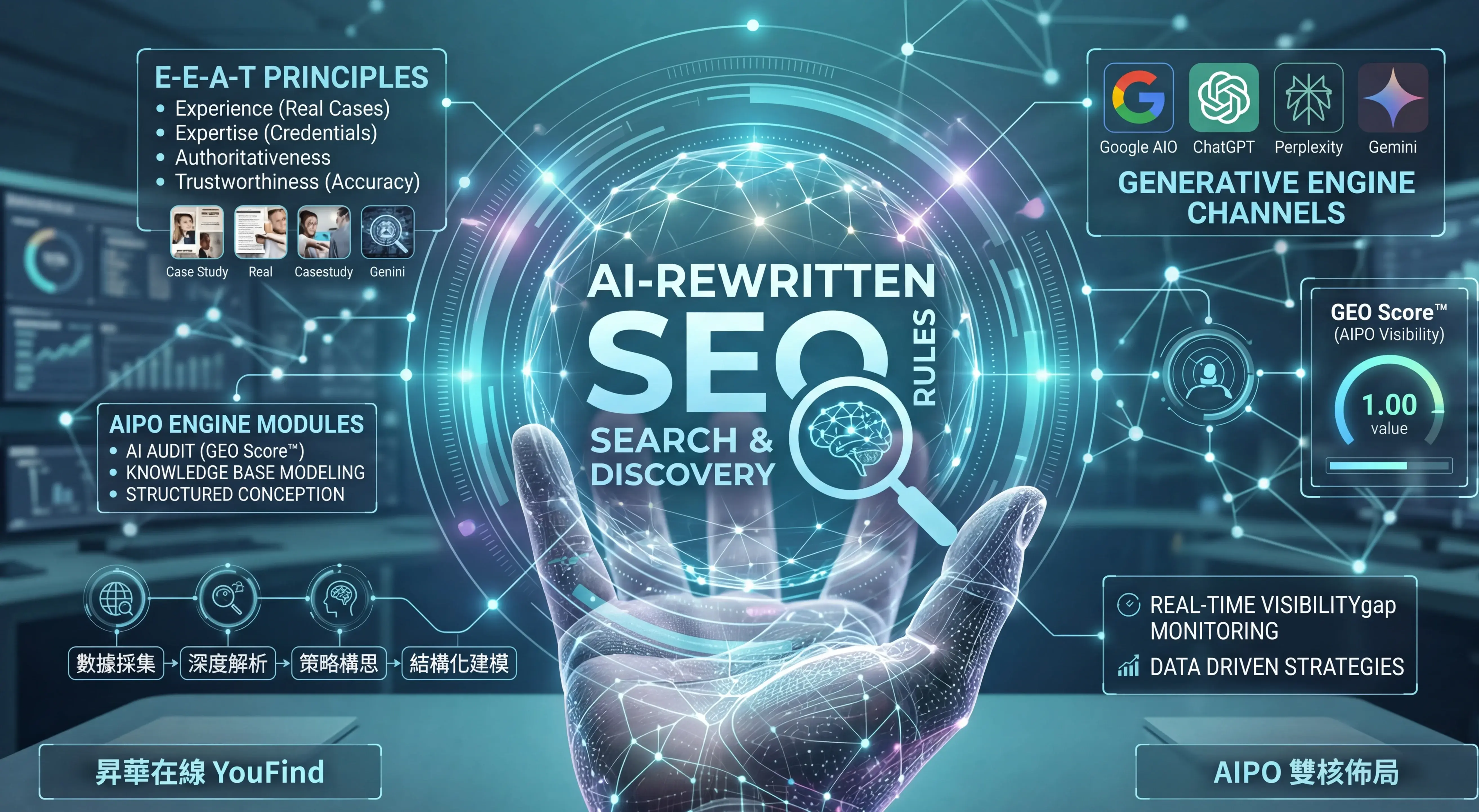
The Four-Phase "Content Intelligent Manufacturing" Logic of the AIPO Engine:
- Data Collection: Automatically crawl AI platforms' citation sources, locking in industry high-weight sources.
- Deep Analysis: Deconstruct competitors' content structure, filtering out knowledge points most easily extracted by AI.
- Strategic Conception: Combined with Google E-E-A-T principles, generate titles and content strategies with click-trigger appeal.
- Structured Modeling: Transform brand advantages into AI-preferred Source Centers, ensuring they become AI's preferred recommendation.
"Authority" at the Core: Deep Practice of E-E-A-T
To gain AI's favor in 2026, content must strictly follow Google E-E-A-T principles. This is no longer a slogan but tangible code and logic. In helping enterprises go global, we've found that AI tends to cite content that demonstrates real "Experience." For example, in healthcare, an article authored by a named doctor and containing clinical observation data has a much higher probability of being cited by AI as an answer than an encyclopedia webpage full of jargon.
Building Authoritativeness depends on "structured data markup." By importing Schema Markup (such as FAQ Schema or HowTo Schema), we clearly indicate the logical hierarchy of content to AI. When AI answers "How to..." or "Why..." questions, it can immediately capture the standard answers you've preset. This structured processing transforms brand content from fragmented information into a node in AI's knowledge graph.
To more intuitively understand this thinking shift, we can compare the differences between traditional content and AI authority content:
| Dimension | Traditional SEO Content Thinking | 2026 AIPO Authority Thinking |
|---|---|---|
| Core Goal | Get keyword rankings, pursue search volume | Get AI citation weight, pursue conversion and trust |
| Content Structure | Long-form, keyword density 3%-5% | Structured modules, high-information-density summaries and data |
| Trust Endorsement | Internal links and general external links | E-E-A-T evidence, professional certificates, first-hand research data |
| Technical Implementation | Modify HTML tags and Meta Data | Maximizer patent optimization + brand knowledge base modeling |
AIPO Practice in Five Major Hong Kong Industries
In Hong Kong, this highly specialized market, competition in finance, real estate, healthcare, education, and beauty industries has reached white-hot intensity. Using AIPO technology, we can achieve more precise commercial conversion:
- Finance and Insurance: When users ask AI "2026 Hong Kong tax deduction limit," our optimized content ensures the brand becomes the only citation source in AI summaries, building extremely high professional trust.
- Healthcare and Beauty: By showing professional medical team backgrounds and real-world test data, eliminate AI's sensitivity to YMYL content and boost brand exposure in health-related queries.
- Real Estate and Education: Use GEO keyword gap monitoring to precisely lock in high-conversion commercial words, directing AI traffic directly to real inquiries and orders.
Real-world cases show that after AIPO optimization, brands' citation rate in Google AI summaries can be boosted an average of 3.5x, with overseas inquiry volume rising about 22%. This proves that in the AI era, those with "authority" hold the pricing power of traffic.
Conclusion: Capturing the First-Mover Advantage in the AI Era
The rewriting of SEO rules is not scary — what's scary is using old-era "keyword" thinking to face new-era "authority" challenges. In 2026, the deciding factor in brand globalization and local marketing is whether you can become the answer AI trusts. Through YouFind's AIPO engine, we are not only optimizing webpages but also building a sustainable digital asset for brands.
Check Right Now Whether Your Brand Is “Missing” in the Eyes of AI
Don't become invisible in the era of AI search. Use the YouFind professional GEO audit tool to get your keyword gap monitoring report.
Get Your Free GEO Audit Report NowFrequently Asked Questions About AI SEO Authority (FAQ)
What Is GEO (Generative Engine Optimization)?
GEO is an optimization strategy targeting generative AI engines (such as Google AIO, ChatGPT). Through structured data, boosting content authority and information density, it ensures brand content is preferentially cited by AI and presented to users as the standard answer.
Why Does My Traditional SEO Rank Well but Traffic Is Declining?
This is because AI summaries directly answer user questions (Zero-click Search). If your content isn't cited by AI, users can get information without clicking into the webpage, causing traffic loss from traditional rankings.
How Does YouFind's AIPO Technology Differ From Ordinary AI Writing?
Ordinary AI writing only generates text, while AIPO is a data-driven optimization system. It includes the proprietary Maximizer patented system and GEO Score™ diagnosis, designed to boost a brand's "weight" and "citation rate" in AI engines — not just produce articles.
How to Measure a Website's Performance in AI Search?
You can get a report through YouFind's GEO audit tool. We mainly measure AI visibility, citation frequency, trigger mechanisms, and GEO keyword gaps versus competitors.
Want to more deeply cope with the marketing transformation in the AI era? Learn About AI Article Writing and begin your brand's authority transformation journey.