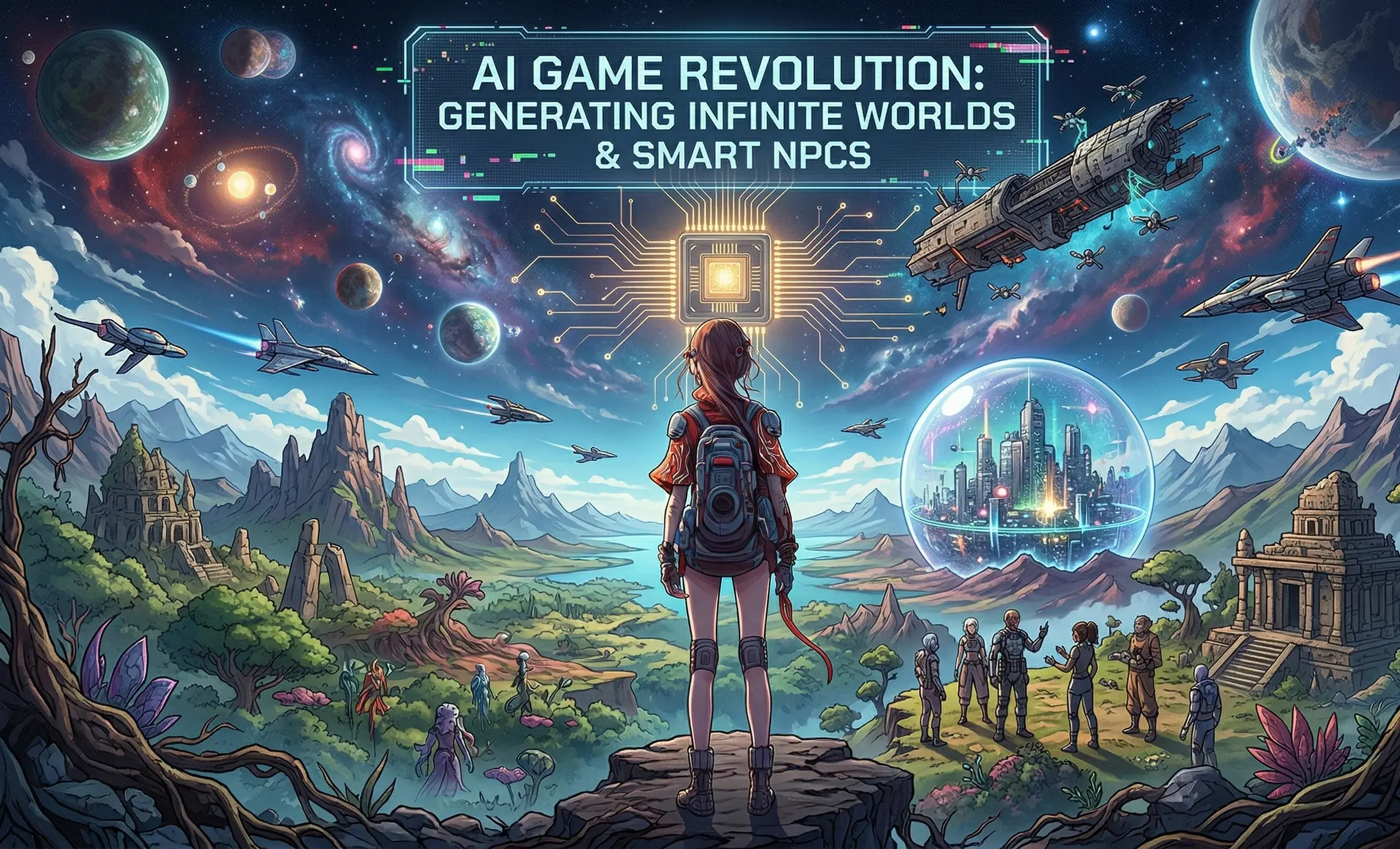
Have you ever had this experience: in a grand open-world game, you eagerly walk up to an old villager by the roadside, hoping to uncover some hidden storyline, only to receive the same cold, repeated dialogue? The existence of this "script wall" has long been the biggest bottleneck hindering game immersion. However, with the explosion of Generative AI, this situation is undergoing a seismic change. According to the latest industry surveys, over 70% of game developers are considering or have already begun integrating AI into their development process [Source: Unity 2024 Trend Report]. The core of this revolution is not just making game visuals more exquisite — it's about truly "awakening" games.
When Games "Awaken" — From Fixed Scripts to Generated Futures
Traditional game NPCs (Non-Player Characters) are essentially a rigid piece of "if-then" code. No matter what you do to them, their response is within the developer's preset range. This model is stable but lacks surprise. The emergence of AI gaming NPCs marks a paradigm shift in the underlying architecture of content generation. It means games are transforming from "display cases of prefab content" to "real-time interactive ecosystems."
In YouFind's nearly 20 years of digital marketing practice, we've found that "data-driven" applies not only to brand communication but is also the lifeline of content generation. The essence of AI gaming NPCs is the real-time processing of player input signals through large-scale language models (LLMs). Imagine you no longer select dialogue from menu options — you communicate directly with characters through voice or text, and the character's response is based on its personality settings, the current environment, and your previous interaction history. This shift from "fixed paths" to "generative logic" is the most vivid embodiment of AIPO (AI-Powered Optimization) logic in the entertainment field.
What Are the Core Breakthroughs of AI NPCs: How to Achieve "Real Dialogue" and "Emotional Resonance"?
To make players feel "I'm facing a living person," AI NPCs must cross the technological "singularity." This is not just about plugging in a chatbot — it involves extremely complex structured modeling and logical rigor.
- Dynamic Dialogue Systems: LLM-based NPCs have extremely strong intent recognition. They're no longer parrots — they can adjust tone and wording based on the player's emotional fluctuations. For example, if you behave arrogantly in conversation, an AI NPC may express dislike or even refuse to provide key quest clues.
- Persistent Memory and Evolution: This is the killer feature for boosting immersion. Through long and short-term memory mechanisms, NPCs can remember the quest you completed three hours ago or the life-saving kindness you once showed them. This sustained feedback based on historical data gives social relationships in the virtual world a sense of weight.
- Logical Constraints Based on E-E-A-T Principles: To prevent AI NPCs from "talking nonsense" and breaking immersion, developers need to build a tight "knowledge base" for them. In YouFind's AIPO technical logic, this is called structured modeling. By converting the game's worldview, history, geography, and racial taboos into AI-understandable weights, we ensure that every utterance by an NPC aligns with the game background, maintaining content "authority" and "consistency."
How to Build AI-Driven "Infinite Worlds": From Dynamic Maps to Personalized Quests
If AI NPCs give games a "soul," then the combination of Procedural Content Generation (PCG) with AI gives games "infinite flesh." Traditional open worlds often face the problem of "content consumed too quickly" — after 100 hours of exploration, the world loses vitality.
AI's intervention changes all this. Through deep collection and analysis of player behavior data, AI can adjust the game environment in real time. If you're a player who loves stealth, AI may dynamically generate more vertical building structures and more shadowy blind spots ahead; if you prefer hardcore combat, the terrain may evolve into a battlefield full of cover and elevation changes. This dynamic environment generation ensures that every player's experience is unique.
Going further, personalized quest chains are becoming reality. AI designs side stories in real time based on your play style. This closed-loop process — from player behavior analysis to strategic conception and then to automated content production — perfectly matches the AIPO engine's operational logic. It is no longer about blindly pushing content but about precisely matching needs.
Why Do Game Developers Need to Care: Brand Moat in the GEO Era
In the AI wave, game developers should not only optimize gameplay but also think: today, when players habitually use ChatGPT, Perplexity, or Gemini to check guides and reviews, how can your game brand survive? This is exactly the strategic core of crossing from SEO to GEO (Generative Engine Optimization) that we have proposed.
Traditional marketing competes for Google keyword rankings, but in the AIPO era, you must ensure that your game IP is preferentially cited and positively recommended by AI engines. For game brands, building a moat for the AI era requires the following strategies:
- AI Visibility Diagnosis: Using the proprietary GEO Score™ algorithm, analyze the frequency with which your game is cited across major AI platforms. When players ask AI "What are the most worthwhile open-world games in 2026?" — does your brand appear in the top recommended slot?
- Brand Knowledge Base Modeling: Structurally process the game's unique gameplay, equipment data, and background stories. This is like teaching AI to learn your business context, enabling it to cite accurate, authoritative information when answering player questions.
- Competitive Gap Monitoring: Use AI to monitor the evaluation trends of competitors on AI engines. If a competitor's copy is being criticized excessively, this is the best time for you to capture the weight of that segment through content intelligent manufacturing.
Comparison of Traditional SEO and Modern AIPO Strategy (for Gaming Brands)
| Dimension | Traditional SEO Strategy | Modern AIPO (GEO) Strategy |
|---|---|---|
| Core Goal | Get clicks on Search Engine Results Pages (SERP) | Get citation sources and positive recommendations in AI answers |
| Content Logic | Keyword stuffing and backlink building | Structured modeling and source weight based on E-E-A-T principles |
| Technical Core | Maximizer patented system (no architecture changes needed) | GEO Score™ diagnosis + AI content intelligent manufacturing engine |
| Conversion Focus | Vanity traffic (pageviews) | High-value inquiries and brand mindshare (citation rate) |
Professional Perspective: Ethics, Safety, and Compliance Principles for AI in the Gaming Industry
As an expert deeply engaged in overseas digital marketing for nearly 20 years, YouFind has always emphasized that the application of AI must be built on Trustworthiness. In the gaming industry, this involves several key dimensions:
First is content safety filtering. AI NPCs have randomness and must have strict firewalls to prevent them from producing discriminatory, violent, or socially inappropriate speech. This is not only a technical problem but a compliance problem. In jurisdictions with strict rule of law like Hong Kong, data privacy protection is the bottom line. When developers collect player behavior data to optimize AI logic, they must ensure the process is transparent and compliant with relevant laws.
Second is copyright and originality. Although AI can assist in generating large amounts of content, the core creative soul still belongs to humans. We need to mark which content is AI-generated, building honest connections with users. Truly high-quality AI content should be people-first, not a mechanical product seeking algorithm weight. This is the value Google SpamBrain advocates.
The Future Has Arrived: Reshaping Gaming Brand Power in the AI Search Era
AI gaming NPCs and dynamic generation technology are no longer plot elements of science fiction. As players' habits for obtaining information shift from "searching" to "asking," the gaming industry's marketing logic must evolve accordingly. YouFind, leveraging the AIPO engine's four standardized intelligent phases — from data collection to structured modeling — is helping numerous enterprises build new competitive advantages in the generative AI era.
Real-world data shows that through GEO optimization, brands' citation rates in Google AI summaries can rise up to 3.5x. In this rapidly changing era, rather than waiting to be redefined by AI, proactively use AIPO technology to make your gaming brand the "preferred answer" that AI engines trust most.
Check Right Now Whether Your Brand Is “Missing” in the Eyes of AI
Don't become invisible in the era of AI search. Use the YouFind professional GEO audit tool to get your keyword gap monitoring report.
Get Your Free GEO Audit Report NowFAQ: Common Questions About AI Gaming NPCs
1. Will AI NPCs Replace Human Game Writers?
Experts believe that AI is more an efficiency tool and inspiration amplifier. While AI can handle massive random dialogues and trivial tasks, the game's core themes, emotional arcs, and epic narrative structures still require human writers' delicate insight. AI handles "enriching the body"; humans handle "forging the soul."
2. How to Ensure AI-Generated Content Doesn't Contain Factual Errors?
This requires Retrieval-Augmented Generation (RAG) technology to link AI models to the game brand's authoritative proprietary databases. Through YouFind's brand knowledge base modeling, we can constrain AI to generate content only within the given business context and logical outline, effectively avoiding logical flaws caused by AI hallucinations.
3. How Specifically Does AIPO Technology Help Indie Game Developers?
For indie developers lacking massive marketing budgets, AIPO is the key to "overtaking on curves." By optimizing content structure so that AI preferentially cites your game when answering long-tail questions like "Which high-quality indie games would you recommend?" you can acquire highly precise traffic at extremely low cost, directly boosting overseas inquiries and download conversions.
To learn more about using AI to boost content production efficiency and optimize search engine performance, we welcome you to Learn About AI Article Writing.