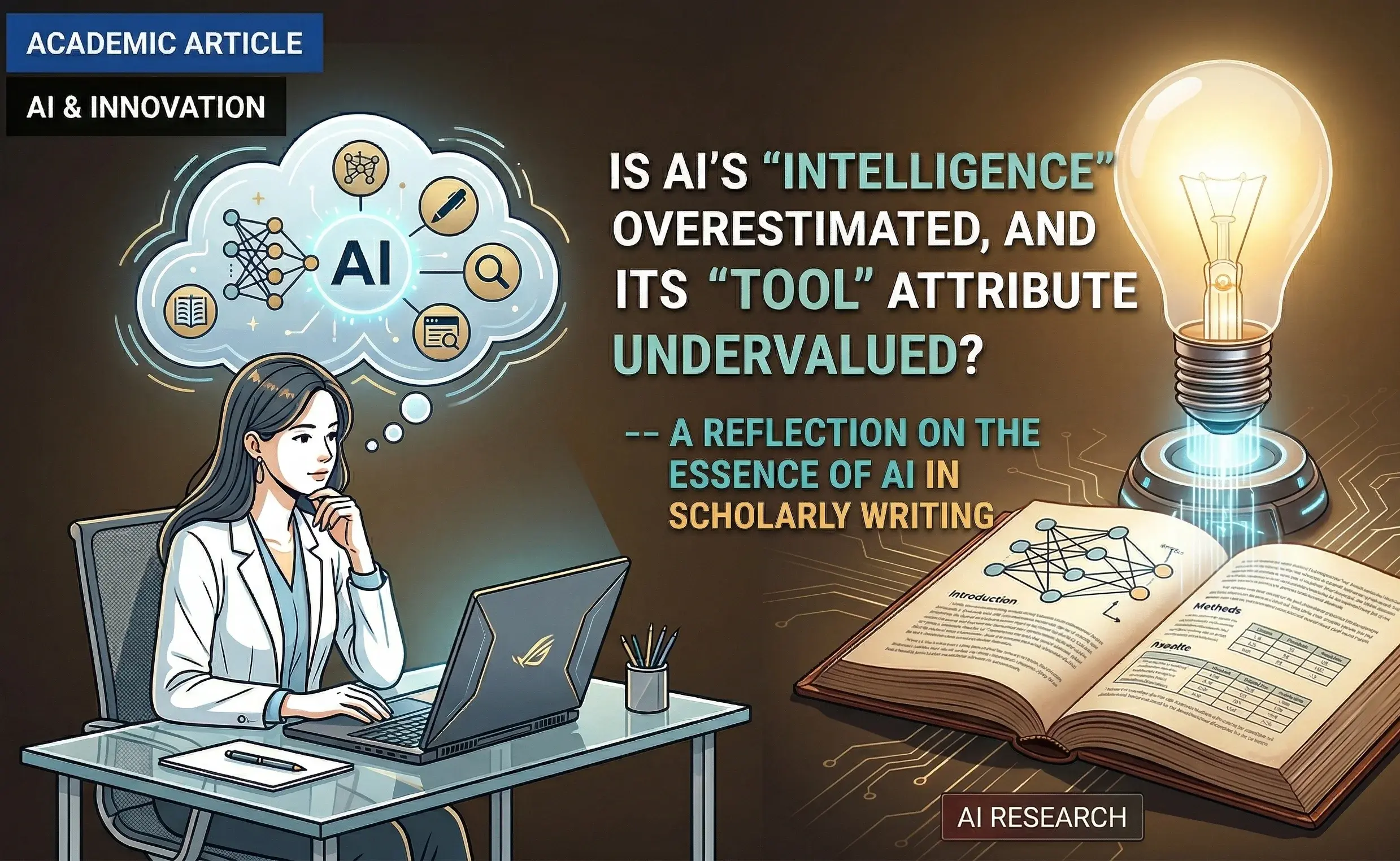
Open social media or a business weekly today and you can hardly avoid being surrounded by narratives like "AI replaces humans" and "AGI (Artificial General Intelligence) is about to awaken." When ChatGPT can write code like poetry and Gemini can fluently parse complex financial reports, we seem to have collectively fallen into a "techno-worship" fervor, instinctively treating AI as some kind of soulful, omniscient "intelligent being." However, according to one survey of enterprise decision-makers, over 60% of AI projects fail — not because the technology isn't powerful enough, but because users mistake AI for a "brain" rather than a "tool."
When we over-deify AI's intelligence and overlook its core "tool" nature, enterprises begin to face resource misalignment and strategic confusion. For professionals, engineers, and marketers in North America or engaged in overseas business, clarifying the essence of AI is the only watershed for turning from "technological anxiety" to "technological profit."
What Is the Essence of AI? Why Is It Just Advanced Pattern Matching?
To understand AI's limits, we must peel off its seemingly "human-like" outer layer. The underlying logic of Large Language Models (LLMs) is essentially a large-scale mathematical prediction game: "Next Token Prediction." When you ask it "What color is the sky?" it's not actually looking up at the sky, nor "thinking" about the definition of blue — it calculates, based on probability distributions over massive corpora, that the word most likely to follow "sky" is "blue."
This is the essence of AI: extreme Pattern Matching. It excels at extracting correlations from chaotic data, not reasoning about causation. Human intelligence has consciousness, emotion, and moral constraints, while AI is merely a powerful "digital lever." It amplifies the user's intent and instructions (Prompting) — it has no spontaneous intent of its own. If you feed it low-quality junk data, it returns only beautifully packaged "data waste."
| Dimension | Human Intelligence | AI Intelligence (Essence: Tool) |
|---|---|---|
| Operating Logic | Causal reasoning and logical deduction | Probabilistic prediction and pattern recognition |
| Source of Consciousness | Subjective consciousness, emotion, and experience | Unconscious algorithms and matrix operations |
| Decision Basis | Values, morality, and dynamic environment | Correlations in static historical data |
Why Does Confusing "Intelligence" With "Tool" Create Risks in Specialized Industries?
In YMYL (Your Money or Your Life) fields such as finance, healthcare, and law, the cost of blurring this boundary can be devastating. AI has an inborn flaw: data hallucination. Because it only "predicts" and doesn't care about "facts," it may confidently fabricate legal clauses or medical diagnosis recommendations without any responsibility for the real world.
Under Hong Kong's heavily regulated financial framework, if analysts blindly rely on AI-generated forecasts without professional verification, they face not only regulatory scrutiny (e.g., SFC) but also complete erosion of client trust. This is why Google repeatedly emphasizes E-E-A-T (Experience, Expertise, Authoritativeness, Trustworthiness) in its search guidelines. AI can help you organize data and polish tone, but it cannot replace your professional experience or industry credentials. It is the brush in your hand — not the painter.
How to Precisely Master the AI Tool: Strategic Shift From Traditional SEO to GEO
Since we acknowledge that AI is a "powerful information extractor," brand owners' and creators' strategies must evolve. User behavior patterns are undergoing dramatic change: they no longer merely click links in search engines — they ask AI directly. This gave rise to GEO (Generative Engine Optimization).
To survive in the AI era, your brand content must be "fed" in a way AI likes. This means you can no longer rely on keyword stuffing. You need to build structured, authoritative content so that AI considers your content the most reliable "source data" in its domain.
- Structured Data Modeling: Use FAQ Schema and similar markup to let AI quickly grab core Q&A information.
- Reinforce E-E-A-T Signals: Show real test data, first-hand case studies, and professional credentials in your content.
- Source Center Construction: Teach AI to learn your business context so that when generating answers it preferentially cites your brand assets.
YouFind AIPO Dual-Core Layout: Building a Brand Moat in the Generative Era
YouFind has been deeply rooted in overseas digital marketing for nearly 20 years — we understand the commercial essence behind technological iteration. In response to the current AI wave, we were the first to launch the AIPO (AI-Powered Optimization) engine. This is not merely optimizing search rankings — it is optimizing a brand's "weight" in AI's mind.
Using our proprietary GEO Score™ algorithm, we can precisely diagnose your brand's visibility across mainstream AI engines such as ChatGPT, Gemini, and Perplexity. Many enterprises have rankings in traditional search but disappear in AI summaries (Google AIO). Our AIPO engine transforms your content into authoritative summaries that AI prefers through four phases: data collection, deep analysis, strategic conception, and structured modeling.
Leveraging the Maximizer system with its SEO patents, we help clients achieve the "traditional SEO + AI Platform Optimization (AIPO)" dual-core layout without changing the site architecture or rebuilding the site. Real-world data proves that enterprises optimized through AIPO see overseas inquiry volume increase by an average of 22% and citation rates in Google AI summaries soar 3.5x. This is the compounded effect of mastering the essence of the tool.
Check Right Now Whether Your Brand Is “Missing” in the Eyes of AI
Don't become invisible in the era of AI search. Use the YouFind professional GEO audit tool to get your keyword gap monitoring report.
Get Your Free GEO Audit Report NowFrequently Asked Questions About the Essence of AI and AIPO Optimization
Will AI-Generated Content Be Penalized by Google?
Google's "Helpful Content System" does not penalize AI creation — it penalizes "low-quality content that lacks value." As long as your content meets E-E-A-T principles and genuinely solves user problems, whether AI-assisted or human-written, it will be favored by the algorithm. AIPO's core is precisely helping you polish this high-weight, high-quality content.
With ChatGPT, Why Do I Still Need AIPO Optimization?
ChatGPT's answers are based on extracting existing information. If your brand information isn't correctly and authoritatively structured, AI will not cite you — or it may even mislead users. The purpose of AIPO is to ensure that when users ask AI, the answer AI gives is your brand.
Is Traditional SEO Still Useful?
Traditional SEO is the foundation, AIPO is the spire. We are currently in a dual-track era — Google AIO still cites information from traditional web pages. Optimizing AIPO simultaneously reinforces the authority of traditional SEO.
AI is a tool by nature, and the value of a tool is always held by those who use it well. In this era, the most frightening thing is not AI itself but the enterprises still looking at new tools with old mindsets. Want to seize the initiative in the generative search wave? Learn About AI Article Writing in depth and make your brand the authoritative source of the AI era.