Have you noticed that customers today are no longer satisfied with just typing keywords into a search box? They're starting to ask AI directly: "Plan a business trip to Shanghai for me and compare the three most cost-effective five-star hotels." At this point, what decides your brand's fate is no longer the top three rankings on the search results page but rather who AI will cite in its answer. The explosion of China's AI Agents marks the internet's evolution from "finding information" to the "agent era of executing tasks."
From "Dialogue" to "Execution": Why Are China's AI Agents Rewriting Business Rules?
A so-called AI Agent (Intelligent Agent) is no longer just a chatbot that chats with you — it has the ability to autonomously plan, maintain short- and long-term memory, and call external tools (APIs). For Chinese entrepreneurs in North America or overseas marketers positioning for global markets, this is not just a technology innovation — it's a complete reorganization of the traffic entry point. If AI doesn't crawl your brand data when generating answers, then in users' eyes your brand is "invisible."
Currently, the domestic large-model field has formed a three-way standoff: Baidu's Wenxin Yiyan, with its deep search ecosystem; Alibaba's Tongyi Qianwen (Qwen), backed by e-commerce and supply chain DNA; and Zhipu's Qingyan (GLM-4), rising with scientific research foundations and open-source flexibility. Whoever wins this "agent" race will directly determine enterprises' marketing efficiency and conversion rates for the next decade.
Core Evaluation: Real-World Test Performance of the Three Major AI Agents — Baidu, Alibaba, Zhipu
To intuitively compare the business processing capabilities of these three, we set up a complex commercial scenario: "Plan a business trip to Beijing including industry trade show info, hotel comparisons fitting the budget, and generate an exportable itinerary."
In real-world testing, Baidu's Wenxin Yiyan demonstrated a strong "local expert" advantage. Thanks to the integration with Baidu Maps and the search ecosystem, it was extremely smooth in calling real-time traffic and hotel dynamic data, and the task decomposition logic fit Chinese workplace habits very well. Alibaba's Qwen was one step ahead in logical rigor — it automatically analyzed the cost-effectiveness model of different hotels and gave advice similar to a "supply chain management" perspective. Zhipu's GLM-4 performed more like a rigorous research assistant, providing the most detailed trade show background information, but slightly lagged behind the other two in tool-call response speed.
Comprehensive Capability Comparison Table of Mainstream AI Agents
| Evaluation Dimension | Baidu Wenxin Yiyan (Agent) | Alibaba Tongyi Qianwen (Qwen) | Zhipu GLM-4 |
|---|---|---|---|
| Task Decomposition | Extremely high: excels at complex instruction decomposition | High: rigorous logic, suitable for commercial computation | Medium: more inclined toward academic decomposition |
| Tool Call Stability | Excellent: complete ecosystem chain, rich APIs | Good: strong e-commerce and payment API calls | Medium: fewer external plugin integrations |
| Data Timeliness | Extremely good: real-time sync of search data | Good: broad industry data coverage | Good: relies on training corpus |
| Brand Citation Potential | Highest: deeply integrated with Baidu AIO | High: high citation rate in B2B scenarios | Medium: more suited for professional knowledge base indexing |
In-Depth Analysis: Why Enterprises Should Look Beyond "Rankings" and Focus on "Citation Rate"
In the traditional SEO era, we competed for Google's or Baidu's first page by stacking keywords. But in the AI Agent era, the decision logic has changed. AI filters sources it deems most reliable based on the Google E-E-A-T principles (Experience, Expertise, Authoritativeness, Trustworthiness). If your content lacks structured modeling or isn't cited by recognized authoritative sites, AI will abandon you and recommend your competitors instead.
Experts believe that future brand competition is a competition for "citation slots." The essence of AI Agents is filtering noise — they'll only present to users the 1-3 sources they trust most. Therefore, how to get your brand data into AI's "preselected library" has become the core topic of GEO (Generative Engine Optimization). This is precisely the intent behind YouFind's proposed AIPO (AI-Powered Optimization) concept: not only capturing traditional rankings but building brand authority in AI's eyes.
The AIPO Dual-Core Layout: How YouFind Helps Brands Build an AI Moat
Facing the rapidly changing AI environment, many enterprises feel anxious: do I have to scrap my existing website and rebuild it? YouFind's answer is no. Through our proprietary patented technology — the Maximizer system's SEO optimization, we can significantly boost website weight through optimization of the external data environment without altering web architecture. For industries with strict process compliance requirements such as finance and healthcare, this saves huge amounts of cumbersome internal approval and technical development costs.
YouFind's AIPO engine ensures your brand becomes AI's first choice through four standardized phases:
- AI Audit and Visibility Diagnosis: Through the proprietary GEO Score™ algorithm, monitor brand citation rates across ChatGPT, Gemini, and Wenxin Yiyan, precisely identifying keyword gaps competitors have occupied.
- Data Collection and Path Tracking: Automatically crawl citation sources on AI platforms, analyzing which authoritative sites are influencing AI's judgment.
- Structured Modeling: Structurally process brand content to make it easier for large models to extract as "summaries" or "core viewpoints."
- Real-Time Alert System: Once a competitor gains a new citation in an AI recommendation slot, the system immediately alerts, helping enterprises quickly counterattack.
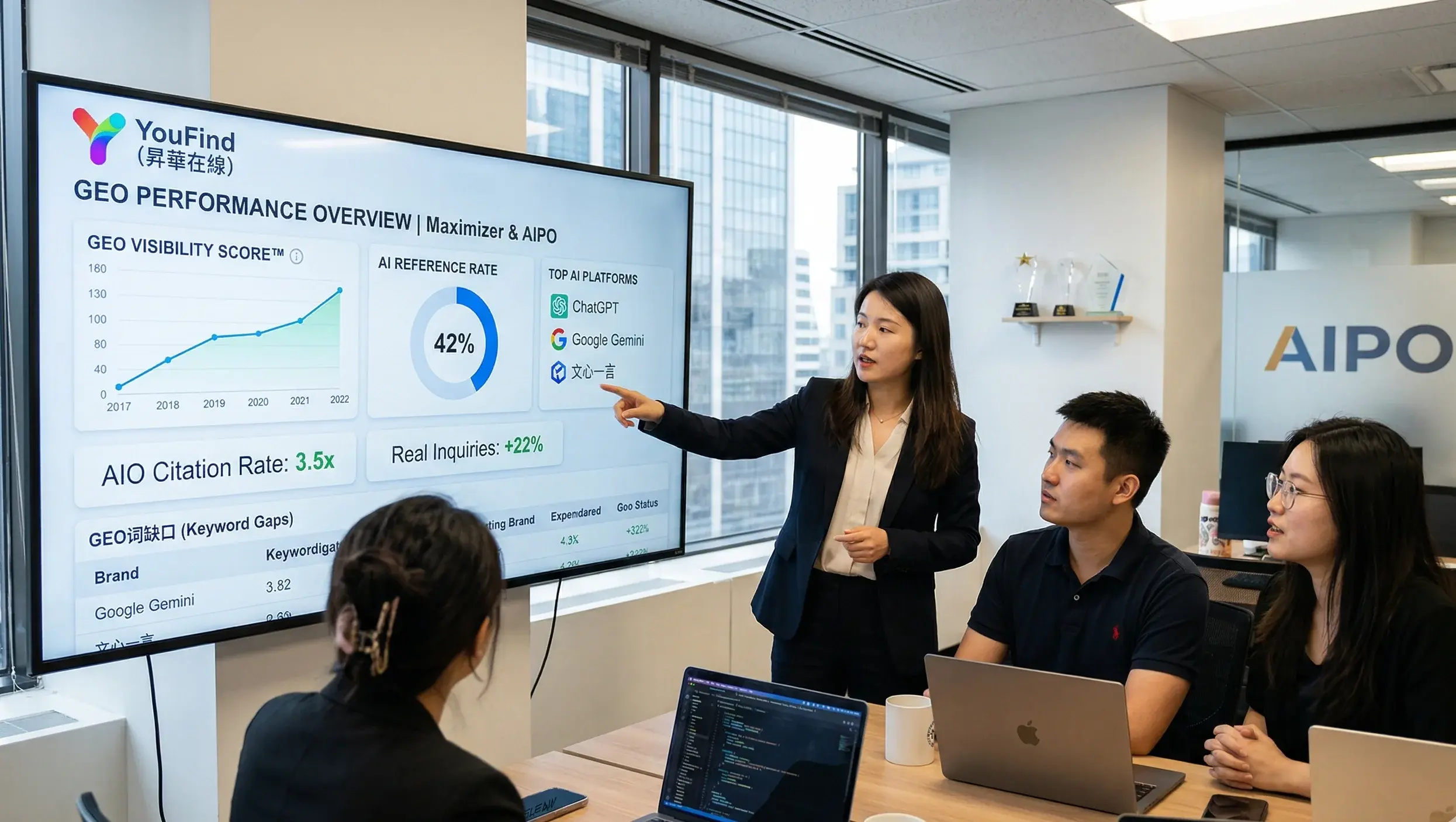
According to real-world testing data, enterprises optimized through AIPO see their citation rate in Google AI summaries (AIO) rise by an average of 3.5x, and overseas real inquiry volume increase by 22%.
AI Agent Application Strategies for Key Industries in Hong Kong
AI Agent deployment strategies have different emphases depending on industry pain points. In finance and healthcare, security and compliance are paramount. When AI crawls information, it preferentially selects sources with clear expert backgrounds (Experience) and authoritative certifications (Authoritativeness). Therefore, content creation must maintain extremely high purity and avoid any factual errors. For real estate, beauty, and retail industries, scenario-based content and visualized data are the "hooks" that attract AI crawling. You need to make AI feel your content is not only real but also extremely reference-worthy.
In the overseas expansion of Chinese enterprises in North America, making good use of the AIPO engine can effectively solve the "brand silence" problem caused by language and cultural differences. Through precise GEO deployment, let AI become your "super salesperson," accurately recommending your services at every stage of user inquiry.
Check Right Now Whether Your Brand Is “Missing” in the Eyes of AI
Don't become invisible in the era of AI search. Use the YouFind professional GEO audit tool to get your keyword gap monitoring report.
Get Your Free GEO Audit Report NowFrequently Asked Questions About China's AI Agents and AIPO
What Is GEO (Generative Engine Optimization)?
GEO is a brand-new optimization strategy aimed at boosting brand visibility and citation frequency in generative AI responses (such as Google AIO, ChatGPT, Wenxin Yiyan). It focuses on how to make AI models learn and recommend your brand information.
How Is AIPO Different From Traditional SEO Advertising?
Traditional SEO focuses on search results page rankings, while AIPO (AI-Powered Optimization) focuses on being "cited by AI." AIPO not only includes traditional ranking optimization but also, through the Maximizer patented system and structured data modeling, lets brands occupy core recommendation slots in AI-generated content — with stronger long-term effectiveness and conversion rates.
Why Should Enterprises Deploy for China AI Agent Recommendation Slots Now?
Because AI has "first-mover" learning characteristics. Once a brand's authority in a specific field is confirmed by AI and included in the knowledge base, latecomers will have to pay multiples of the cost to surpass it. Seizing AI recommendation slots is seizing the "distribution center" of future traffic.
In this new era of AI-driven marketing, choosing the right track and tools is crucial. If you want your brand to stand out in AI search, please Learn About AI Article Writing and begin your AIPO transformation journey.