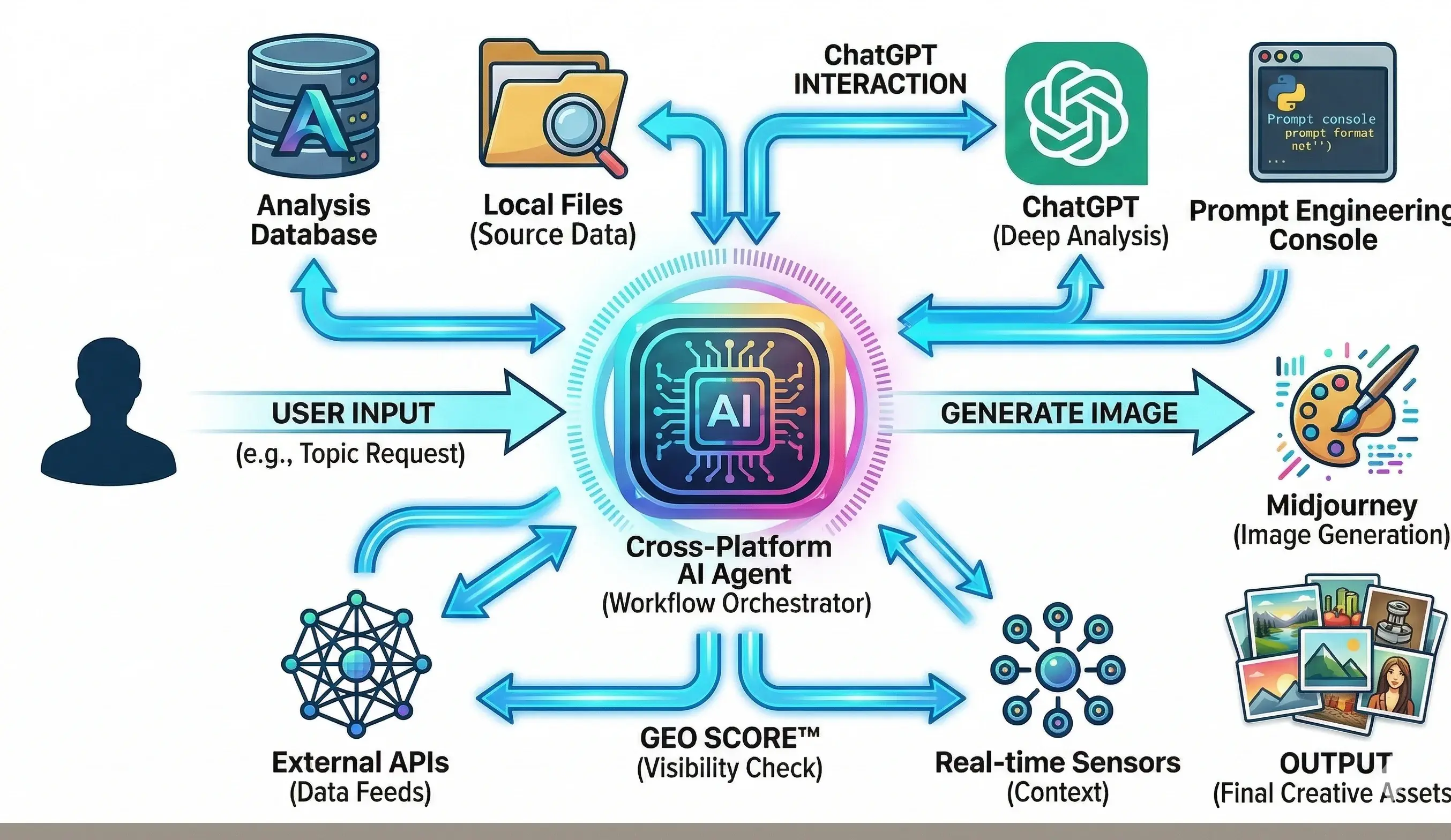
Have you ever been trapped in this "digital mover" cycle: first carefully tuning a perfect piece of copy in ChatGPT, then manually copying key descriptions, switching to Discord, pasting them into Midjourney, and repeatedly tweaking parameters until the image comes out, and finally manually downloading and uploading to your website or social media? For professionals in North America or overseas marketers, this fragmented workflow not only consumes huge creativity but also wastes precious commercial timing in the rapidly iterating AI era.
A true productivity revolution isn't just about learning to use a single AI tool — it's about building an "AI workflow." According to a McKinsey report, generative AI can bring up to $4.4 trillion in annual value growth to the global economy, and the core driver is "automation." Today we'll dive into how to use the core logic of AIPO (AI-Powered Optimization) to seamlessly connect ChatGPT's brain with Midjourney's brush, building a fully automated "content intelligent manufacturing" pipeline.
What Is AI Workflow Automation? Why Is It Critical for Enterprises Going Global?
Simply put, an AI workflow connects multiple AI models (such as LLMs for text and diffusion models for images) through technical means, enabling them to automatically pass data and execute tasks according to predefined logic. In YouFind's 20 years of overseas digital marketing experience, we've found that mere content stacking can no longer satisfy Google's latest E-E-A-T principles. Current search engines, especially Google with AI Overview, value Experience and Expertise more than anything.
Through automated workflows, enterprises can ensure every generated image and every piece of produced copy has high consistency and structural characteristics. This is not only to save labor — it's also to meet the core logic of GEO (Generative Engine Optimization), making it easier for AI engines to crawl, understand, and preferentially cite your brand content. When your content is logically structured, AI feels like it has found a perfect manual and is more inclined to recommend your products when answering user questions.
How to Build Structured Content Modeling Driven by the AIPO Engine?
To make AI collaborate, you must first establish a "standard operating procedure" (SOP). Under the AIPO framework, we no longer enter prompts casually — we perform structured modeling. This involves the following four key phases:
- Data Collection: Automatically crawl citation sources for specific questions across mainstream AI platforms to understand what type of answer AI currently prefers.
- Deep Analysis: Deconstruct competitors' content structure and find the authoritative summary characteristics most easily extracted by AI.
- Strategic Conception: Transform brand advantages into logic chains aligned with AI algorithm preferences.
- Structured Modeling: The most critical step — converting the above information into AI-friendly formats to ensure it becomes the first-choice source when ChatGPT or Gemini cites content.
The core of this methodology lies in meeting Google's Trustworthiness requirement. When your automation pipeline is built on a real, accurate brand database, the output is no longer "AI hallucination" but commercially valuable professional assets.
Tool Comparison: Choose the Best AI Automation Connection Solution for You
To achieve cross-platform linkage between ChatGPT and Midjourney, you need a "middleman" to transfer information. Below is a comparison of the mainstream automation paths on the market today:
| Tool / Solution | Target Audience | Core Advantages | Implementation Difficulty |
|---|---|---|---|
| Zapier / Make | Small and medium enterprises, content creators | No-code, drag-and-drop configuration, supports 5000+ apps | Low |
| Python + Discord API | Technical teams, cross-border e-commerce giants | Extremely flexible, deeply customizable filtering logic | High |
| YouFind Maximizer | Enterprises going global, brand owners | No site rebuild required, patented system directly optimizes AI weight | Low (handled by experts) |
For most efficiency-seeking enterprises, the advantage of using the Maximizer patented system is that it can interface directly with the AIPO engine without altering the web architecture. This means your automated image-text content can be precisely placed in positions AI easily crawls, drastically saving development costs.
Practical Tutorial: Four Steps to Build an Automated Pipeline From ChatGPT to Midjourney
Want to turn ChatGPT's analysis results directly into beautiful Midjourney posters? You can refer to the following practical steps:
How to Design ChatGPT Prompt Engineering to Fit Image Generation?
First, you need to give ChatGPT the persona of a "prompt architect." Don't just ask it to describe an image — require it to output in Midjourney's parameter format. For example: "Based on this financial analysis report, generate 3 Midjourney prompts that must include --ar 16:9, --v 6.0 parameters and use professional photography style descriptions."
How to Achieve Seamless Data Transfer via Webhooks?
Use Make (formerly Integromat) to monitor ChatGPT's API output. When content with specific tags is generated, the webhook automatically grabs these prompts and removes filler like "This is a picture about..." keeping only the core instructions.
Why Use Discord to Indirectly Call Midjourney?
Midjourney currently runs mainly on Discord. Using an automation tool to send slash commands (/imagine) to a specified Discord channel triggers image generation. This step is key to enabling "content factory" batch production.
How to Automatically Sync Generated Content to the Brand Resource Center?
The final step is to reassemble the generated images with the original copy. The AIPO engine automatically applies structured data markup (such as ImageObject and Article Schema) to these images and text and pushes them to your website. This way, when users search related questions in Google AIO, your brand content is preferentially displayed because it is "illustrated and logically rigorous."
How Can Hong Kong's Top Five Industries Apply AI Workflows to Boost Conversions?
Different industries have different AI needs, but the core goal is the same: boost visibility and trust.
- Finance and Healthcare (YMYL): These two industries demand extremely high accuracy. Using an AI workflow, ChatGPT can first review data based on the latest regulations (such as Hong Kong SFC guidelines) and then generate professional data charts, ensuring content meets the "Authoritativeness" of E-E-A-T.
- Real Estate and Beauty: These are "visual-first" fields. Through automated workflows, real estate agents can quickly turn raw-room descriptions into finished renderings; beauty institutions can automatically generate brand-aligned before-and-after case comparisons, reinforcing the "Experience" dimension.
- Cross-Border E-Commerce and Retail: Use AI to monitor competitors' GEO keyword gaps. Once you find a competitor's AI citation rate drops for a specific keyword, the automation workflow immediately launches, producing high-quality content to fill the gap and seize AI recommendation slots.
As we've seen in serving thousands of enterprises going global, optimized brands see citation rates in Google AI summaries increase an average of 3.5x, with inquiry volume rising about 22%.
Check Right Now Whether Your Brand Is “Missing” in the Eyes of AI
Don't become invisible in the era of AI search. Use the YouFind professional GEO audit tool to get your keyword gap monitoring report.
Get Your Free GEO Audit Report NowFrequently Asked Questions About AI Workflows and AIPO (FAQ)
Why Not Just Use ChatGPT to Generate Content — Why Use the AIPO Engine?
Simply using ChatGPT easily leads to "AI hallucinations" and serious content homogenization. The AIPO engine is based on YouFind's proprietary GEO Score™ algorithm, which analyzes a brand's citation gaps across mainstream AI engines, ensuring that generated content is not only "written" but also "chosen."
Will Automatically Generated Images and Text Be Penalized by Google Search?
Google's "Helpful Content System" penalizes low-quality garbage written for search engines. As long as your AI workflow is based on solving user problems and providing unique insights (such as integrating proprietary brand data or real-world testing experience), Google will give it high ratings.
How Can SMEs Launch This System at Low Cost?
This is exactly the advantage of the YouFind Maximizer patented system. You don't need to pay expensive technical R&D fees to rebuild your site — just integrate the AIPO engine on the existing architecture to achieve the transformation from traditional SEO to GEO. This is a "lightweight" yet "high-return" deployment.
In the AI-driven search ecosystem, being one step ahead means occupying the traffic dividend for the next decade. Rather than watching, start optimizing your AI deployment now and make your brand the top choice AI recommends.
Want to dive deeper into building your own automated content system? Learn About AI Article Writing and begin your AIPO transformation journey.