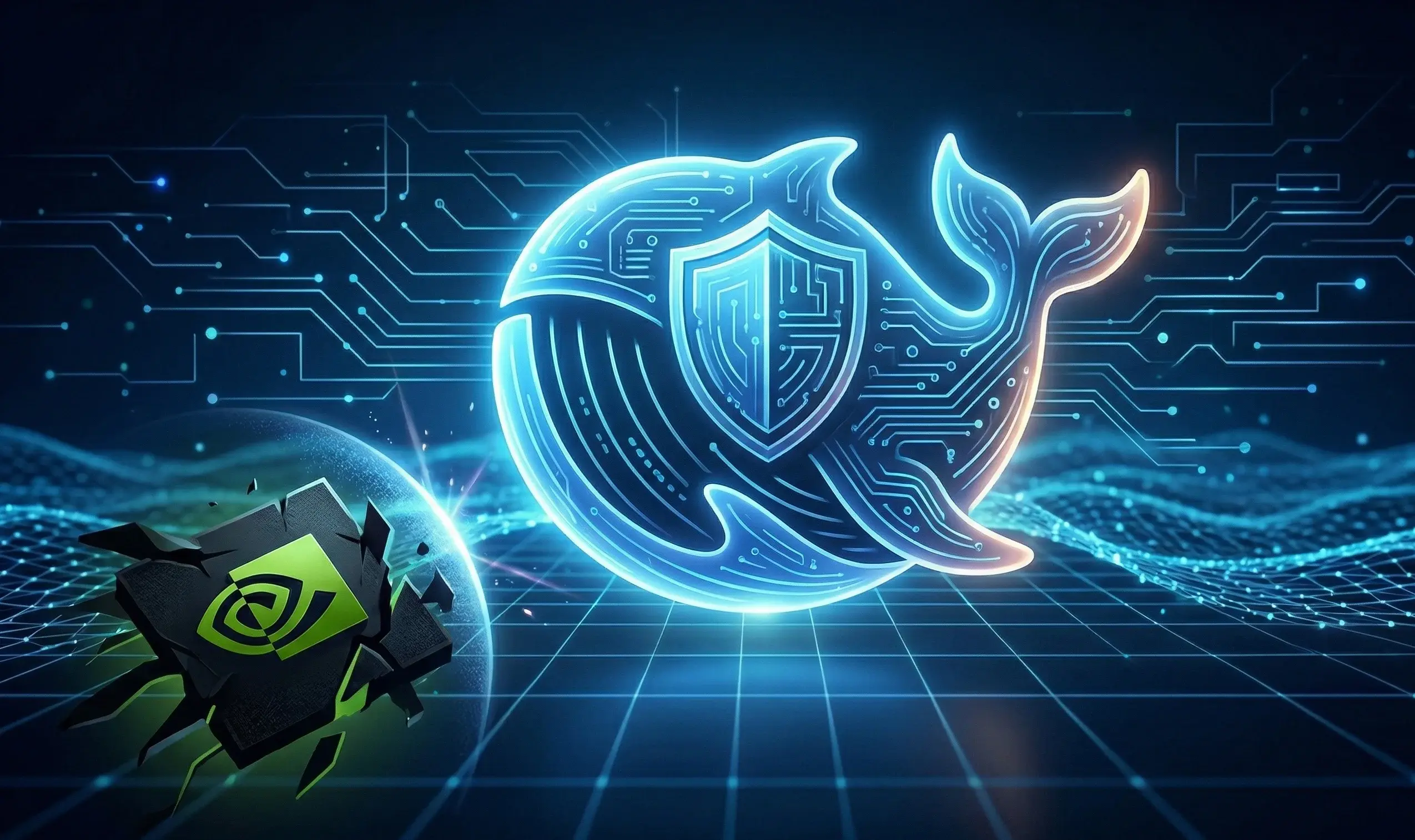
Have you also felt that uneasy stir in the global AI circle? Just when everyone was watching OpenAI's next update, China's DeepSeek (Deep Seek) once again became the “uninvited guest” stirring up the pool. From V3 to R1, DeepSeek achieved performance rivaling GPT-4 at extremely low training cost, completely shattering Silicon Valley's myth that “computing power decides everything.” However, with DeepSeek V4's release imminent, news that shocked the industry came out: this company refused to show Nvidia (NVIDIA) details of its latest model as before. This unusual move not only embarrassed the hardware giant but also revealed that China-US AI competition has entered a new era of “algorithmic sovereignty.”
DeepSeek V4: The Strategic Game and Politics Behind the Rule Breaker
In traditional AI development ecosystems, model developers typically work closely with Nvidia, sharing model architectures in advance to obtain deep CUDA (Nvidia's parallel computing platform) optimization. However, DeepSeek V4 chose to “close the door and practice” — this is by no means simple technological pride but a strategic defense based on three deep logics.
- Underlying Revolution Decoupling From CUDA Dependency: For a long time, all global AI ran on Nvidia's established ecosystem. But with continuously tightening US chip export controls, DeepSeek may be working to decouple V4 architecture (such as further-evolved MLA Multi-head Latent Attention) from standard CUDA paths. If algorithms can directly adapt to domestic computing power or general chips, then Nvidia's “moat” is no longer essential to DeepSeek.
- Algorithmic Sovereignty and Commercial Security: In today's geopolitically sensitive era, core weights and training methods are the lifeblood of enterprises. Refusing to demonstrate aims to prevent core logic from being reverse-engineered, ensuring China's original algorithms have absolute black-box advantages when facing global competition.
- “Biodiversity” Responding to Computing Power Blockades: Darwin's evolution theory tells us that closed environments often breed unique species. Under computing power restriction pressure, DeepSeek is forced to maximize algorithmic efficiency. V4's mystery is actually its “secret weapon” evolved in extreme environments.
The table below compares the essential differences between traditional AI development modes and DeepSeek's “island-style” development mode:
| Dimension | Traditional AI Development Mode (Silicon Valley-led) | DeepSeek Island-Style Development Mode |
|---|---|---|
| Hardware Synergy | Deep dependence on Nvidia CUDA ecosystem for pre-optimization | Algorithm autonomy; prioritizing diverse computing power environments |
| Transparency | Sharing model architecture with chip vendors for performance | Highly closed; protecting underlying training logic and weights |
| Evolution Path | Computing power stacking; pursuing parameter scale breakthroughs | Algorithm optimization; pursuing highest intelligence ratio per compute unit |
| Supply Chain Risk | High (vulnerable to single chip supplier fluctuations) | Low (stronger environmental adaptability and migration capability) |
From Computing Power Race to Algorithmic Sovereignty: The New Landscape of China-US AI Competition
Once, China-US AI competition was simplified into a contest of “H100 chip count.” But DeepSeek V4's emergence marks a shift in the balance: Chinese enterprises start to realize that since they can't buy the most advanced “shovels,” they should improve their “gold-mining” technique. This represents a strategic shift from “computing power hegemony” to “algorithmic sovereignty.”
Nvidia's position in the Chinese market is becoming subtle. On one hand, special edition chips (such as H20) have been performance-castrated; on the other hand, domestic computing power represented by Huawei and Cambricon is rapidly catching up. If leading models like DeepSeek no longer prioritize Nvidia adaptation, the foundation of hardware hegemony will shake. This decoupling won't happen in a day, but DeepSeek V4's nonconformity is undoubtedly an important symbol of China-US tech “soft decoupling.”
The AIPO Era: How Will DeepSeek V4 Change Brand Visibility?
As professional marketing observers, we (YouFind) find that DeepSeek V4's impact extends far beyond the lab — it will directly rewrite enterprise survival rules in the AI search era. With models such as DeepSeek R1 spreading among global developers and individual users, how AI engines (such as ChatGPT, Perplexity, DeepSeek) cite content is becoming the new battlefield of brand marketing.
Why Will V4's Rise Reshape GEO (Generative Engine Optimization)?
When AI models become more independent and smarter, their screening of information sources becomes more strict. DeepSeek V4 is expected to achieve leapfrog improvements in Reasoning and multimodal capabilities. This means if your brand content lacks depth, has chaotic logic, or hasn't been structurally processed, AI will directly ignore you when answering user questions. This is exactly why we propose AIPO (AI-Powered Optimization) dual-core deployment: in an era when AI rules information, being cited by AI is more important than ranking first in traditional search results.
How Should Enterprises Respond? YouFind AIPO's Practical Brand Moat Recommendations
Facing the multi-polar AI model landscape of DeepSeek, OpenAI, and Google, if enterprises only focus on traditional SEO optimization, it's like sticking to a telegraph machine in the 5G era. You need a complete GEO (Generative Engine Optimization) plan to ensure your brand becomes an “authoritative citation source” across AI models with different underlying logics.
- Establish AI Brand Knowledge Base Modeling: Don't let AI guess your business across the web. By building a Source Center matching AI citation preferences, proactively teach AI to learn your business context, making it preferentially extract your official data when generating answers.
- Use GEO Score™ for Visibility Diagnostics: YouFind's proprietary GEO Score™ algorithm can monitor brand citation rate gaps on mainstream platforms such as DeepSeek and ChatGPT in real time. If competitors are cited but you haven't appeared, this is the “high-value keyword gap” you must immediately fill.
- Import Structured Modeling With EEAT Principles: AI loves logically rigorous, well-evidenced content. By internalizing Google's EEAT (Experience, Expertise, Authoritativeness, Trustworthiness) principles into every brand article and combining with Schema structured data markup, you can greatly boost the chances of content being chosen by AI as a “featured summary.”
Check Right Now Whether Your Brand Is “Missing” in the Eyes of AI
Don't become invisible in the era of AI search. Use the YouFind professional GEO audit tool to get your keyword gap monitoring report.
Get Your Free GEO Audit Report NowFAQ: Common Questions About DeepSeek V4 and Global AI Trends
Q1: When Is DeepSeek V4 Expected to Release?
According to industry trends and DeepSeek's past high-frequency iteration rhythm, the industry predicts V4 is very likely to officially debut within 2025. Its core focus will be enhancing complex logical reasoning and significantly reducing inference costs for multimodal tasks.
Q2: Why Is Nvidia No Longer as Indispensable to Chinese AI Models as Before?
Not unimportant — “forced to substitute.” Due to high-end chip import restrictions, leading Chinese enterprises like DeepSeek must innovate massively at the software level, compensating for the hardware computing power gap through algorithm optimization. This forced “algorithmic sovereignty” is weakening Nvidia's voice at the software optimization layer.
Q3: What Is GEO (Generative Engine Optimization)? How Is It Different From SEO?
SEO is about optimizing websites to gain search engine rankings; while GEO is about optimizing content to gain “verbal citations” and recommendations from AI engines (such as Google AIO, ChatGPT). GEO emphasizes content structuring, authority, and direct answer capability for user intent more.
Q4: How Can Enterprises Ensure Their Brand Content Is Indexed by Models Like DeepSeek V4?
The core lies in boosting EEAT content quality. Ensure your website has clear expert profiles, real test data, and uses structured data markup (such as FAQ Schema). Meanwhile, building a brand Source Center through AIPO technical means is the fastest path to boost AI citation rates.
DeepSeek V4's release is not only the tech world's spring festival gala but also a weather vane for China-US AI strength. In this multi-polar AI era, rather than worrying about computing power gaps, deploy AI visibility in advance and build your own brand moat. Want to deeply learn how to make your brand stand out in the AI search era? Learn About AI Article Writing and begin your AIPO transformation path.