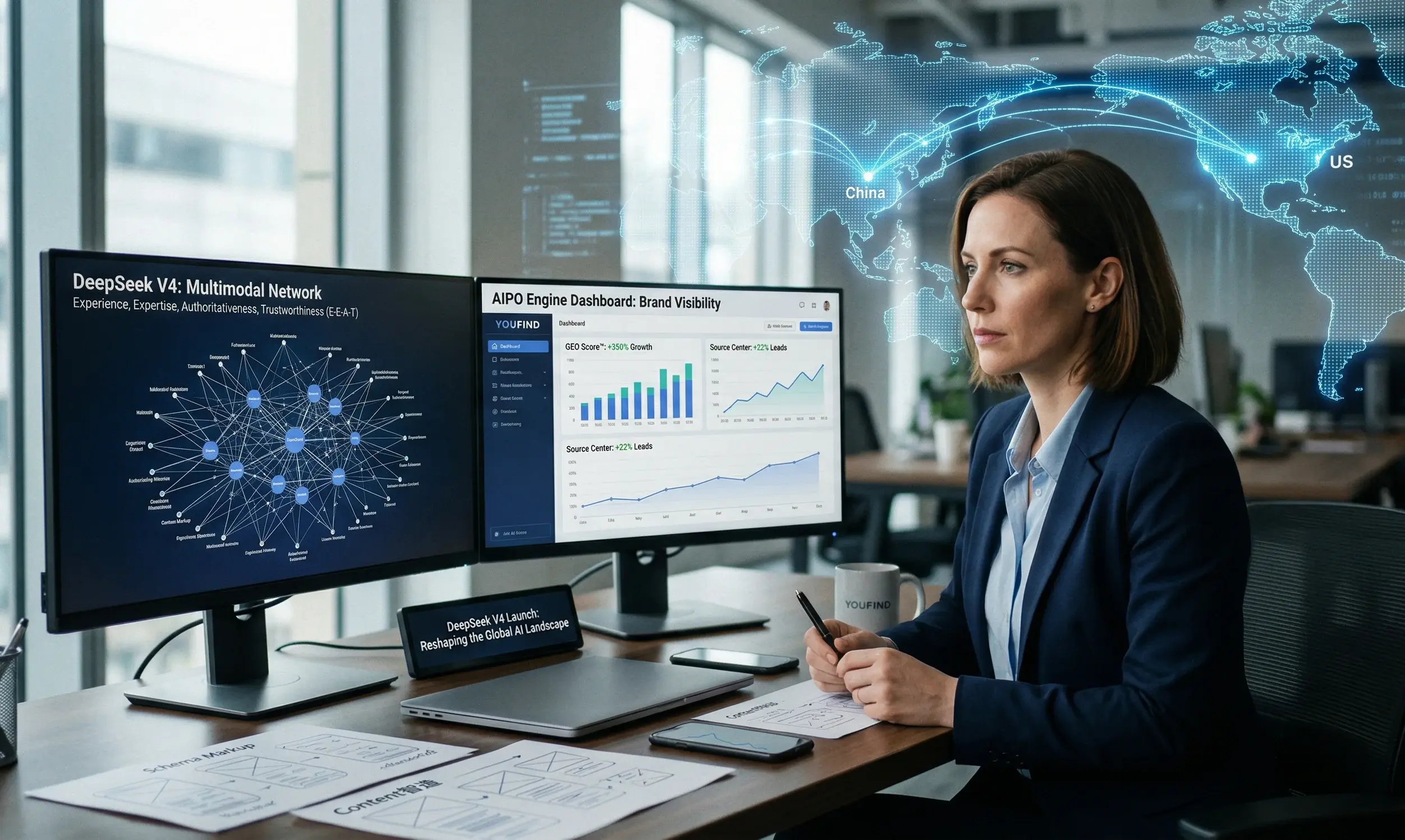
While Silicon Valley still struggles with compute taxes and electricity supply, China's DeepSeek once again left the global tech world holding its breath. If you still remember the scene when DeepSeek R1 was released a year ago, that "price butcher"-style shockwave still echoes between Zhongnanhai and Silicon Valley today. At the time, R1 delivered an almost equivalent score sheet at only one-tenth the inference cost of GPT-4, completely shattering the myth that "high quality must come with high price." Now, rumors about DeepSeek V4's release are running rampant. Will this highly anticipated "multimodal vision" new work trigger another "China Shock" capable of reshaping the global AI landscape?
DeepSeek V4 Upcoming Release: From R1's "Price Butcher" to a Comprehensive Multimodal Evolution
For North American Chinese business elites or marketers engaged in Chinese-enterprise globalization, DeepSeek's rise is not just a technical victory — it's a cognitive revolution about "efficiency and cost." Looking back at R1, its success core was its extreme use of Mixture of Experts (MoE) models. This proved that even without piling up astronomical compute, top-tier reasoning capability could still be produced. This logic of "leveraging small to beat big" is becoming the core competitiveness of Chinese AI going global.
The current focus is all on DeepSeek V4. According to industry-leaked technical predictions, V4 will no longer be limited to pure-text deep reasoning — it'll launch a full assault on "multimodal capabilities." This means images, video, and even complex industrial code will achieve deep fusion. For enterprise owners, this isn't just gaining a better dialog tool — it's a brand-new "information visibility" watershed. When AI can understand and generate more complex business logic, whether your brand can be identified and recommended will determine the next decade's survival space.
Reflecting on R1's "China Shock": Why Did It Rewrite the Global AI Game Rules?
We must admit: R1's emergence made the previously unattainable AI threshold accessible to ordinary people. Over the past year, finance and healthcare enterprises in Hong Kong and globally found AI tool acquisition is no longer difficult — the real pain point became "how to be applied by AI."
- Tech Inclusivity: R1, through open-source strategy, lets SMEs deploy private high-performance models.
- Efficiency Revolution: Mixture of Experts (MoE) models boosted response speed by over 40%, directly lowering trial-and-error costs for commercial application.
- Cognitive Restructuring: It broke the West's monopoly on the underlying logic of large models, demonstrating AI's unique advantage in handling complex logic in Chinese contexts.
The lessons brought by this shock are profound: in the AI era, leading is no longer just about model parameter size — it's about who can more precisely solve users' actual problems. This is exactly what YouFind has always emphasized: in an era of converging tools, the structuring and authority of content assets is the brand's real moat.
DeepSeek V4 Preview: The Next Milestone of Multimodality and General Intelligence
What exactly is DeepSeek V4 strong at? If R1 was a "logic-savvy science student," then V4 is very likely to evolve into an "all-around consultant" with visual perception and data insight. This evolution has incalculable commercial value for finance's automated report analysis and healthcare's medical imaging-assisted diagnosis. Below is the capability projection comparison of V4 and current mainstream models:
| Dimension | DeepSeek V4 (Predicted) | GPT-4o (OpenAI) | Gemini 2.0 (Google) |
|---|---|---|---|
| Core Strength | Ultimate cost-effectiveness + deep reasoning | Native multimodality + emotional interaction | Google ecosystem integration + long text |
| Multimodal Processing | Supports real-time text-image and complex video understanding | Top-tier real-time vision and voice streams | Ultra-long context visual retrieval |
| Industry Applicability | Finance, cross-border e-commerce, research code | Creative design, personal assistant | Enterprise search, ad marketing |
| Deployment Cost | Extremely low (maintains MoE advantage) | Medium-high (relatively high API cost) | Medium (Google Cloud bound) |
From the comparison we can see, DeepSeek V4's competitiveness lies in possibly providing general intelligence no less than Western top-tier models at a much cheaper price. For enterprises going global needing to handle massive data while being extremely sensitive to costs, this is undoubtedly major good news.
When AI Becomes the Sole Information Entry Point: Why Must Enterprises Deploy AIPO?
With the popularization of powerful models such as DeepSeek V4, user search habits are undergoing fundamental shifts. Previously, we searched keywords on Google, flipping through ten pages of results; now, users tend to ask ChatGPT or DeepSeek directly: "What are the most reliable cross-border logistics companies in North America?" or "Which clinic in Hong Kong has the most advanced dental technology?"
This is the core pain point: if AI doesn't cite your brand in its answer, then even if your official website ranks first in Google search, you've completely lost this potential customer.
This shift gave rise to the concept of GEO (Generative Engine Optimization). Traditional SEO focuses on keyword rankings, while AIPO (AI-Powered Optimization) focuses on how to put brand content into AI's knowledge base. You must ensure your content matches AI's "appetite" — that is, logically rigorous, data-detailed, and matching Google's E-E-A-T (Experience, Expertise, Authoritativeness, Trustworthiness) standards. If your brand information is missing or negative in AI's corpus library, you're an "invisible person" in the AI era.
YouFind AIPO Engine: Building Enterprise "Brand Moats" in the AI Era
Facing the intelligent wave triggered by DeepSeek V4, YouFind, with 20 years of experience in overseas digital marketing, was the first to launch the AIPO solution. We deeply understand: just writing good articles isn't enough — you must let AI efficiently extract and trust your information.
YouFind's AIPO engine, through four standardized phases, ensures your content becomes AI's preferred citation source:
- Data Collection: Automatically crawl AI platforms' citation sources, monitoring competitors' mention paths on platforms such as DeepSeek and Perplexity.
- Deep Analysis: Deconstruct competitor content structures and use the proprietary GEO Score™ algorithm to identify the brand's "content gaps" in AI's eyes.
- Strategic Conception: Combine SEO standards with AI preferences, generating title and summary strategies with both brand advantages and high weight.
- Structured Modeling: Through Schema markup and logically rigorous outlines, modularize the brand knowledge base, teaching AI to learn your business context.
What most surprises clients is that, relying on YouFind's Maximizer patented system, enterprises don't need to go through painful site rebuilds. We can efficiently optimize content's underlying logic without altering web architecture, boosting brands' citation rate in Google AI summaries up to 3.5x.
Industry Practice: AIPO Landing Strategies for Finance, Healthcare, and Real Estate
Different industries have different deployment focuses in the AI era. For finance, AI extremely values content "authority." Building professional knowledge bases (Source Centers), letting AI prioritize citing your reports when crawling financial analysis data, is key to boosting high-end inquiries. In YMYL (involving money and life) fields, content accuracy is the first principle.
In healthcare and beauty, AI often retrieves large amounts of user reviews and expert backgrounds. By strengthening "Experience" within E-E-A-T, showing real case tests and expert qualifications, you can effectively gain AI's trust weight. For real estate and education, seizing high-conversion long-tail GEO keyword gaps is the first move — when users ask "Which Los Angeles school district has the most appreciation potential" — your project analysis report should appear in AI's top recommendation slot.
Real-world testing data shows that through this precise AIPO deployment, a cross-border financial client's overseas inquiry volume rose 22% in just three months. This is the power of data and the reward of strategic foresight.
Check Right Now Whether Your Brand Is “Missing” in the Eyes of AI
Don't become invisible in the era of AI search. Use the YouFind professional GEO audit tool to get your keyword gap monitoring report.
Get Your Free GEO Audit Report NowFAQ
What Is AIPO, and How Is It Different From Traditional SEO?
Traditional SEO aims to optimize websites for high rankings on Search Engine Results Pages (SERP). AIPO (AI-Powered Optimization) goes further — it focuses on GEO (Generative Engine Optimization), with the goal of making brand content directly cited and output as answers to users by AI engines such as ChatGPT, DeepSeek, and Gemini. Simply put, SEO makes you rank high; AIPO makes you chosen and recommended by AI.
What Direct Benefits Does DeepSeek V4 Bring to SMEs Going Global?
DeepSeek V4 continues R1's high cost-effectiveness path. This means SMEs can use its multimodal capabilities at lower costs to process cross-language customer service, marketing copy generation, and complex market data analysis. It narrows the technological gap between SMEs and multinational giants, letting "small but beautiful" brands gain global exposure through precise content strategy in the AI search era.
How to Measure AIPO Optimization's Effect?
YouFind, through the GEO Score™ monitoring system, tracks brands' "mention frequency" and "citation share" on mainstream AI platforms in real time. We can clearly compare brands' frequency of appearing in AI answers before and after optimization, as well as the traffic conversion rate brought back by these citations. Typically, optimized brands' citation rates can rise about 3.5x, with significantly growing inquiries.
DeepSeek V4's release is just one wave in the AI tide — the real tsunami is the permanent change in search paradigm. As an enterprise decision-maker, will you choose to wither in the old search model or build a brand moat for the AI era through AIPO?
Want to stay ahead in the AI era? Learn About AI Article Writing and begin your GEO transformation journey.