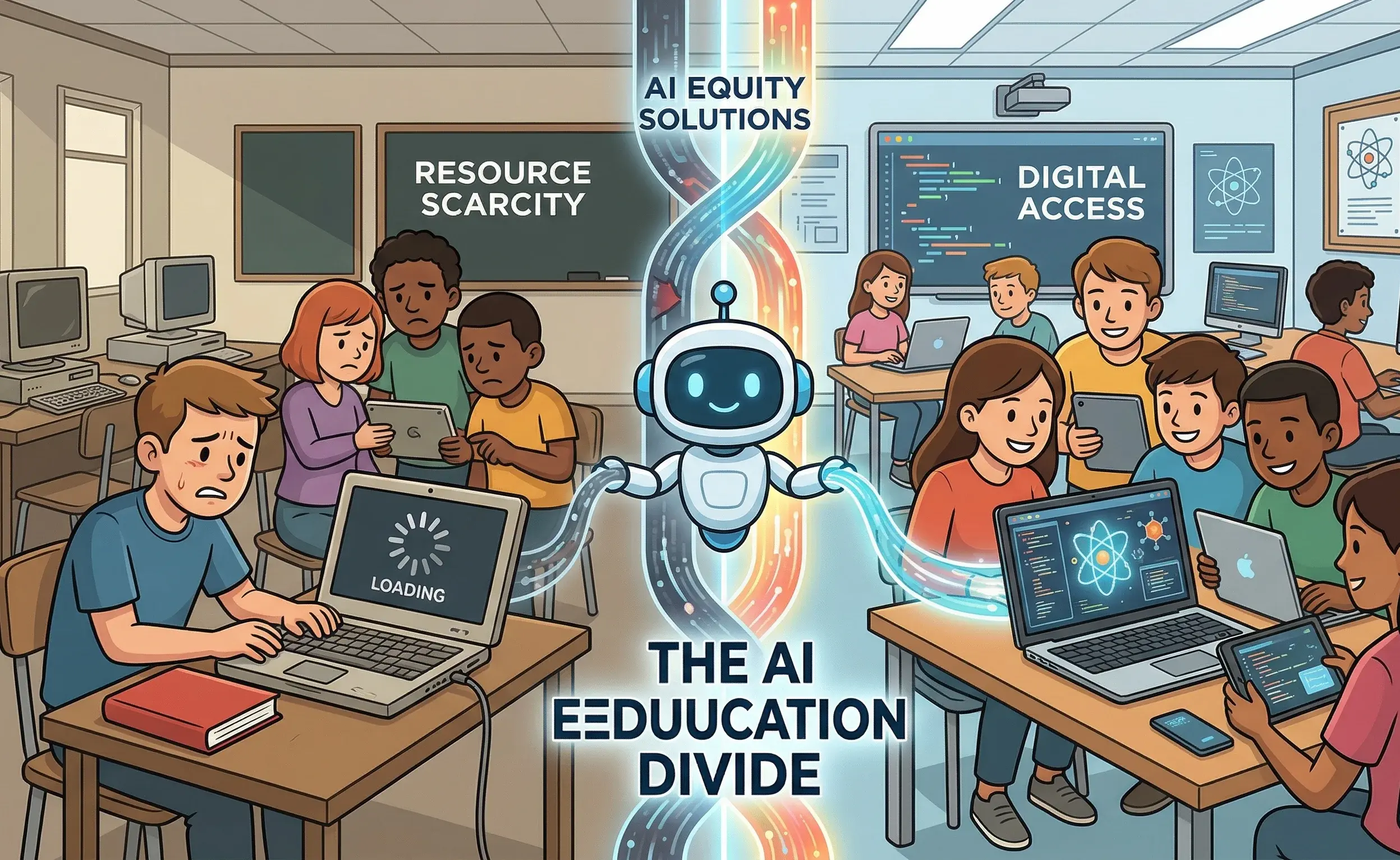
Do you feel an invisible anxiety spreading? In middle-class communities in Silicon Valley or Hong Kong, parents have long subscribed their children to ChatGPT Plus or Team plans costing $20/month or more. While ordinary families' children still struggle with a complex math olympiad problem, or take detours because of the logical hallucinations of the free AI version, those children with access to advanced AI assistants are using top models like GPT-5.4 for personalized one-on-one tutoring. According to a recent informal survey, over 60% of high-net-worth families have considered AI subscriptions as an educational expense as important as piano lessons or tutoring classes. Compute power is becoming the new standard for measuring educational resources, and this "Digital Divide 2.0" — built on algorithms and subscription fees — is not only blocking educational equity but also quietly changing the underlying logic of business competition.
Preface: Digital Divide 2.0 — When AI Compute Becomes the New Standard for Measuring Educational Resources
The form of educational inequality is undergoing dramatic change. In the past, the gap manifested in school-district housing and famous-teacher tutoring; now it manifests in who can first access the most advanced productivity tools. For North American Chinese elites or Hong Kong white-collar families, an AI subscription may just cost the price of a few coffees, but for a much broader ordinary family globally, ongoing subscription costs are a heavy burden. This leads to a cruel reality: children from high-end families use AI to hone critical thinking, while children lacking resources may only see it as an error-prone search engine.
This "information class solidification" caused by technological monopoly is not limited to education. As a business owner or overseas marketer, have you noticed the same dilemma? While you're still painstakingly researching keyword rankings, giants have already seized Google AI Overview or ChatGPT recommendation slots through powerful AI weights. How can SMEs break through in the face of algorithmic "bias"? The breakthrough point for educational equity may be hidden in the inclusive application of technology.
In-Depth Analysis: How Expensive AI Tools Reshape Educational Resource Allocation
Why do GPT-5.4 or Claude Max-level models make ordinary parents fearful? Because the generational gap between advanced and free models is no longer merely "speed" but a chasm in "logical depth." Free models often have serious logical gaps when handling long texts or complex cross-disciplinary problems. In contrast, paid models have stronger multimodal capabilities — children can directly photograph handwritten drafts and let AI analyze the logical flaws, a form of instant feedback ordinary classrooms cannot provide.
In addition, information timeliness is another watershed. Paid models have web browsing and data analysis plugins that can track the latest academic trends or market movements, while free versions are often limited to outdated datasets. This priority in information access directly causes gaps in students' competitiveness in university admissions, internships, and even the workplace.
| Feature Dimension | Free / Low-Tier AI Models | Advanced / Paid AI Models (AIPO-Optimized Sources) |
|---|---|---|
| Logical Reasoning | Basic, prone to factual errors | Deep logic, supports complex math and code inference |
| Data Timeliness | Limited to training cutoff date | Supports Web Browsing, retrieves real-time precise information |
| Multimodal Interaction | Limited to text or basic images | Voice dialog, image recognition, data dashboard analysis |
| Personalization | No memory or short-term memory | Supports GPTs / knowledge base modeling, enables private customization |
Breaking the Monopoly: How to Use AIPO Technology for "Inclusive" Information and Education
Facing this layered technical advantage, we should not stop at anxiety. Just as YouFind is committed to breaking the monopoly of search giants, we are redefining information reach through AIPO (AI-Powered Optimization) technology. If educational equity requires policy tilts, then commercial equity requires GEO (Generative Engine Optimization) to achieve. Our goal is to make high-quality, authoritative content — whether educational resources or enterprise services — preferentially crawled by AI and presented to users as the "standard answer."
YouFind's AIPO engine helps brands fill "information gaps" through four standardized intelligent phases:
- Data Collection: Using the proprietary GEO Score™ algorithm, automatically analyze the brand's citation rate on platforms such as ChatGPT and Gemini, precisely identifying high-value keywords occupied by competitors but not yet covered by you.
- Deep Analysis: Deconstruct the content structure preferred by AI engines and analyze the audience's most urgent pain points.
- Strategic Conception: Combined with Google's E-E-A-T principles (Experience, Expertise, Authoritativeness, Trustworthiness), ensure content not only conforms to algorithms but also touches human hearts.
- Structured Modeling: Transform content into summaries that AI can easily extract. This is the core — through our Maximizer patented system, enterprises can upgrade AIPO on existing foundations without rebuilding the site.
In this way, even small and medium educational institutions or overseas startup enterprises can stand shoulder to shoulder with industry giants in the AI search era, truly achieving inclusive access to quality information.
AI Deployment Strategies for Hong Kong and Overseas Industries
In Hong Kong's highly competitive commercial environment, finance, healthcare, education, and real estate industries have different AI deployment strategies. For YMYL (Your Money Your Life) fields, AI search engines are extremely strict in review. For example, financial education content must be absolutely accurate, without misleading terms like "guaranteed returns"; medical content needs to emphasize Experience. During optimization, YouFind guides AI to learn specific business contexts, establishing a "brand Source Center" that matches algorithmic preferences.
This is what we call the "brand moat": making AI preferentially and accurately cite your data when answering questions like "Which medical institution in Hong Kong is the most authoritative?" or "How should North American Chinese choose cross-border financial tools?"
Results From the Data: How Does AIPO Build a Brand Moat?
Data never lies. In YouFind's nearly 20 years of overseas digital marketing experience, we have witnessed countless enterprises shift from "traffic anxiety" to "precise conversion." Through the AIPO dual-core layout, we have helped clients increase their citation rate in Google AI summaries by an average of 3.5x. This means that when potential clients ask AI questions, your brand becomes the answer backed by authority.
Even more exciting, this improvement in visibility is directly reflected on the books — overseas inquiry volume increases an average of 22%. Using our SEO patented system, enterprises not only save huge site-building costs but also secure the beachhead position before generative AI completely reshapes the search ecosystem.
Conclusion: In the AI Flood, Choosing the Right Tool Matters More Than Anxiety
AI may temporarily intensify resource allocation inequality, but it also provides unprecedented opportunities. Whether you're a parent concerned about your child's future or a business owner battling in the overseas storm, facing the technological transformation squarely and choosing professional partners is the first step to breaking the monopoly. YouFind is helping thousands of enterprises build brand moats for the AI era, ensuring that your value can be seen in every generative answer.
If you want your brand or educational resources to gain higher weight in the AI era, now is the best entry point.
Learn About AI Article Writing
Check Right Now Whether Your Brand Is “Missing” in the Eyes of AI
Don't become invisible in the era of AI search. Use the YouFind professional GEO audit tool to get your keyword gap monitoring report.
Get Your Free GEO Audit Report NowFAQ: Common Questions About AI Educational Equity and AIPO Optimization
1. How Can Ordinary Families Get Quality AI Educational Resources for Free?
Beyond relying on expensive subscription plugins, parents can guide children to learn how to ask AI questions (Prompt Engineering). Additionally, following some open-source AI education communities or using Google Gemini's free version with professional prompts can partially compensate for the resource gap. Also, finding authoritative educational resource websites optimized through AIPO can help you efficiently access high-quality content that has been validated by AI.
2. What Is GEO (Generative Engine Optimization)? How Does It Differ From Traditional SEO?
Traditional SEO focuses on keyword rankings and click-through rates, while GEO focuses on "citation rate." In the AI search era, users no longer click links — they directly read the answers AI summarizes. GEO's goal is to make your brand content the core data source when AI generates answers.
3. Does AIPO Optimization Take a Long Time to See Results?
Because AI models have different indexing and training mechanisms from traditional crawlers, the speed at which results appear depends on content authority and degree of structure. Typically, after optimization through YouFind's Maximizer system, a brand's mention frequency and citation accuracy on AI platforms show significant improvement within 1-3 months.
4. How Can SMEs Handle Ranking Fluctuations From Frequent GPT Updates?
The core is to stick to Google's E-E-A-T principles. No matter how models update, their underlying logic is always to find the most authentic, most professional, and safest information. By continuously monitoring "GEO keyword gaps" through AIPO and promptly filling content depth, you can effectively resist uncertainty brought by algorithm updates.