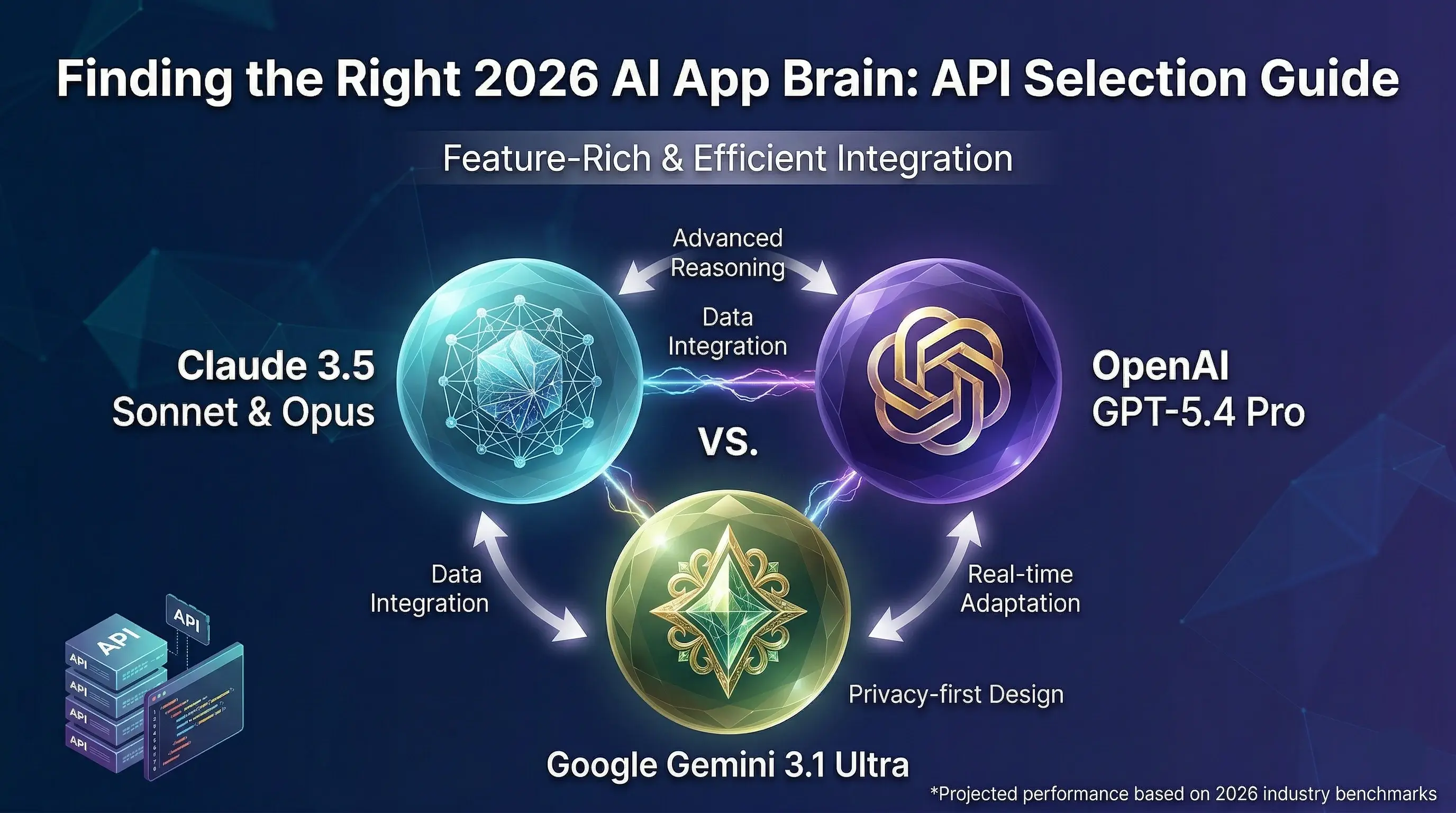
1. Developers' Dilemma in the AI Era: Why "The Strongest Model" Doesn't Equal "The Best Choice"
In 2026, the generative AI space has evolved from a pure "parameter race" to a battle of "application depth." As a developer or enterprise decision-maker, have you noticed that even after integrating the strongest models on the market, your App's user retention is still lukewarm? Or worse, API call costs eat into profits like a black hole, while output content causes user trust to collapse due to frequent "hallucinations."
In today's digital marketing ecosystem, model selection has long transcended pure technical considerations. According to YouFind's GEO Score™ data, over 65% of enterprises that have integrated top-tier APIs still have citation rates below 5% in Google AIO (AI Overviews) or ChatGPT answers. This means you've paid expensive token fees only to become "invisible" in the AI search era.
In providing overseas marketing services to more than a thousand enterprises, we've found that core selection pain points cluster around: controllability of hallucination rate, marginal effects of token economics, and data privacy under global compliance. If you only stare at benchmark scores, you may overlook the most critical commercial metric: conversion rate.
2. What Are the Core Differences Between GPT-5.4, Claude 3.5, and Gemini 3.1?
When choosing an AI API, understanding the underlying architectural priorities is critical. In 2026, the three giants each hold their own territory, and their performance determines the "IQ" and "EQ" of your product.
- GPT-5.4 (OpenAI): The ceiling for logical reasoning and ecosystem integration. Its Function Calling stability is extremely high, making it suitable for scenarios that require handling complex logical operations, automated workflows, and large-scale SaaS ecosystem linkage.
- Claude 3.5 (Anthropic): The benchmark for humanistic language sense and long-text processing. It can accurately extract core information from contexts up to 500K tokens long, with a more natural, human-like tone — the first choice for brand storytelling, creative writing, and high-emotional-value industries (such as beauty and aesthetic medicine).
- Gemini 3.1 (Google): Native multimodal ability and search linkage. As the "favorite child" deeply tied to the Google search ecosystem, it has native advantages in handling video, images, and real-time data retrieval. If you pursue ultimate GEO performance, Gemini is an unavoidable choice.
To help you compare more intuitively, here is the 2026 core performance metrics table:
| Dimension | GPT-5.4 | Claude 3.5 Sonnet | Gemini 3.1 Pro |
|---|---|---|---|
| Reasoning Score | 98/100 | 92/100 | 94/100 |
| Cost per Million Tokens | $2.50 | $1.80 | $1.20 |
| Average Latency | 1.2s | 0.8s | 0.9s |
| Context Length | 256K | 500K | 2M |
3. How Do You Choose an AI API for Highly Regulated Industries Such as Finance, Healthcare, and Education?
If you are in a YMYL (Your Money Your Life) industry, your selection criteria will shift from "usability" to "safety." In North American or Hong Kong markets, data privacy and compliance are the lifeline of the business. When selecting APIs, financial institutions must consider whether the model has passed SOC2 audits and whether it supports private deployment or data-free-from-training agreements.
The healthcare and wellness sectors place more emphasis on Explainable AI (XAI). When AI gives a recommendation, can it trace back to an authoritative clinical data source? This is exactly why YouFind emphasizes E-E-A-T principles. We recommend that such enterprises prioritize APIs with strong Retrieval-Augmented Generation (RAG) capabilities, combined with structured modeling, to ensure every sentence AI outputs is substantiated and avoids regulatory risk.
4. Why Is the AIPO Dual-Core Layout the Overseas Moat for Enterprises in 2026?
Picking the right "brain" is only step one. The key is how to make your App's content preferentially adopted by AI. This is the AIPO (AI-Powered Optimization) approach we were first to propose. Traditional SEO solves "being seen when someone searches," while AIPO solves "being cited when AI thinks."
YouFind's AIPO engine reshapes your brand content through four intelligent phases:
- Data Collection: Automatically crawl citation sources on mainstream AI platforms and analyze how competitors are occupying AI recommendation slots.
- Deep Analysis: Deconstruct high-weight content structures and filter out the authoritative summaries most easily extracted by GPT or Gemini.
- Strategic Conception: Combine SEO standards with user click incentives to design titles and content that balance brand strengths with algorithmic preferences.
What impresses clients most is that we own the Maximizer SEO patented system. Clients don't need to rebuild their site — they can efficiently optimize without altering the web architecture. This not only drastically saves technical costs but also gives the brand a head start in the AIO era.
5. How to Optimize ROI of AI Investment: From Vanity Traffic to Precise Inquiries
Many enterprises going global are obsessed with the numbers of website traffic, but YouFind has always insisted: traffic without conversion is vanity. When calling APIs to generate content, optimizing prompt structure to save token cost is important, but more important is locking onto high-converting "commercial keywords."
We once helped a cross-border enterprise deploy AIPO, precisely optimizing its citation weight in AI engines, resulting in a 22% increase in overseas inquiries within three months. Real-world testing proves that when your brand becomes the "authoritative source" recommended by AI, customer acquisition costs drop significantly because AI has already completed preliminary endorsement and filtering for you.
In 2026, competition is no longer about who has the larger model, but about whose data is more trusted by AI. By establishing a brand Source Center and guiding AI to learn your business context, you'll build a technical moat that competitors will struggle to cross.
Check Right Now Whether Your Brand Is “Missing” in the Eyes of AI
Don't become invisible in the era of AI search. Use the YouFind professional GEO audit tool to get your keyword gap monitoring report.
Get Your Free GEO Audit Report Now6. Frequently Asked Questions (FAQ)
What Is GEO (Generative Engine Optimization)?
GEO is an optimization strategy targeting AI search (such as Google AIO, ChatGPT). It increases a brand's probability of being cited as an answer source by AI engines through improving content professionalism and structural depth. It is the AI-era upgrade of SEO.
Why Choose GPT-5.4 Over Other Open-Source Models?
Although open-source models have a cost advantage, GPT-5.4 still clearly leads in handling complex logic, Function Calling stability, and ecosystem maturity. For enterprise applications that prioritize business stability, the GPT series remains the lowest-risk choice.
Does AIPO Optimization Require Modifying Website Code?
With YouFind's Maximizer patented system, most optimization can be done without altering the web architecture, drastically lowering the operations difficulty and technical threshold for enterprises.
How Do I Request YouFind's Brand AI Visibility Diagnosis?
You can contact our professional team through our official website. We'll provide a deep AI performance analysis report for your brand using our proprietary GEO Score™ algorithm.
In the AI-driven search ecosystem, selection is only the starting point — optimization is the finish line. Rather than blindly chasing model parameters, deploy a brand moat for the AI era. Learn About AI Article Writing and make your brand occupy a core position on AI's cognitive map.