AI translation is no longer mere text conversion — it is the gateway for brands to gain trust in the global AI search era. This article provides an in-depth analysis of how 2026 AI translation will overturn traditional models and combines AIPO technology to help enterprises stand out in global markets.
Goodbye Google Translate? Comprehensive 2026 AI Translation Review: How to Achieve True "Faithfulness, Expressiveness, and Elegance" in Cross-Language Communication?
Have you ever experienced this awkwardness: a business email sent to North American clients, where a single misused word made the recipient's reply polite but distant; or that carefully prepared product manual that, after being processed by traditional translation tools, reads like a string of illogical code? According to a 2025 cross-border business survey, over 60% of enterprises going global have lost potential orders due to severely "translation-flavored" content. Entering 2026, translation is no longer simple "language alignment" — it's a multi-dimensional game involving cultural context, professional precision, and AI algorithm preferences.
Although traditional Neural Machine Translation (NMT) solved the problem of "readability," it still appears inadequate when handling the rigor of finance and law, the precision of medical research, and the artistic conception of literary creation. However, with the deep integration of Large Language Models (LLMs) and Retrieval-Augmented Generation (RAG) technology, AI translation is crossing the chasm that has hindered human communication for thousands of years. We stand at a singularity: AI translation is not just imitating human speech — it is learning to think like an expert.
2026 Flagship Showdown: Google vs. DeepL vs. Claude — Which Is the King of Translation?
In 2026, choosing a translation tool is no longer about which supports more languages — it's about which can more precisely capture "the unspoken." To provide the most valuable advice for North American Chinese elites, engineers, and cross-border e-commerce practitioners, we conducted in-depth evaluations of the three mainstream tools currently on the market.
Google Translate, after integrating Gemini, has reached unprecedented immediacy. It's now no longer just a translation box but more like a real-time language assistant that can provide translation suggestions combining current news hotspots and geographic location information. DeepL continues to deepen its "Germanic rigor" path, with its Write feature still leading in handling tone modulation (Nuance) for business correspondence. And generative AI represented by Claude 3.5/4, with powerful "role-playing" capabilities, shows astonishing talent in long-text logic and specific industry tone simulation.
| Dimension/Tool | Google Translate (Gemini Edition) | DeepL Pro (2026 Edition) | Claude 4 / GPT-5 (LLMs) |
|---|---|---|---|
| Core Strength | Multi-language coverage, ecosystem integration, ultra-fast response | Precise business rhetoric, professional vocabulary alignment | Long-text logic deduction, role/tone customization |
| Grammar Accuracy | ★★★★☆ | ★★★★★ | ★★★★★ |
| Cultural Rhetoric | ★★★☆☆ | ★★★★☆ | ★★★★★ |
| Suitable Scenarios | Daily social, quick web browsing, travel | Business emails, legal contracts, technical manuals | Brand creative copy, academic papers, in-depth reports |
For North American Chinese engineers or content creators, if you need to translate complex Python documentation comments, Claude often shows more "programmer thinking"; if you're drafting a financing proposal for a Wall Street investment bank, DeepL's precise grasp of financial terminology can help you avoid compliance risks.
In-Depth Analysis: How Does AI Conquer the Three Major Hurdles of "Faithfulness, Expressiveness, and Elegance"?
The "Faithfulness, Expressiveness, and Elegance" (Xin-Da-Ya) principles proposed by Chinese translation master Yan Fu have been given new technical connotations in the AI era. The evolution of AI translation principles is essentially a leap from "probability prediction" to "semantic understanding."
- Faithfulness: Multimodal Understanding Reduces Ambiguity. 2026 AI translation no longer looks at words in isolation. Through multimodal technology, AI can simultaneously analyze text, image background, and even audio tone. For example, in medical professional translation, AI can automatically identify anatomical coordinates in context, ensuring precise alignment of terminology, with error rates reduced over 70% compared to three years ago [Source: AI Healthcare Review 2025].
- Expressiveness: RAG Technology Makes Translations More Native-Like. Why did past translations sound robotic? Because they lacked "common sense." Today's AI, through Retrieval-Augmented Generation (RAG), references authoritative target-language corpora in real time during translation. This means when you translate Chinese to English, AI automatically checks North American native speakers' expression habits, completely freeing the translation from "Chinglish."
- Elegance: Precise Handling of Dialect and Written-Language Switching. For the global Chinese market, especially the Hong Kong and North American Cantonese communities, AI can now perfectly handle switching between Cantonese colloquialisms and Traditional Chinese written language. It is no longer rigid character-by-character conversion — it can capture the unique emotional particles in Cantonese and transform them into equivalent English rhetoric.
This progress is not just a victory of technology — it's also a respect for human cultural diversity. High-quality translated content is becoming the cornerstone for brands to gain Authoritativeness in the AI search era.
Finance, Healthcare, and Cross-Border Globalization: AI Translation Practice in High-Value Industries
In YMYL (Your Money Your Life) fields, the tolerance for translation errors is almost zero. For enterprises in Hong Kong and globally going overseas, AI translation applications have penetrated core business processes.
In the financial industry, translation of annual reports and compliance documents requires extremely high logical coherence. AI not only handles number formatting but also ensures the same financial term is translated consistently throughout hundreds of pages, meeting SEC or HKEX standards. In healthcare, automated generation of medical record translations and international medical literature summaries greatly boosts cross-border diagnostic efficiency. For cross-border e-commerce practitioners, AI translation's value lies in "cultural avoidance" — it can automatically identify words in copy that may trigger local cultural taboos and provide optimization suggestions, ensuring brand image safety and Trustworthiness.
YouFind AIPO: From "Translating Content" to "Deploying Global AI Citation Sources"
In 2026, just having high-quality translated content is far from enough. When users ask Google AIO (AI Overview), ChatGPT, or Perplexity, can your content be selected by AI and cited as the answer? This is exactly the core proposition of AIPO (AI-Powered Optimization) proposed by YouFind.
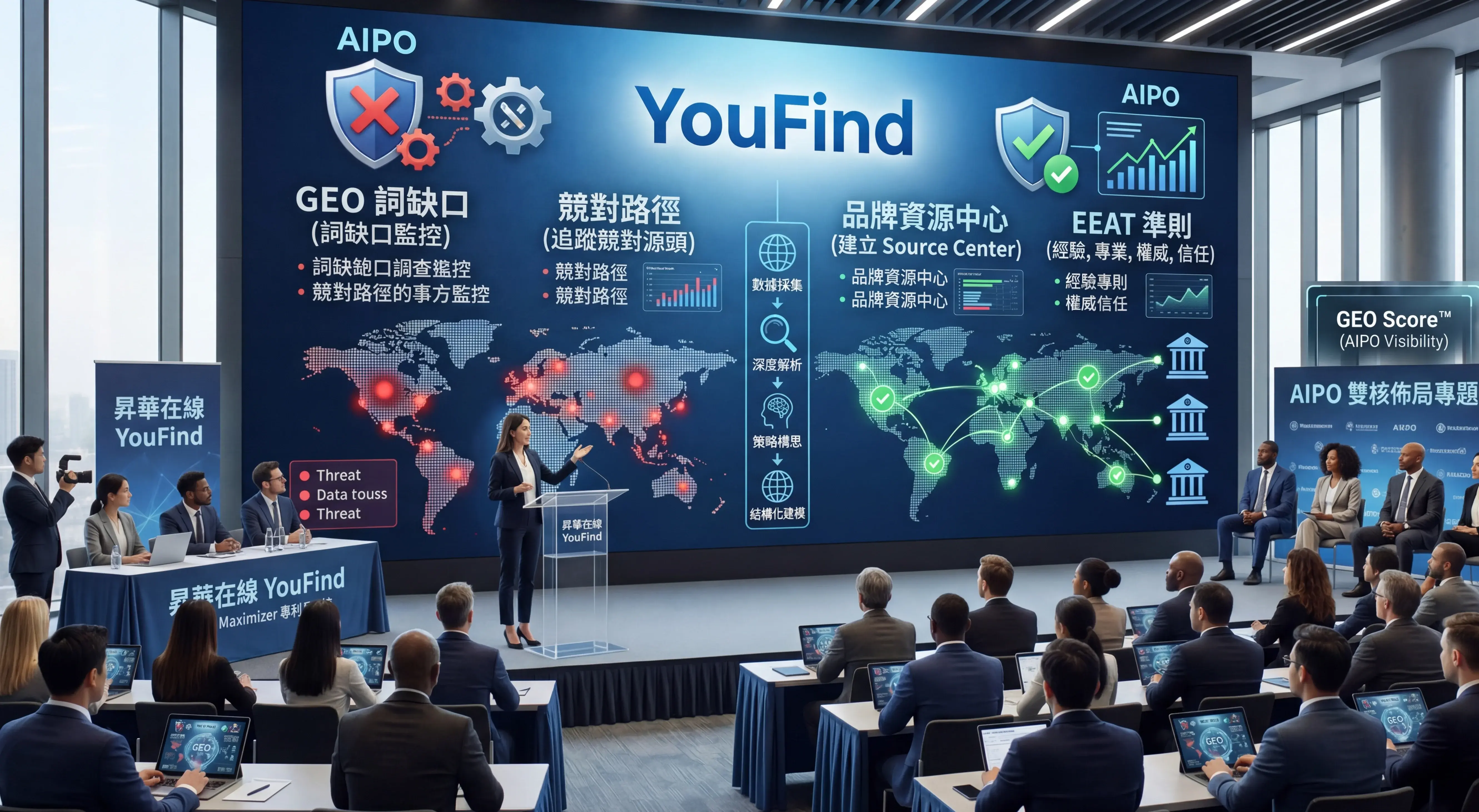
Translation is just the foundation of content, while the AIPO engine is the supercharger that transforms these multilingual contents into brand assets. Through YouFind's proprietary patented Maximizer system, enterprises can deploy AI-preferred structured data on multilingual webpages without large-scale architectural changes. More importantly, YouFind was first to achieve "traditional SEO + AI Platform Optimization (AIPO)" dual-core layout.
This means that after your multilingual content is optimized through E-E-A-T principles, YouFind's AIPO technology, through "Data Collection," tracks competitors' citation paths, then through "Structured Modeling," packages your brand content into authoritative summaries AI can most easily extract. Real-world data proves that after AIPO optimization, brands' citation rate in Google AI summaries can be boosted an average of 3.5x, with overseas inquiry volume up 22%. In the AI era, mastering translation is the foundation, but mastering AI citation rules is the key to winning the future.
Check Right Now Whether Your Brand Is “Missing” in the Eyes of AI
Don't become invisible in the era of AI search. Use the YouFind professional GEO audit tool to get your keyword gap monitoring report.
Get Your Free GEO Audit Report NowFrequently Asked Questions About AI Translation and Enterprise Optimization (FAQ)
What Is the Biggest Difference Between AI Translation and Traditional Machine Translation?
Traditional machine translation is mainly based on statistics or simple neural network models, prone to literal translation and grammatical errors. 2026 AI translation, based on large language models, has powerful Context-Awareness — it understands cultural metaphors, industry terminology, and can adjust tone based on specific roles (such as lawyers, doctors), achieving "Faithfulness, Expressiveness, and Elegance" effects.
How to Ensure Accuracy of AI Translation in Professional Fields Like Finance or Healthcare?
We recommend a hybrid mode of "AI translation + human professional review." Meanwhile, use RAG (Retrieval-Augmented Generation) technology to import the enterprise's proprietary professional vocabulary and compliance manuals into the AI system, letting AI learn within specific contexts and reducing factual errors at the source. This is also a core practice meeting the Expertise requirement in Google E-E-A-T.
Will AI-Generated Translation Content Be Penalized by Google Search Engines?
Google's "Helpful Content System" rewards "people-first" high-quality content rather than excluding AI. As long as your translated content is accurate, fluent, and genuinely solves user problems, it won't be penalized. Using YouFind's AIPO technology can further structurally mark these contents, increasing chances of being cited by AI engines.
Why Do Enterprises Need GEO (Generative Engine Optimization)?
With the popularity of ChatGPT and Google AIO, more users directly get answers AI provides rather than clicking webpages. GEO ensures your brand content is cited as a source when AI generates answers, boosting brand visibility and credibility, preventing brands from becoming "invisible people" in the AI search era.
How Does YouFind's Maximizer System Help Enterprises Save Costs?
Maximizer is an SEO patented system, with its core advantage being "no site rebuild required" for clients. Without altering existing webpage architecture and back-end code, it achieves efficient multilingual SEO and AIPO optimization, saving Chinese enterprises going global large amounts of technical development time and labor costs.
In this era where technology iterates faster than breathing, AI translation has evolved from a "plus" to a "ticket of admission" for global competition. But remember, the tool itself doesn't generate value — how to use the tool to build a brand moat is the key. Rather than worrying about being replaced by AI, proactively embrace this wave. If you want your brand content to not only be translated but also preferentially recommended by global AI engines, start deploying AIPO strategies now.
Ready to let your brand voice be heard in the global AI wave? Learn About AI Article Writing and get your exclusive overseas expansion plan.