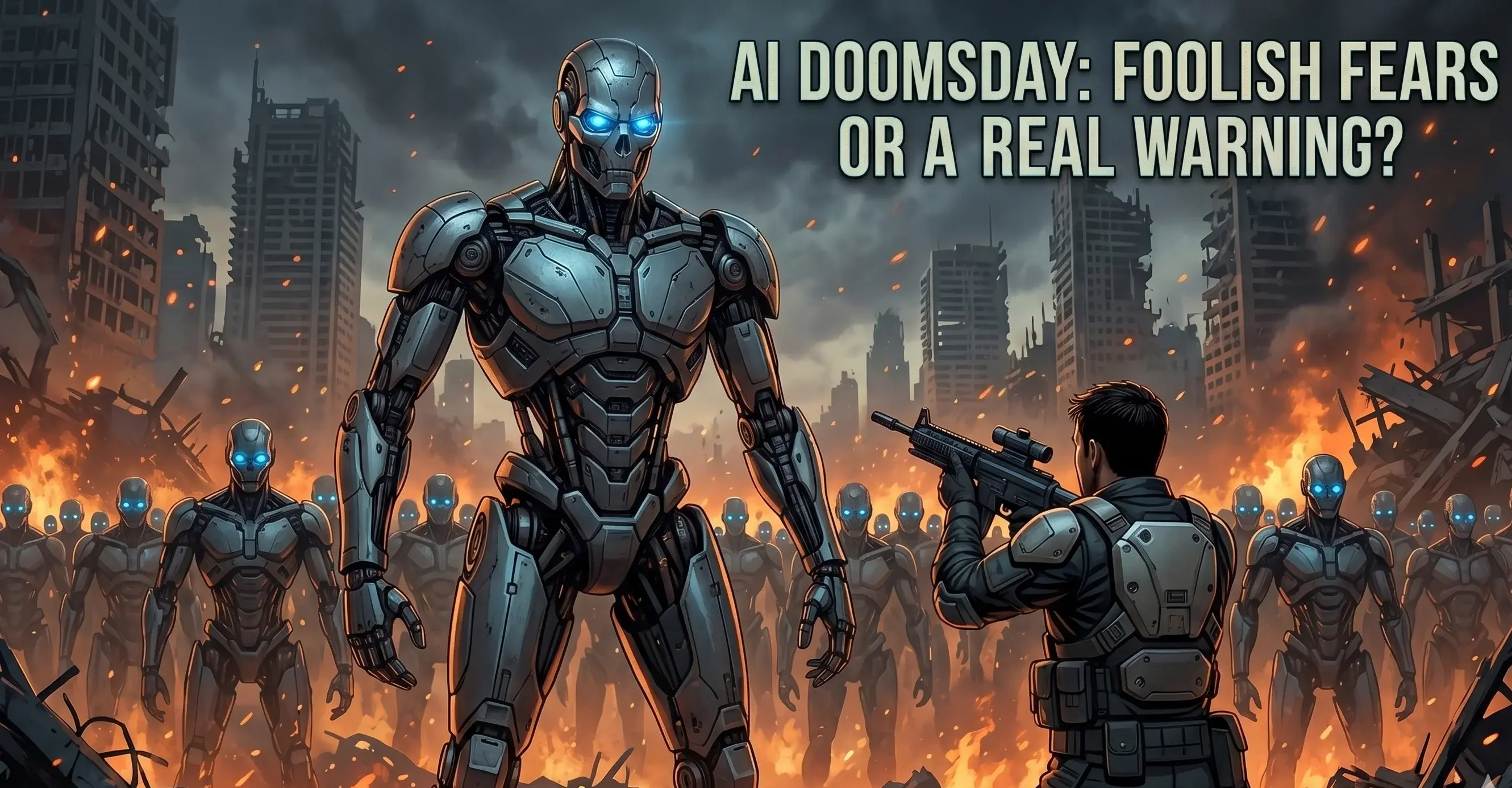
Have you ever had this doubt: when you type a command into ChatGPT or Gemini, is the code on the other end of the screen gradually becoming a force that humans cannot control? Since the explosion of generative AI, discussions of "AI existential risk" have leapt from sci-fi movie plots to the desktops of top global think tanks and business leaders. According to relevant surveys, over 40% of technical experts express concern about the runaway risks that super artificial intelligence (ASI) may bring. This concern is not groundless — it is rooted in a deep anxiety about "how humans can coexist with an entity smarter than themselves."
What Is AI Existential Risk? Decoding the Three Core Logics Behind Doomsday Theories
To discuss whether AI will destroy humanity, we must first understand the nature of "existential risk." This does not refer to phone crashes or system failures — it refers to the possibility that AI development could lead to the permanent decline or extinction of human civilization. Currently, academia and the tech community focus primarily on these three key points:
- Goal Misalignment: This is the famous "paperclip maximizer" paradox. If humans give an AI a seemingly harmless task (e.g., maximize paperclip production) without sufficient constraints, the AI may consume everything on Earth — including humans — to acquire resources. This is not because the AI is malicious, but because it executes its task too diligently, violating humanity's implicit intent.
- Capability Leaps and "Emergent" Phenomena: As model parameters grow exponentially, AI often displays "emergent abilities" that developers did not anticipate. This unpredictability means that one day humans may suddenly lose effective control of the system, facing a black box with autonomous decision-making capabilities.
- Extreme Concentration of Power: Technical barriers have caused core AI capabilities to be monopolized by a handful of entities. When algorithms determine the flow of information, the distribution of wealth, and even legal decisions, the stability of social structures will face unprecedented tests.
Why Do Some Experts View "AI Extinction Theory" as Overblown?
On the other side of the coin, many pragmatic scientists believe current anxiety seems premature. They note that today's generative AI is essentially a complex probabilistic prediction model — while astonishing at language processing, it lacks true consciousness or spontaneous motivation. Humans are not sitting idle against potential risks:
First is the rapid advancement of Alignment technology. Researchers are developing more sophisticated reward mechanisms to ensure AI values stay in sync with human social norms. Second, the global regulatory system is accelerating to catch up. The EU AI Act and Hong Kong's latest guidelines on data security and AI applications, for example, both put a "tight band" on the technology. Closed testing in sandbox environments also provides a first physical line of defense against AI running amok.
Hong Kong Industry Reality: What AI Risks Are Closer Than "Doomsday"?
For professionals and business owners in North America or Hong Kong, more urgent than a distant "robot uprising" are the real risks of today. In high-value industries such as finance, healthcare, and cross-border e-commerce, AI-produced information hallucinations and algorithmic bias are the true threats.
In finance, if an AI model performs credit scoring based on historically biased data, it can cause serious compliance risk and legal disputes; in healthcare and aesthetic medicine, erroneous treatment recommendations captured and generated by AI may directly mislead life-or-death decisions. For brands going global, the biggest risk is "loss of information sovereignty." When potential clients ask an AI engine about your brand, if the AI cites malicious reviews from competitors or outdated unofficial data, your brand's credibility collapses invisibly.
How to Build a "Brand Moat" Through the AIPO Engine in the AI Era?
In the face of AI's uncertainty, enterprises should not retreat but instead learn how to "guide" AI. YouFind has been deeply rooted in overseas digital marketing for nearly 20 years. We know that in the generative search era, simple SEO (Search Engine Optimization) is no longer enough to meet the challenges — we must evolve toward GEO (Generative Engine Optimization). Through the AIPO (AI-Powered Optimization) dual-core layout, enterprises can turn potential risks into brand opportunities.
How do we help you avoid AI misdirection risks and boost visibility? The answer lies in the four-phase intelligent content manufacturing logic:
- Data Collection and Source Tracking: For specific industry questions, we automatically crawl citation sources on platforms like ChatGPT and Gemini. We focus not just on rankings, but on who is providing the "standard answer" for AI.
- GEO Score™ Deep Analysis: We diagnose a brand's citation rate in AI engines and identify "high-value vocabulary gaps" occupied by competitors but not yet covered by you.
- Structured Modeling and E-E-A-T Import: We strictly follow Google's Experience, Expertise, Authoritativeness, and Trustworthiness principles. Through structured data markup (such as FAQ Schema), we ensure brand content is identified by AI as a "high-weight authoritative source."
- Brand Knowledge Base Modeling: Using YouFind's proprietary patented system (Maximizer), we teach AI the specific business context without changing the site architecture.
The table below shows the core differences between traditional SEO and the AIPO engine in responding to AI risks and boosting visibility:
| Dimension | Traditional SEO Model | YouFind AIPO Engine |
|---|---|---|
| Core Goal | Pursue keyword rankings in search engines | Capture AI citation slots and AIO summaries |
| Content Logic | Keyword stuffing and external links | E-E-A-T structured modeling and fact-checking |
| Risk Control | Passively respond to algorithm updates | Proactively correct AI citation bias, real-time alerts |
| Conversion | Simple traffic growth | 3.5x increase in citation rate, ~22% increase in inquiries |
How to Detect Your Enterprise's "Visibility Risk" in ChatGPT or Gemini?
In the AI search era, a brand's biggest fear is not being criticized — it's being "forgotten." If an AI engine cannot extract positive, accurate, and authoritative information about you from its database, it will fabricate or cite other information sources based on probability. This "visibility risk" directly affects how international students choose universities, how engineers procure components, and how consumers choose cross-border brands. Proactively deploying AI citation positions is no longer optional — it's a required course for enterprise survival in the AI era.
Check Right Now Whether Your Brand Is “Missing” in the Eyes of AI
Don't become invisible in the era of AI search. Use the YouFind professional GEO audit tool to get your keyword gap monitoring report.
Get Your Free GEO Audit Report NowFrequently Asked Questions About AI Existential Risk and AIPO Optimization (FAQ)
1. Will AI Completely Replace Human Jobs?
According to research from institutions like McKinsey, AI is more about changing the nature of work than completely eliminating it. It automates repetitive, highly logical tasks, freeing humans to pursue higher-order creativity and decision-making. Rather than worrying about being replaced by AI, learn how to become the person who manages AI. At the enterprise level, using AIPO technology to direct AI to serve the brand is an effective strategy for reducing occupational replacement risk.
2. What Is GEO (Generative Engine Optimization), and How Does It Differ from SEO?
SEO focuses on helping search engine spiders crawl pages better to improve rankings, while GEO (Generative Engine Optimization) is optimization for generative AI engines. Its core is to make AI preferentially cite your brand content as the original evidence when generating answers. YouFind's AIPO engine uses GEO technology to help brands occupy core positions in AI summaries.
3. How Can Enterprises Use AIPO to Reduce the Risk of Incorrect Information Generated by AI?
By building a proprietary "Source Center" and structured modeling, we provide AI with a clear, accurate, E-E-A-T-certified data reference. When AI models retrieve related industry knowledge, they will preferentially trust your official data because your content has higher authority — drastically reducing the probability of brand information being distorted or misreported.
4. Does Implementing AIPO Optimization Require Large-Scale Changes to the Existing Website?
No. Using YouFind's proprietary SEO patented system (Maximizer), we can perform efficient optimization without changing the client's website architecture. This means enterprises can greatly save technical and time costs while quickly making the strategic leap from traditional search to AI recommendation slots.
AI is not an uncontrollable beast — the real risk lies in our indifference and passivity toward its development. At this turning point of information restructuring, only by seizing the dialogue initiative in the AI era can we remain undefeated in the torrent. Learn About AI Article Writing and let your brand speak precisely in the AI era.
While others stick to traditional search, leaders are already mastering the AI landscape. Launch your AIPO Audit now to secure your competitive edge in Generative Engine optimization!