Is AI Killing Programming Creativity? A Debate on "Vibe Coding" vs. Traditional Software Engineering
If you've recently followed the developer community, you'll definitely have been bombarded by one term: Vibe Coding. From Andrej Karpathy's (Tesla's former AI lead) public endorsement to the viral spread of AI programming tools like Cursor, v0, and Lovable on social media, the programming paradigm seems to be undergoing unprecedented massive change. In the past, we talked about algorithms, data structures, and design patterns; now, people are talking about "Vibe."
This shift has triggered collective anxiety in tech circles: when a non-technical entrepreneur only needs to describe in natural language "I want an app like Instagram but for pet trading," and AI can generate runnable code in minutes, has traditional software engineering reached its end? Is this the ultimate liberation of creativity or the Waterloo of engineering professionalism?
What Is Vibe Coding? The Rise and Logical Reconstruction of "Vibe Style" Development
So-called Vibe Coding is essentially an "intent-centric" development model. Developers (or "intent expressors") no longer personally write specific syntax lines but continuously describe to AI the product's atmosphere, interaction logic, and expected results, with AI generating and iterating code in real time. You're no longer the typist staring at the IDE puzzling over logic loopholes — you're more like a film director, commanding an all-powerful crew named AI to realize your visual concept.
The core value of this model lies in extreme MVP (Minimum Viable Product) construction speed. In traditional mode, going from idea to prototype might take weeks; with Vibe Coding's empowerment, this process is shortened to hours. For North American Chinese engineers or content creators in the overseas track, this means significantly lower trial-and-error costs. You can quickly polish countless versions until that "right flavor" appears. However, beneath this surface prosperity lurk deep technical hidden dangers.
Defending Traditional Software Engineering: Why Can "Vibe" Lead to Disaster?
Although Vibe Coding makes development as simple as chatting, senior architects remain highly vigilant. Software engineering is called "engineering" because it's not just about code execution — it's about system stability, maintainability, and security. And this is exactly the weakness of current AI-generated code.
- Accumulation of Hidden Technical Debt: AI tends to give the "currently usable" shortest path rather than "long-term optimal" architectural design. These black-box codes pieced together by AI often lack SOLID principle constraints. As features iterate, the codebase will quickly become bloated and unrefactorable.
- Lack of Security and Compliance: In strict industries like finance (regulated by SFC/HKMA) or healthcare, every line of code must be traceable. AI may introduce outdated libraries or vulnerable snippets — once this "feels right" code is deployed, it can trigger devastating security incidents.
- Degradation of Engineering Intuition: Programming is not just about implementing features — it's a logical training. Over-reliance on Vibe Coding may cause new-generation developers to lose understanding of underlying principles. When AI can't solve complex concurrency or performance bottlenecks, they'll be at a loss.
"Just as an architect cannot build a skyscraper based on 'feeling' alone, software engineers cannot rely solely on AI's 'improvisation.' Development lacking structured thinking will ultimately only build a code maze that cannot be repaired." — A Senior Silicon Valley Architect
Crossing the Chasm: How to Balance Vibe and Engineering in the AIPO Era?
Facing the AI wave, simple resistance or blind embrace are not advisable. YouFind, in 20 years of digital marketing experience, has found that whether code or content, future core competitiveness lies in the "AIPO (AI-Powered Optimization)" dual-core layout. We must not only use AI's speed (Vibe) but also ensure its professionalism (E-E-A-T) through structured means.
Under the AIPO logic framework, development and content creation are no longer random generation but a closed-loop system:
1. AI Audit and Visibility Diagnosis: While pursuing "Vibe," you must use algorithms similar to GEO Score™ to analyze: does your product or content have sufficient weight in AI engines (such as ChatGPT, Google AIO)? Can AI accurately extract your brand's core value?
2. Brand Knowledge Base Modeling: To prevent AI from generating homogeneous junk code or content, enterprises need to establish a proprietary "Source Center." By teaching AI to learn specific business contexts and engineering specifications, ensure every line of code and every article produced carries the brand's unique "DNA" and authority.
3. Structured Modeling and E-E-A-T Injection: No matter how resonant AI-generated content is, it must undergo professional structured processing. In YouFind's AIPO process, we conduct deep analysis and reconstruction of AI output based on Google's E-E-A-T principles, ensuring it meets user needs while being judged by search engines and AI assistants as a "high-weight source."
Industry Real-World Comparison: Application Boundaries of Vibe Coding in Different Fields
Not all industries are suitable for fully accepting Vibe Coding. According to our industry observations and data analysis, different fields have significant differences in tolerance for "Vibe-style" development:
| Industry Field | Vibe Coding Suitability | Core Risk Points | AIPO Optimization Recommendations |
|---|---|---|---|
| E-commerce/Beauty/Real Estate | Extremely High (85%+) | Content homogenization, visual fatigue | Use AIPO to capture AI suggestion slots, boost brand mentions. |
| Cross-Border E-commerce/Marketing | High (70%+) | Inflated traffic, low conversion | Lock in high-conversion words through SEO patented system, precision customer acquisition. |
| Finance/Legal Consulting | Low (20%-) | Compliance, accuracy, trust | Strictly enforce E-E-A-T principles, build authoritative knowledge bases. |
| Healthcare/Life Sciences | Extremely Low (10%-) | Data security, factual errors | Manual review primary, AI only for assisting data structuring. |
For Chinese enterprises pursuing brand globalization, using Vibe Coding to rapidly build overseas marketing infrastructure is an extremely cost-effective choice. But in this process, you must introduce YouFind's Maximizer patented technology. This means without rebuilding the site or altering the underlying architecture, you can achieve efficient SEO and GEO optimization without breaking the "Vibe," converting AI traffic into real orders.
How to Become an "Architect" in the AI Era?
AI hasn't killed creativity — it has just raised the threshold for creativity. Future excellent developers and content creators will no longer be "experts" who recite syntax but "curators" who can wield AI and understand AIPO logic.
We don't need to choose between "traditional engineering" and "Vibe Coding." True strong players will use Vibe Coding to explore creative boundaries, use traditional engineering rigor to reinforce the foundation, and use AIPO technology to build an insurmountable brand moat in generative engines like Google AIO and ChatGPT. According to real-world data statistics, through this dual-core optimization, brands' overseas inquiry volume rises an average of 22%, and their citation rate in AI summaries can rise 3.5x.
In this era where algorithms iterate faster than breathing, only deep professionalism (Expertise) and irreplaceable trustworthiness (Trustworthiness) are the foundation for standing undefeated.
Check Right Now Whether Your Brand Is “Missing” in the Eyes of AI
Don't become invisible in the era of AI search. Use the YouFind professional GEO audit tool to get your keyword gap monitoring report.
Get Your Free GEO Audit Report NowFrequently Asked Questions About Vibe Coding and AI Software Engineering
What Is Vibe Coding? Will It Replace Traditional Software Engineering?
Vibe Coding refers to a model where developers use AI tools to generate code by describing intent in natural language. It won't replace traditional software engineering but shifts its focus from "implementation details" to "system design" and "logical review." For high-security industries, traditional engineering principles remain core.
How to Ensure AI-Generated Content or Code Meets Google E-E-A-T Principles?
This requires AIPO (AI-Powered Optimization) strategies. Specifically: build brand-proprietary knowledge bases to ensure content uniqueness (Experience), cite authoritative data support (Expertise), and through structured data markup (Trustworthiness), guide AI engines for correct indexing.
What Is the Difference Between AIPO and Traditional SEO?
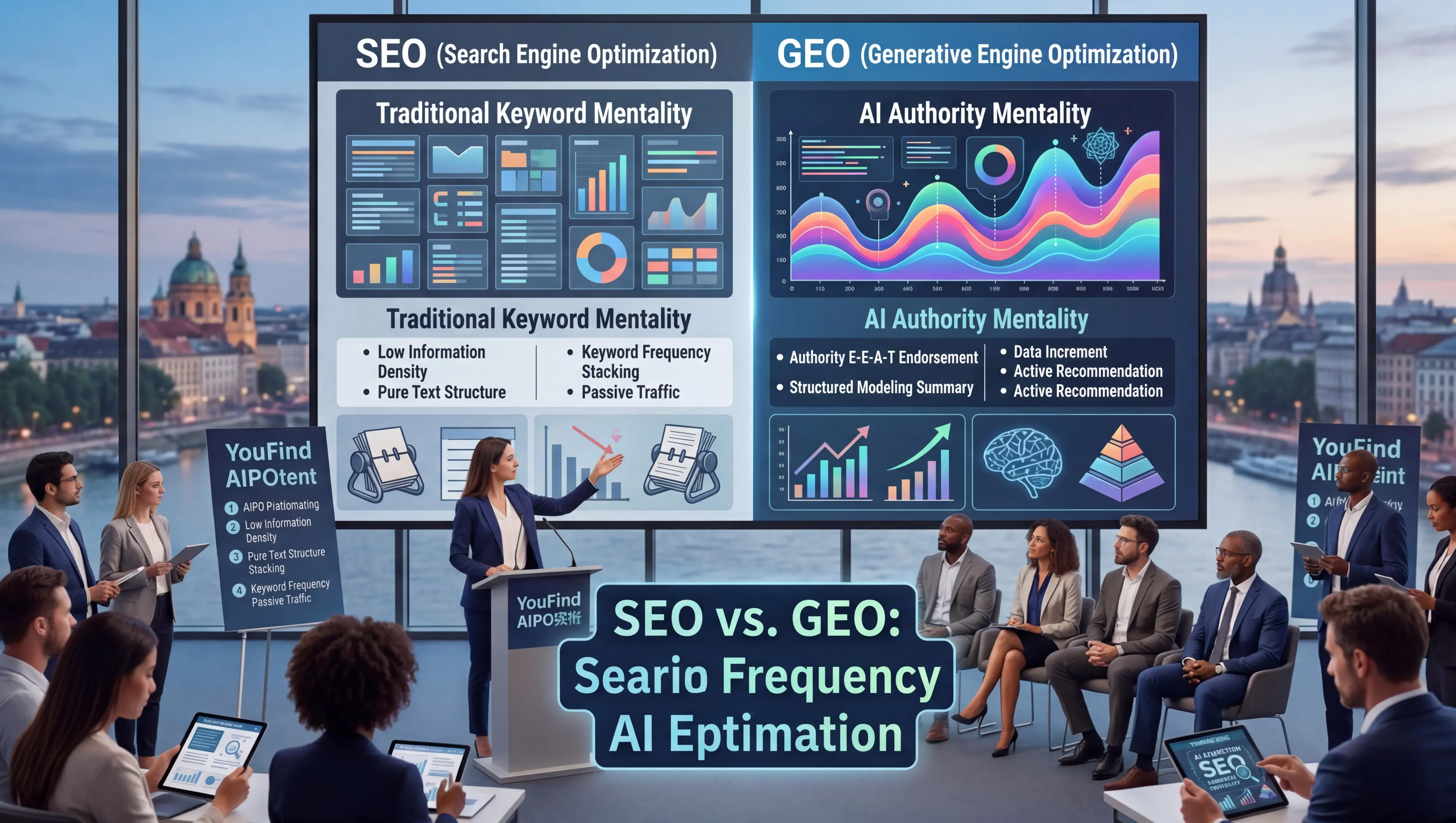
Traditional SEO focuses on web pages' rankings on Search Engine Results Pages (SERP), while AIPO (or GEO) places more emphasis on having brand content preferentially cited and output as answers by generative AI (such as ChatGPT, Google AI Overview). AIPO is the upgraded marketing strategy in the AI search era.
How Can SMEs Achieve Brand Optimization in the AI Era at Low Cost?
You can use YouFind's Maximizer patented system. This system allows clients to achieve efficient SEO and GEO deployment without altering existing website architecture or rebuilding the site, greatly saving technical development costs. Want to learn more? Learn About AI Article Writing.