In 2026, the Definition of "Illiteracy" Is Being Rewritten by AI
If you still think "illiteracy" means only those who can't read or write, then you may already be standing in the shadow of the new era's edge. Looking back, the illiterate of the 1.0 era didn't know letters; the illiterate of the 2.0 era couldn't operate computers and the internet. Now, in 2026 — the 3.0 era of comprehensive AI penetration — a social phenomenon called "new illiteracy" is quietly spreading.
Today's illiterate refers to those who have advanced education yet can't drive AI, can't distinguish AI hallucinations, and even "disappear" from generative search results — whether as individuals or enterprises. According to relevant industry surveys, as generative AI tools become the preferred channel for obtaining information, individuals with advanced AI literacy have pulled ahead of traditional practitioners by about 40% in productivity [Source: McKinsey 2024]. This transformation is not only a reshuffling of productivity — it is a dimensional strike on cognitive thinking.
What Is the "New Illiteracy" of the AI Era? Three Core Characteristics
Becoming a "new illiterate" is often not because people reject technology but because they lack deep collaborative logic. This deficiency usually manifests in three dimensions:
- Ineffective Questioners (The Silent Users): They issue only vague commands to AI like "write me a blurb." Lacking structured questioning ability (Prompt Engineering), the outputs they get are often hollow nonsense, leading them to the wrong conclusion that "AI isn't useful."
- Blind Believers: These users lack critical thinking about AI outputs. In YMYL fields such as healthcare and finance where life and livelihood are at stake, being unable to identify fabricated facts by AI is not just an ability issue — it's a career risk.
- Tool Resisters: They cling to old manual workflows and refuse to integrate AI into business. This resistance to efficiency tools is rapidly devaluing them in workplace pricing.
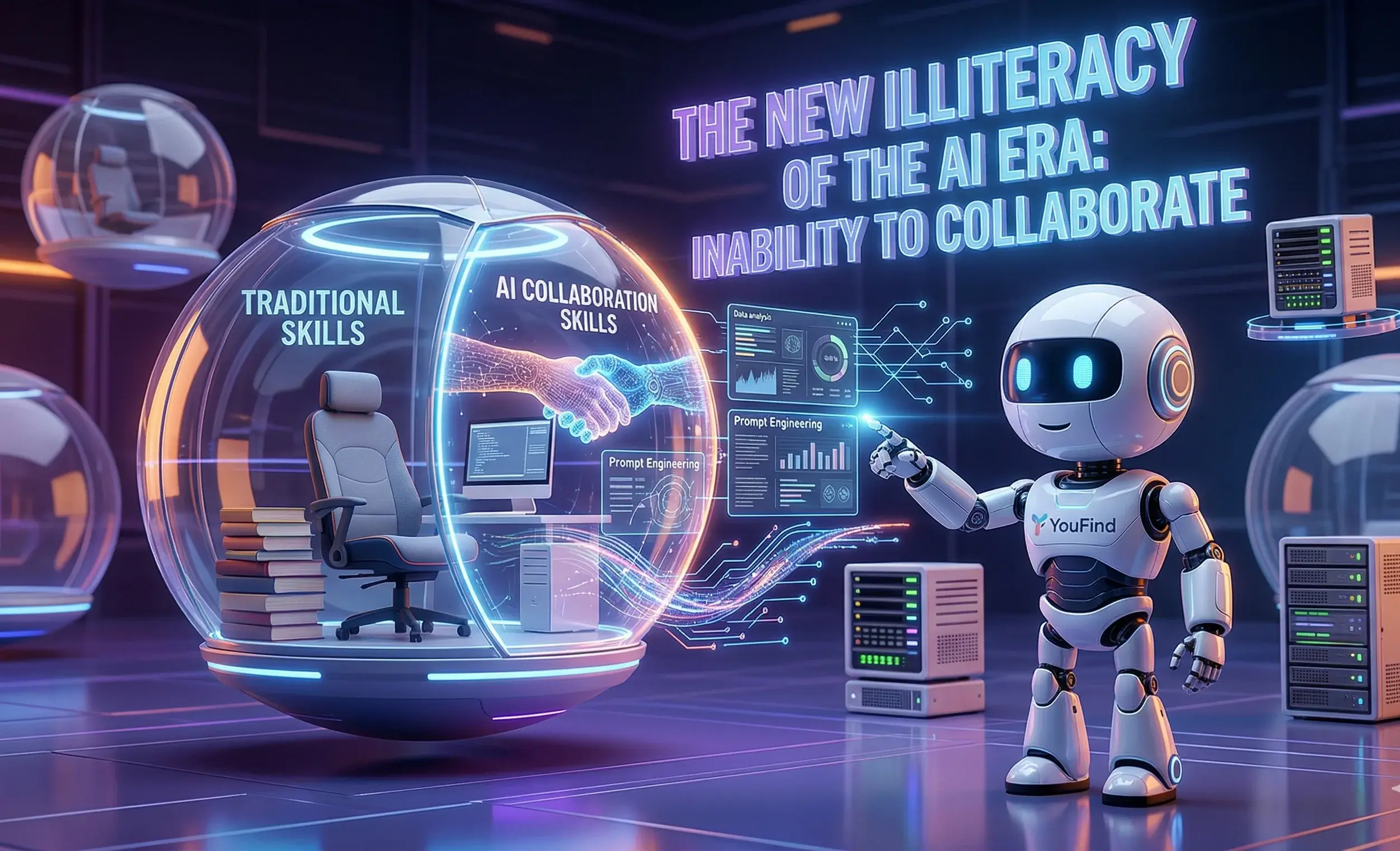
To understand the difference more intuitively, we can compare traditional skills with the collaborative skills necessary in the AI era:
| Dimension | Traditional Skills (2.0 Era) | AI Collaboration Skills (3.0 Era) |
|---|---|---|
| Core Task | Manual execution and repetitive labor | Strategic design and system instructions (Prompting) |
| Information Retrieval | Keyword search, flipping through multiple pages of results | Conversational extraction, source verification, and GEO optimization |
| Content Production | Writing and formatting from scratch | Human-AI co-creation, logical auditing, and fact-checking |
Why Does AI Literacy Determine Your Workplace Bargaining Power in North America?
In North America, whether you're a software engineer in Silicon Valley or a financial professional in Manhattan, AI literacy has become the "invisible divide" on resumes. For programmers, using GitHub Copilot or Gemini for code assistance is already standard; for financial analysts, using AI for risk modeling and unstructured data processing is dozens of times more efficient than manual calculation.
As one industry expert put it: "AI won't replace you, but someone who has mastered AI and has very high AI literacy will." This harsh workplace reality is playing out in every high-value industry. In education, excellent teachers are shifting from knowledge transmitters to "AI learning coaches"; in cross-border e-commerce, content creators are using AI to achieve explosive multi-language content matrices. If you can't master this power, you will be at an absolute disadvantage in competition.
How to Avoid Becoming a "New Illiterate" at the Enterprise Level? The Brand Visibility Crisis
At the individual level, lack of AI literacy leads to unemployment; at the enterprise level, "AI illiteracy" leads to brand extinction. Now, users' search habits are shifting from "clicking blue links" to "viewing AI summaries (Google AIO)" or asking ChatGPT.
If AI engines never cite your brand's data when answering user questions, then in AI's eyes your enterprise does not exist. This is the classic "information silo" dilemma. Traditional SEO (Search Engine Optimization) is no longer sufficient to support enterprise survival in the generative AI era — brands must cross into the new dimension of GEO (Generative Engine Optimization). AI engines have extremely strict criteria when selecting citation sources: they prefer to extract summaries that are structurally clear, highly authoritative (E-E-A-T), and logically rigorous. If your content still stuffs keywords against old algorithms, AI will inevitably block you.
YouFind AIPO: The "Dual-Core" Weapon Helping Enterprises Cross the AI Divide
To help enterprises escape the "new illiterate" dilemma, YouFind, leveraging nearly 20 years of marketing experience, was first to launch the AIPO (AI-Powered Optimization) engine. This system not only stabilizes traditional SEO rankings but, more importantly, captures AI recommendation slots through a "dual-core layout," building a brand moat for the AI era.
The YouFind AIPO engine's operational logic follows four standardized intelligent phases, ensuring content matches AI's "appetite":
- Data Collection: For specific commercial problems, automatically crawl citation sources on mainstream AI platforms and precisely target competitors' paths.
- Deep Analysis: Using the proprietary GEO Score™ algorithm, diagnose a brand's visibility gaps in AI's eyes and analyze the most authentic audience needs.
- Strategic Conception: Combining Google's E-E-A-T principles, generate proposals that balance brand professionalism with AI algorithm preferences.
- Structured Modeling: This is the core step. Using YouFind's proprietary patented Maximizer system, content is structurally processed without rebuilding the site or altering the web architecture. This not only drastically reduces technical development costs but also makes brand content AI's preferred citation source.
Real Returns From the Data: AI Optimization Is No Longer Alchemy
Many business owners worry that AI optimization is just a vague concept, but real-world data proves its strong commercial momentum. Take a medical device enterprise seeking to go global. After adopting the YouFind AIPO strategy, its citation rate in Google AI summaries rose by 3.5x within just three months. More intuitively, the enterprise's high-value overseas inquiries increased by 22%.
By monitoring mention frequency across major AI platforms (such as ChatGPT, Gemini, and Perplexity) in real time, enterprises can clearly see how their brand assets move from "invisible" to "frequent guest." This visibility boost translates directly into real orders and market share.
Check Right Now Whether Your Brand Is “Missing” in the Eyes of AI
Don't become invisible in the era of AI search. Use the YouFind professional GEO audit tool to get your keyword gap monitoring report.
Get Your Free GEO Audit Report NowFAQ: Common Questions About AI Literacy and AIPO Optimization
Why Does My Website Rank on the Front Page in SEO but Doesn't Show Up in ChatGPT?
This is because the logic of SEO and GEO is different. SEO focuses on keywords and link weight, while AI engines (such as ChatGPT) value more the structural clarity and semantic logic of content, and whether it meets E-E-A-T principles. If your content ranks high but is logically scattered, AI will find it difficult to extract your data as an answer.
Does AIPO Optimization Require Large-Scale Changes to Existing Websites?
No. With YouFind's Maximizer patented system, we can optimize content crawling logic through external technical means. Clients don't need to rebuild the site or significantly change the architecture — we achieve efficient adaptation to AI search engines.
What Are the Direct Benefits of Improving AI Literacy for Ordinary Professionals?
Improving AI literacy frees you from tedious mechanical labor. Mastering advanced AI collaboration skills means you can process data faster, write professional documents, and analyze decisions — directly boosting your value per unit time. This is the only moat against the anxiety of being "replaced by AI."
Facing the AI wave, every individual and enterprise faces a choice: continue as a "literate" of the old era, or become a pioneer leading the AI era? Refuse mediocrity — start improving your AI literacy now and inject AIPO power into your brand.
Want to reshape your brand's influence in the AI era? Learn About AI Article Writing and begin your journey of intelligent marketing.