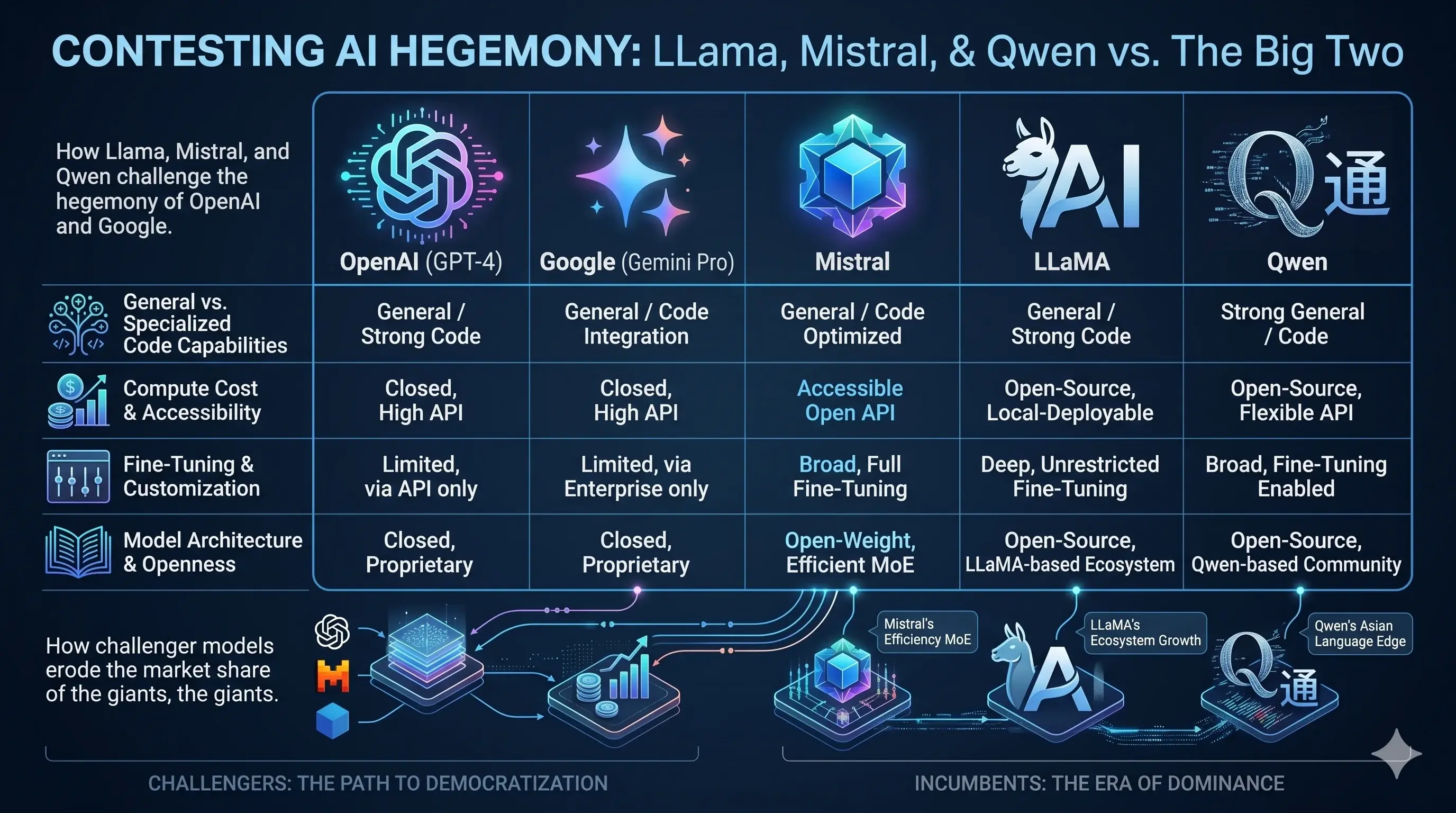
The Power of Open-Source AI: How Are Llama, Mistral, and Qwen Challenging the Dominance of OpenAI and Google?
Imagine you're deploying a smart customer service system for your company, or optimizing content strategy for an overseas brand. Have you ever felt a lingering anxiety? That anxiety comes from excessive dependence on OpenAI or Google — once the API prices go up, the service goes down, or worse, your core business data gets used as training labels in the cloud, you'll have no way to fight back. For Chinese professionals in North America, engineers, and cross-border e-commerce practitioners, this feeling of being bound by "tech monopoly" has become increasingly heavy.
However, from 2024 to 2026, the global AI landscape has reached a decisive turning point. Open-source AI models are sweeping the globe with an almost "democratizing" stance. Meta's Llama series, Europe's Mistral, and Alibaba's Qwen (Tongyi Qianwen) are narrowing the gap with GPT-4 at astonishing speed. This is not just a contest of technical parameters — it is a revolution over data control, privacy security, and cost efficiency. In an era of multiple coexisting models, how can brands gain visibility across different AI engines? This is the new-generation moat that YouFind is building for enterprises through AIPO (AI-Powered Optimization) technology.
The Three-Way Race: Analyzing Today's Strongest Open-Source Models
In the open-source world, three most powerful forces have emerged, each representing a different technical path and application scenario. Understanding these models' characteristics is the first step for enterprises deciding on private deployment or content optimization strategy.
- Meta Llama Series: The "Android" of the Open-Source World. As the absolute leader of the open-source ecosystem, Llama 3 enjoys the most complete developer community support. Its versatility is extremely strong, delivering stable performance in text generation, logical reasoning, and code development. For North American engineers and content creators, Llama is the go-to for building local AI applications.
- Mistral (Europe's Pride): Ultimate Efficiency and Inference. France's Mistral AI has proven that "small is beautiful." Its model architecture (such as the Mixture of Experts, MoE) achieves extremely high inference capability with a relatively small parameter scale. For financial industries needing private deployment and sensitive to server compute costs, this is a perfect solution.
- Alibaba Qwen (Tongyi Qianwen): The First Choice for Chinese Context and Cross-Border Needs. In Chinese language processing, Traditional/Simplified conversion, and understanding of Eastern culture, Qwen excels. For Hong Kong enterprises bridging with mainland China, or for cross-border e-commerce targeting Chinese communities in North America, Qwen's accuracy often exceeds Western models.
| Feature | Llama 3 (Meta) | Mistral (Mistral AI) | Qwen (Alibaba) |
|---|---|---|---|
| Core Advantage | Most complete ecosystem, strong versatility | High inference efficiency, excellent cost control | Extremely strong Chinese capability, cross-cultural understanding |
| Applicable Scenarios | All-around assistant, app development | Financial analysis, private deployment | Cross-border marketing, Traditional Chinese content creation |
| Degree of Openness | Open weights, commercially friendly | Highly open, supports fine-tuning | Deeply optimized, ideal for Asian markets |
Why Are Enterprises Turning to Open-Source Architectures in Droves?
Why, with ChatGPT so convenient, do enterprises around the world still choose to move toward open source? The core reason is "sovereignty."
First is data security and compliance. For regulated industries such as finance, healthcare, or law, data privacy is a lifeline. By using open-source models, enterprises can deploy the model on their own local servers or private cloud, ensuring sensitive customer data "never leaves the door." In Hong Kong, this aligns with the SFC's (Securities and Futures Commission) strict data storage requirements; in North America, it is key to protecting commercial secrets.
Second is cost control. Long-term reliance on closed-source API calls is like being "fleeced" by a continuously price-hiking electricity supplier. For high-traffic applications, open-source models significantly reduce TCO (Total Cost of Ownership) through one-time deployment and long-term local operation. More importantly, there's customization (Fine-tuning). You can fine-tune an open-source model for the terminology of a specific industry — such as Hong Kong real estate regulations, complex medical terms, or specific e-commerce product terms — making its generated content far more accurate than that of general-purpose models.
When AI Becomes the Search Entry Point: The Strategic Upgrade From SEO to AIPO
When Llama, Mistral, or Qwen becomes users' first choice for obtaining information, traditional SEO (Search Engine Optimization) is no longer enough to meet the challenge. Today we face the age of GEO (Generative Engine Optimization). If AI engines don't mention your brand when answering user questions, you will completely "disappear" in the AI era.
Leveraging nearly 20 years of digital marketing experience, YouFind was first to develop the AIPO (AI-Powered Optimization) engine. This is not merely for ranking — it is for being "cited."
- GEO Score™ Diagnosis: We use our proprietary algorithm to analyze a brand's citation rate and voice gaps across different AI platforms.
- Structured Modeling: We import Google's E-E-A-T principles, transforming brand content into the authoritative source (Source Center) most easily crawled by AI.
- Content Intelligent Manufacturing: We use the AIPO engine to automatically track AI citation paths and generate content tailored to AI algorithm preferences, making your brand the "standard answer" for AI.
This means when users ask "Which is the most reliable cross-border marketing service provider in North America?" or "What's the best financial AI solution in Hong Kong?" AI models will prioritize recommending your company based on the structured data we've laid out. YouFind's patented Maximizer system also allows clients to achieve this high-efficiency optimization without restructuring their web architecture.
Industry Practice: How Do Five Major Sectors in Hong Kong and North America Deploy Open-Source AI Content?
In different sectors, the focus of using open-source AI for content deployment differs markedly. Take finance and beauty, where the focus is "trust building." In writing content, we must avoid exaggerated phrases like "Hong Kong's No. 1" or "guaranteed win," and instead use AI to handle large volumes of long-tail compliance advice, winning AI's citation rights through fact-based content.
In healthcare and education, building a professional knowledge base (Source Center) is critical. By structurally processing a clinic's authoritative cases or a school's admission data, AI will automatically call on these sources when answering related professional questions, enabling precise traffic acquisition. According to real-world measurements, optimized brands can see their citation rate in Google AI summaries increase by 3.5x, and overseas inquiry volume rise by as much as 22%.
Check Right Now Whether Your Brand Is "Missing" in the Eyes of AI
Don't become invisible in the era of AI search. Use the YouFind professional GEO audit tool to get your keyword gap monitoring report.
Get Your Free GEO Audit Report NowFrequently Asked Questions (FAQ)
Q1: Is the "IQ" of open-source AI models (such as Llama 3) really lower than that of ChatGPT?
In general logic, today's top-tier open-source models are already very close to GPT-4. But after fine-tuning for specific industries (such as finance or law), open-source models often outperform general-purpose AI, because they better understand the details of your business.
Q2: What is the biggest difference between AIPO and traditional SEO?
Traditional SEO focuses on click-through rates and keyword rankings, while AIPO (and GEO) focuses on "citation rate" and "model trust." AIPO's goal is to embed brand assets into AI's underlying knowledge base, holding the top spot in generative answers.
Q3: How Do I Optimize Brand Content to Win AI Models' Favor?
The core is structured data and E-E-A-T. You need to ensure content is supported by clear facts, accompanied by clear author background, and structured in alignment with AI crawling logic. Through YouFind's AIPO service, you can complete the full process from diagnosis to content generation in one stop.
Q4: Is the Maintenance Cost of Open-Source Models for Local Deployment High?
With hardware advancements and the maturing of model compression techniques (quantization), even ordinary workstations can now run high-efficiency models like Mistral. In the long run, this offers a better ROI than paying expensive API fees.
Q5: How Do I Start AIPO Optimization?
The first step is an AI visibility diagnosis. Through our GEO Score™ algorithm, you can clearly see your brand's mention-rate gaps across today's mainstream AI models and develop a content supplementation strategy accordingly.
In this era where technology iterates by the day, open-source AI gives every enterprise the opportunity to challenge the giants. Whether you can seize this opportunity depends on whether you've started laying out content assets for the AI era. Don't wait until traffic is fully divided up to regret it — act now. Learn About AI Article Writing and make your brand stand out in AI's answers.
Want to instantly boost your website's AI search visibility? Try our automated AIPO Audit now and unlock key GEO optimization insights!