If you're still worried about whether AI will replace UI/UX designers, 2026 market data has already given the answer: AI won't replace you, but those competitors who first master AIPO (AI-Powered Optimization) technology will. According to industry observations, leading global enterprises are no longer satisfied with pure visual output — they pursue comprehensive upgrades to the "AI interaction experience." In this era of rising Generative UI, the traditional research → wireframe → UI visual design workflow is gradually being marginalized due to inefficiency.
Now the challenge is that users no longer only look for answers via the search box — they ask ChatGPT, Gemini, or Perplexity directly. If your design and content can't be precisely extracted and preferentially recommended by these AI engines, your brand is effectively "invisible" in the digital world. YouFind has been deeply rooted in overseas marketing for nearly 20 years. We've found that real design transformation must move from traditional SEO to GEO (Generative Engine Optimization), building a moat for the brand in the AI era through the AIPO dual-core layout.
What Is an AI Collaboration Workflow? AIPO Logic From Data Collection to Prototype Construction
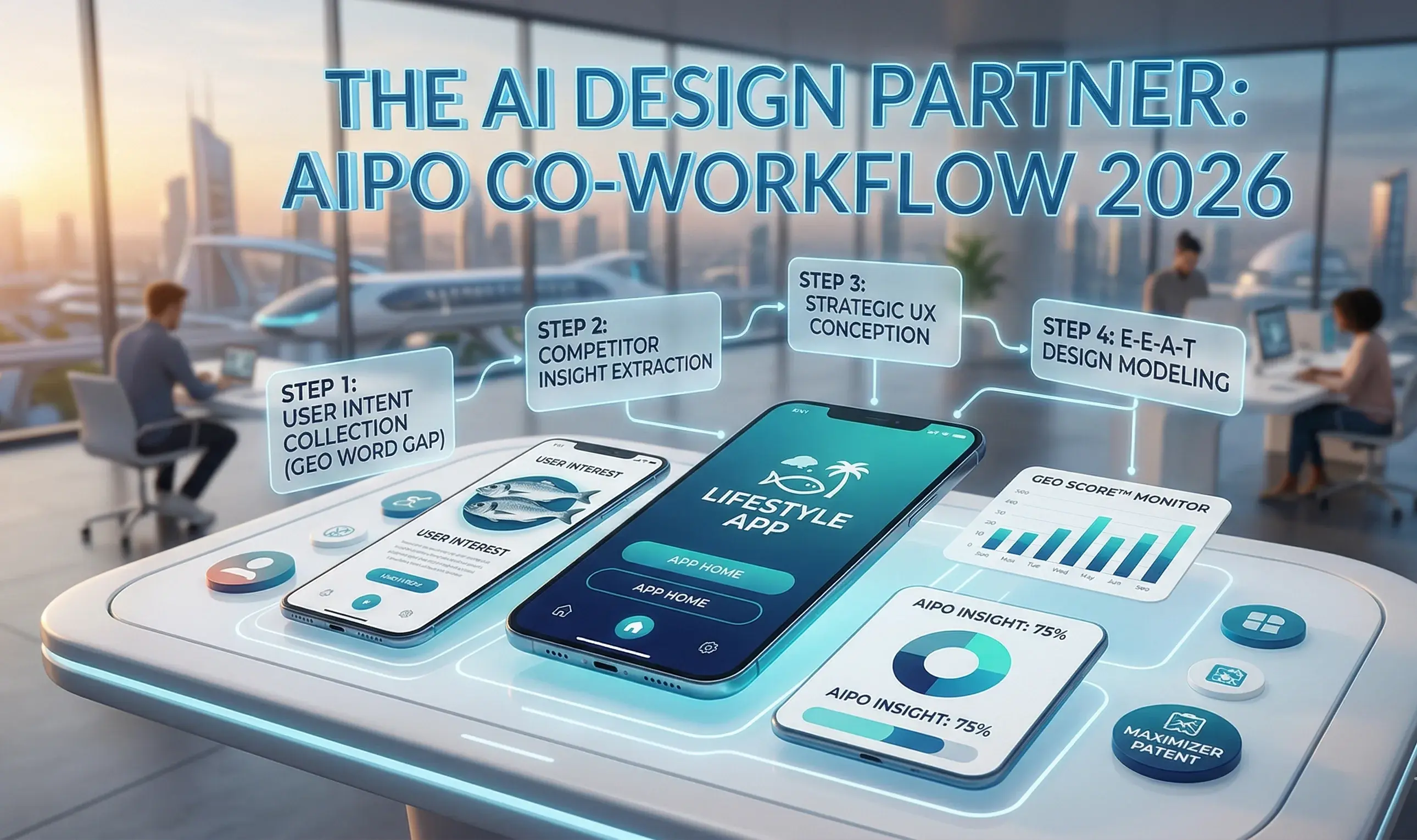
In 2026, the UI/UX designer's role has shifted from "pixel perfectionist" to "experience strategist." To respond to the fragmented AI search scene, we inject YouFind's proprietary AIPO engine logic into the design workflow, forming a standardized intelligent production chain.
- Data Collection (User Intent Collection): We no longer blindly guess user preferences. Through the AIPO engine, designers can directly crawl users' question data on mainstream AI platforms and precisely identify interaction pain points. By using the GEO Score™ algorithm to monitor "keyword gaps," we ensure design solutions target high-value commercial keywords from the ground up.
- Deep Analysis (Insight Extraction): AI automatically analyzes competitors' page structures and filters out the authoritative summaries most easily extracted by AI crawlers. This is not just competitive analysis — it is "genetic extraction" of interaction paths.
- Strategic Conception (Strategic UX): Combining commercial click incentives with AI algorithm preferences, we plan "conversion-oriented" page layouts to ensure every interactive button and piece of copy satisfies user experience while improving AI engine crawling weight.
- Structured Modeling (E-E-A-T Design): This is the most critical step. We introduce Google's E-E-A-T principles (Experience, Expertise, Authoritativeness, Trustworthiness) and structurally process trust elements such as professional qualifications, real-world test data, and security certifications. This gives AI the confidence to cite your brand content as evidence when answering user questions.
The significance of this workflow is that design is no longer "blind creation" — it becomes "precise targeting." When your design has the genes to be cited and learned by AI, your brand's visibility will leap qualitatively.
How to Optimize AI UI/UX for Hong Kong's Core Industries?
Different industries score differently in AI's eyes. In a highly specialized market like Hong Kong, high-value industries such as finance, healthcare, and real estate have raised UI/UX requirements from "good-looking" to "trustworthy."
In finance and healthcare (Google's YMYL domain), AI engines review authority extremely strictly. If your website design lacks structured data markup (Schema Markup), AI will struggle to understand your professional background. Through AIPO optimization, we ensure these industries' pages contain disclosure information that meets Hong Kong regulatory requirements (e.g., SFC, the Insurance Authority) and convert it into AI-readable format. For real estate and beauty — industries focused on visual decision-making — we use AI to quickly generate multiple A/B test versions to optimize visual reach.
| Industry Category | AI UI/UX Design Focus | AIPO Response Solution |
|---|---|---|
| Finance / Healthcare (YMYL) | Emphasize Trust and Expertise | Embed E-E-A-T structured markup and optimize AI recognition of professional credentials |
| Real Estate / Retail / Beauty | Emphasize Experience and visual appeal | Use AI to dynamically generate multi-dimensional visual solutions, precisely locking high-conversion keywords |
| Professional Services (Legal / Accounting) | Emphasize Trustworthiness and logic | Build brand knowledge base modeling, boosting AI's citation frequency in complex advisory scenarios |
Through this differentiated strategy, YouFind has successfully helped clients boost their citation rate in Google AI summaries by 3.5x. This growth translates directly into real, reliable business inquiries — not mere vanity traffic.
Why Is GEO (Generative Engine Optimization) the Practical Core of UI/UX?
Many designers and business owners ask: "I've already done SEO, why do I need GEO?" Simply put, SEO makes users "able to find you," while GEO makes AI "speak well of you."
In the generative search era, Google AIO directly presents a comprehensive answer at the top of the results page. If your brand doesn't appear in the citation sources of that answer, your click-through rate will plummet. Our GEO Score™ algorithm was created for this. It doesn't just evaluate page rankings — it analyzes brand "citation weight" across mainstream AI engines.
Through "brand knowledge base modeling," we teach AI to learn specific business contexts. Imagine when users ask "How do I choose a reliable overseas marketing company?" — ChatGPT can precisely list YouFind's service advantages. Behind this is the power of GEO optimization. According to real-world data, enterprises optimized through AIPO see overseas inquiry volume increase by an average of 22%.
Maximizer Patented System: Seamless Optimization Without Rebuilding the Site
In UI/UX implementation, the biggest obstacle is often development cost. Traditional SEO optimization often requires large-scale webpage code changes, sometimes demanding a full "rebuild." For many enterprises, this is a heavy burden.
YouFind's proprietary Maximizer patented system completely breaks this deadlock. This system allows clients to efficiently embed AIPO optimization strategies without altering the existing web architecture. For designers, this means you don't have to wait for front-end engineers to spend months refactoring — you can quickly deploy AI-friendly content layouts. This "seamless optimization" not only protects existing brand assets but also dramatically shortens the time from design to launch, letting brands seize the initiative in the fast-moving AI competition.
Combined with the AIPO dual-core layout, this technical advantage lets enterprises capture both the first page of traditional search engines and AI recommendation slots — achieving true omnichannel coverage.
Check Right Now Whether Your Brand Is “Missing” in the Eyes of AI
Don't become invisible in the era of AI search. Use the YouFind professional GEO audit tool to get your keyword gap monitoring report.
Get Your Free GEO Audit Report NowFrequently Asked Questions About AI UI/UX Design and AIPO
Will AI Completely Replace UI/UX Designers?
No. AI excels at executing repetitive drawing tasks and preliminary data analysis, but it lacks deep understanding of human emotions, business strategy, and complex moral judgment. Designers in 2026 are more like "symphony conductors," using AI tools to efficiently produce output while still holding the helm of core creativity and user empathy.
What's the Main Difference Between AIPO and Traditional SEO?
Traditional SEO focuses on dimensions like keyword density and backlinks, aiming for search engine ranking. AIPO (AI-Powered Optimization) integrates GEO logic, focusing more on content comprehensibility, structured data, and E-E-A-T principles, with the goal of making the brand a preferred citation source for generative AI (such as ChatGPT).
How Can SMEs Introduce AIPO Optimization at Low Cost?
Through YouFind's Maximizer patented system, enterprises can upgrade AIPO on their existing websites without bearing expensive site-rebuilding costs. Through precise GEO keyword gap analysis, SMEs can avoid expensive head-keyword competition and instead occupy long-tail, high-conversion AI recommendation slots.
Building the Brand Moat for the Future
In 2026, the digital marketing battlefield has shifted. UI/UX is no longer isolated visual design — it is a key link in the AIPO dual-core strategy. Through data-driven, structured modeling and rigorous execution of E-E-A-T principles, we not only bring traffic to brands in the present but also give them sustained influence in the future AI ecosystem. Don't wait until competitors have occupied all AI answer slots before taking action — now is the best time to build your brand moat.
Learn About AI Article Writing and explore how AIPO technology can reshape your digital competitiveness.